A neglected American symphony receives an impassioned revival at Grant Park Music Festival

A popular Beethoven concerto (aren’t they all?) and an American rarity made up the bill of fare for the Grant Park Music Festival concert Wednesday night.
Beethoven may have been the box-office bait at Millennium Park but it was the timely excavation of Howard Hanson’s Symphony No. 2 that proved the most notable element.
Hanson (1896-1981) was among the leading American symphonists of the mid-20th century, a remarkably rich period for domestic composers working in the genre, which included David Diamond, Walter Piston, William Schuman and Paul Creston. Hanson was founding director of the Eastman School of Music, a post he held for four decades. Not only an estimable teacher and successful composer, Hanson was also a committed advocate for other American composers, recording a vast amount of homegrown music in addition to his own.
Premiered in 1931 by Serge Koussevitzky for the 50th anniversary of the Boston Symphony Orchestra, the Second Symphony found great acclaim and instant popularity. Yet Hanson’s symphony has long fallen into unaccountable neglect, its warm-hearted lyricism seemingly out of step with our somber postmodern era. The Chicago Symphony Orchestra performed the Second Symphony on three occasions in the 1930s but, apart from a one-off of the slow movement, hasn’t touched the work since 1987 (when Leonard Slatkin led the last subscription performances).
Hanson gave his Symphony No. 2 the title “Romantic,” though that term could apply equally to all of his oeuvre. Cast in three movements, the symphony is imbued with a big arching lyricism allied to a tough, stentorian vigor that seems to reflect something of Hanson’s background as a no-nonsense Midwesterner (Wahoo, Nebraska) of Swedish stock.
For all its melodic richness and engaging style, Hanson‘s Second is not an easy piece to conduct, with mercurial switches between tempos and much expansive slow music that needs to have a firm underlying pulse.
Conductor Joseph Young made a solid local debut last season at Lyric Opera in the problematic Blue. On Wednesday night, Young was more impressive still, leading the Grant Park musicians in a powerful and richly textured performance of Hanson’s symphony.
Young took an aptly spacious tempo for the Adagio introduction of the first movement, yet segued deftly into the ensuing Allegro, while giving rich ardor to the indelible second theme—the work’s true motto.
There is nothing soft about Hanson’s brand of American Romanticism, and Young and the GPO put across the indomitable strength of the music as well as its lyrical essence in the second movement. The finale’s driving brilliance was duly rousing with the four Grant Park horns investing their imposing theme with majestic impact. Young built the final section with cumulative strength, pulling back for the intimate string quartet iteration of the main theme before the resonant coda.
Joseph Young seems to have an innate feel for American music in general and Hanson’s tricky idiom in particular. The conductor inspired the Grant Park Orchestra musicians to a polished, virtuosic and fully committed performance—all the more impressive for being done on short summer rehearsal time and in a score most have likely never played before. Back in town to conduct the final two weeks of the festival, Giancarlo Guerrero was in the audience to lead the enthusiastic applause for his podium colleague and the orchestra.
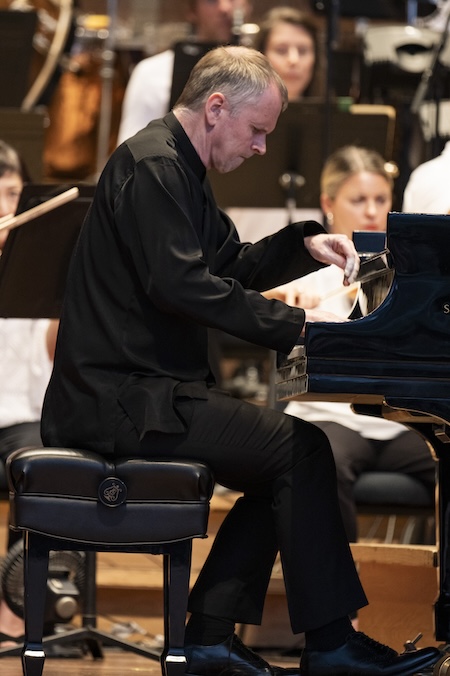
Beethoven’s Piano Concerto No. 4 led off the program. I missed most of the first movement due to a massive traffic jam, with I-55 backed up from Lake Shore Drive for five miles and converted into a parking lot.
Soloist Steven Osborne showed himself an inspired and eloquent Beethoven hand in the latter two-thirds of Op. 58. In the middle movement, the Scottish pianist floated the soft, yielding phrases with uncommon delicacy, bringing an otherworldly expression that contrasted effectively with the orchestra’s gruff statements as directed by Young.
The two men were simpatico partners as well in a delightful rendition of the Rondo with energized back-and-forth exchanges between piano and orchestra, concluding the performance with high-stepping vivacity.
Osborne favored the audience with an inward and concentrated encore of Keith Jarrett’s Improvisations on a Theme.
Giancarlo Guerrero conducts the Grant Park Orchestra 6:30 p.m. Friday and 7:30 p.m. Saturday at the Harris Theater. The program includes Brian Nabors’ Pulse, Missy Mazzoli’s These Worlds In Us, Richard’s Strauss’s Death and Transfiguration, and Peter Lieberson’s Neruda Songs with mezzo-soprano J’Nai Bridges. gpmf.org
Posted in Performances
Leave a Comment
 Subscribe via RSS.