CSO, Alsop and Liu deliver the goods at Ravinia season opener
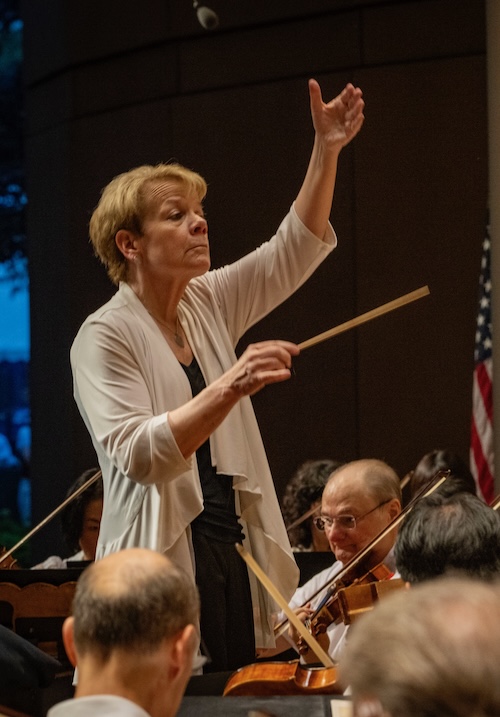
The Chicago Symphony Orchestra launched its 89th summer residency at the Ravinia Festival on Friday night, and, true to tradition, the program ticked all the wonted boxes. Soloistic glitter? Check. Thrilling symphonic sinew? Check. A rousing nod to barrier-breaking contemporary Americana? Check.
Apart from the heavens opening up roughly midway through Stravinsky’s The Rite of Spring, causing lawn patrons to scurry for shelter from the rain, the opening program of Marin Alsop’s 2025 tenure came off without any serious glitches. The festival’s chief conductor secured performances that, while lacking the ultimate polish of their winter-season counterparts, generated enough eclat to warrant the appreciative roar of the rather underpopulated pavilion at the end.
The festival is fielding several big-name piano soloists this summer and the orchestral season opener brought the joint Ravinia and CSO debut of one of today’s most promising up-and-comers, the brilliant and sensitive Canadian virtuoso Bruce Liu.
Winner of the International Chopin Piano Competition in 2021, Liu demonstrated with his exciting account of the Rachmaninoff Rhapsody on a Theme of Paganini a refusal to indulge in the flashy bravura typical of many competition prizewinners. Rather, he presented this ingenious set of 24 variations as a firmly and clearly articulated whole, pointing up detail with immaculate pianism that allowed romantic sentiment to hold proper sway without gushy sentimentality clouding the musical picture, particularly in the famous 18th variation.
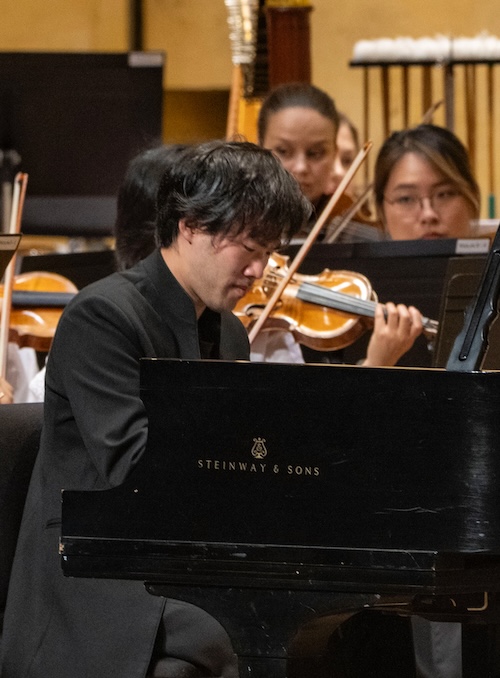
In short, quality of sound seemed to matter as much to Liu as quantity—Liu had both, using the full sonority of the Steinway concert grand invariably to the music’s advantage. Tempo relations between variations were carefully judged save for rather poky pacing of the first “Dies irae” variation. Alsop and the orchestra were with him every step of the way although other conductors have highlighted Rachmaninoff’s delicious moments of instrumental conversation more vividly. The fluid camerawork of Ravinia’s closed-circuit system added much to the pleasures of the performance.
Once the dust had settled, Liu obliged his loudly cheering listeners with a briefer solo set of variations, Liszt’s La Campanella. Here he allowed himself the freedom to combine fiery virtuosity with subtle capriciousness and did so marvelously.
Alsop began the evening with the first CSO/Ravinia performance of Carlos Simon’s brief AMEN, originally scored for symphonic band in 2017 but later arranged for symphony orchestra. The capital-lettering of the title reflects the frenzied fervor of the choir and congregation in Pentecostal church worship services. Simon is composer-in-residence at Washington’s John F. Kennedy Center for the Performing Arts. Drawing on the black gospel music tradition, his music erupts in joyous smears of syncopated trombones and high-energy blasts of jazzy strings before closing with the amiable crack of a slapstick. Perfect outdoor-populist fare for a warm summer night at Ravinia.
Stravinsky’s revolutionary masterpiece Le Sacre du Printemps remains, 112 years after its tumultuous premiere as a ballet in Paris, one of the most astonishing orchestral creations of the last century. Its harmonic and rhythmic innovations seeped into every corner of 20th century modernism, and while sheer familiarity and a cumulative abundance of even more shocking feats of musical daring have diminished its shock value to today’s listeners, the score remains a potent thrill-ride in its primal energy and pulverizing dissonances.
The Rite has long been almost as vital a part of the CSO’s canonic repertory as Beethoven and Mahler. You expect the players to sail over its convulsive rhythmic and metric dislocations as easily as if this were Mozart—and so they did on Friday, a scattered horn bobble notwithstanding. True, the storm gods weren’t smiling during Part 2’s sacrificial section, but what were a few raindrops compared to the corporate might of the Chicago Symphony, especially its storied brass section, punctuated by elemental wallops of percussion?
Alsop proved herself a capable elucidator of the gnarly intricacies of this landmark, steering a great orchestra with a firm beat and eyes clearly fixed on the long view, if insufficient rhythmic punch at some key nodal points. Was this Rite as good as what this orchestra under a more commanding Stravinskian can achieve, with greater rehearsal time, downtown? No. But it did the job pretty well on the whole; for that, one must be grateful.
The Chicago Symphony Orchestra’s summer Ravinia residency continues with Marin Alsop conducting works by Gershwin, Tchaikovsky and Jessie Montgomery with soloist Jean-Yves Thibaudet 7:30 p.m. Saturday. ravinia.org
Posted in Performances
Leave a Comment


 Subscribe via RSS.