Guerrero opens final GPO week with stellar Saint-Saëns, vivid premiere
Sir Thomas Beecham is reported to have deemed Camille Saint-Saëns “the greatest writer of second-rate music that ever lived” (a bon mot also attributed to the witty composer himself).
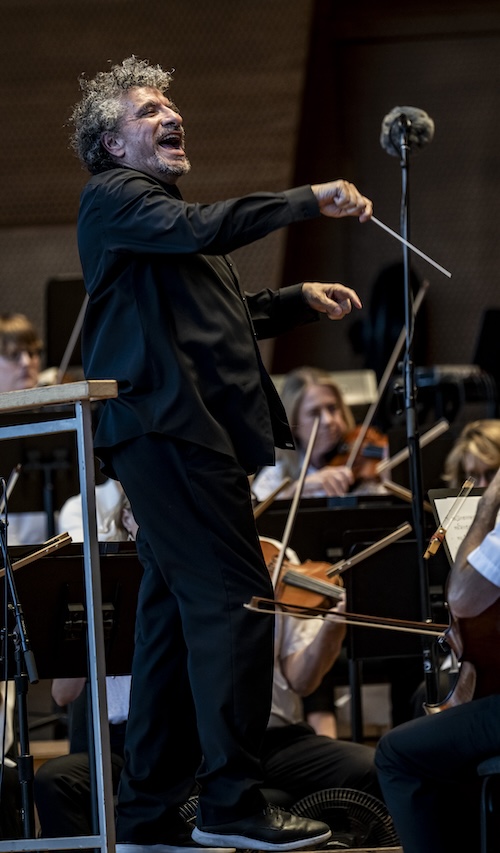
While there may be a kernel of truth in the British conductor’s assessment, the Grant Park Orchestra’s stirring performance of Saint-Saëns’ Symphony No. 3 under Giancarlo Guerrero Wednesday night made it hard to avoid the conclusion that Beecham was being overly harsh.
Guerrero was opening the final week of concerts of his first season as the GPO’s artistic director, and Wednesday’s results were a testament to the dynamic rapport he has quickly developed with his players. He created a haunting atmosphere in the symphony’s introductory Adagio, fluently segueing into the anxious skittering of the Allegro moderato. Here the articulate Grant Park winds effortlessly kept pace with their string colleagues, with Guerrero capturing Saint-Saëns’ agitated lyricism.
In his opening remarks, Guerrero made clear it is a misnomer to call this work the “Organ Symphony,” as the French title obviously translates as “Symphony with Organ.” This was clear in the Poco adagio, where the organ part—expertly handled by Patrick Godon—provides a resonant sonic bed supporting the orchestral textures. Guerrero heeded the “poco” marking here, keeping the movement flowing in a way that kept its gentle expression forthright rather than luxuriant.
Guerrero drew martial vigor in the opening of Part II, mining the effervescent Gallic charm of the Presto with shimmering contributions from pianist Christopher Guzman. The conductor brought a Handelian regalness to the fugal portions of the finale, the organ sonorities both underpinning and interwoven with the orchestral escapades. It was remarkable to achieve such an accomplished performance of this complex work on the limited summer rehearsal schedule.
The evening began with the first Grant Park Orchestra performance—and the second ever—of Chelsea Komschlies’ Mycelialore. A mycelium is the underground root network of mushroom colonies, and Komschlies, who is also interested in neuroscience, fantastically imagines this subterranean lattice as a sentient brain, recounting to itself (to each other?) its own folklore. Midway through the ten-minute work, the mycelium becomes aware of human eavesdropping, and rebukes the “overtreaders” for their intrusion.

Komschlies creates a naturalistic atmosphere in the opening bars with rainstick and chirpy string glissandos sounding over bardic harp chords, and ultimately the feeling of an otherworldly courtly dances emerges with the uncanny sound of an electronic harpsichord. Mycelialore features a prominent electronic track, also handled by Guzman, with hissed voices, guttural spoken words, and menacing sprechtstimme sounding throughout: “they heard us,” “we hear you,” “seen your nature, “strange roads,” “use up.” The impression recalls brief moments of orc conversation in Peter Jackson’s The Lord of the Rings films. Komschlies creatively (if somewhat literally) projects her imagined narrative, and was on hand Wednesday to receive the audience’s appreciation of her vivid storytelling.
The evening’s soloist was pianist Clayton Stephenson, returning to Grant Park after his memorable performance of Rachmaninoff’s Rhapsody on a Theme of Paganini last summer. The young Stephenson’s vehicle this time was Liszt’s Piano Concerto No. 1 in E-flat, a far less subtle work that did not showcase him as effectively.
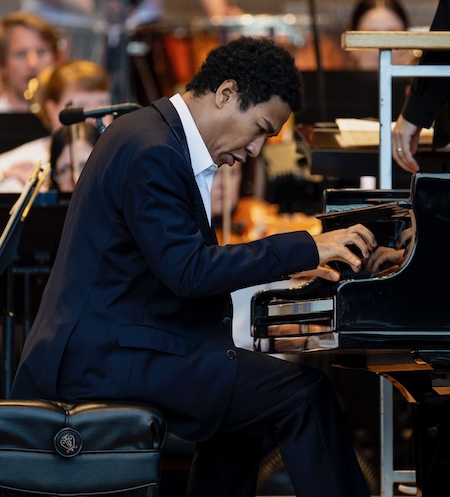
Stephenson offered the requisite thunderous opening, but the through-composed concerto’s more lyrical moments consistently fell flat over the Pritzker Pavilion amplification, which has yet to find a balance this summer that serves both the orchestra and all registers of the piano equally. Typically bracing moments, like the piano’s icy invocations over string tremolos, failed to make an impression Wednesday night.
Stephenson was able to capture some of the quicksilver feel of the Allegretto vivace, and deftly dispatched the bombastic closing fireworks, though overall this routine performance did not amount to an effective argument for Liszt’s awkward opus. Let us hope Chicago has the opportunity to hear Stephenson in more understated repertoire and an indoor acoustic someday soon.
As an encore, Stephenson offered Art Tatum’s arrangement of “Tea for Two,” a jazzy palate cleanser perfectly suited to the easy al fresco summer atmosphere.
The Grant Park Orchestra performs Rimsky-Korsakov’s Russian Easter Overture, Alan Hovhaness’s Symphony No. 2 “Mysterious Mountain,” and Orff’s Carmina Burana 6:30 p.m. Friday and 7:30 p.m. Saturday. grantparkmusicfestival.com
Posted in Uncategorized
Leave a Comment
 Subscribe via RSS.