Chicago a cappella explores a rich range of modern Mexican song
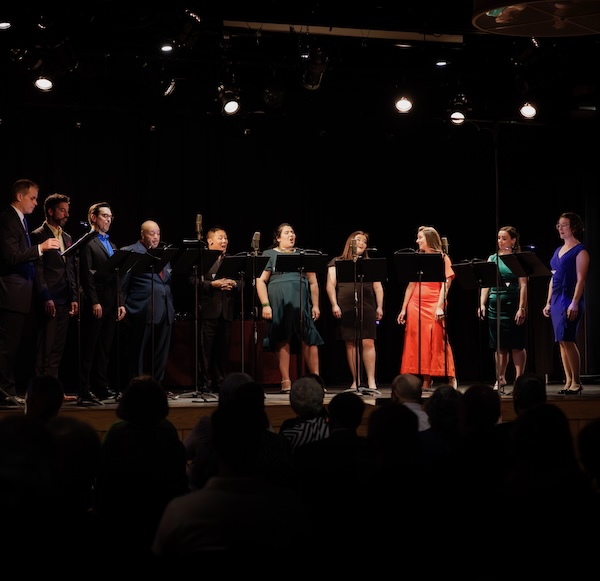
For the past nine years, Chicago a cappella has been fostering a cultural exchange between Mexico and Chicago with their “Cantaré” initiative: bringing Mexican composers to Chicago to work with local public schools, and bringing Chicago audiences to Mexico by way of the composers’ music. An instance of the latter was Sunday afternoon’s concert, which was performed at Nichols Concert Hall in Evanston.
Six of the eleven songs on the program—by composers Rodrigo Cadet, Jorge Córdoba, Novelli Jurado, Julio Morales, and Elisa Schmelkes—were written specifically for Chicago a cappella or for a local choir as part of the Cantaré. project. Two songs were by Agustina Crespo (an Argentine composer who was the program’s only non-Mexican representative) and Emma Wilde, who won Chicago a cappella’s HerVoice competition, a mentoring program for young female composers. Crespo’s “Haikus” and Schmelkes’ “We Have Not Long to Love” were world premieres. The remaining three (by José Manuel Fernández Espinosa and Carlos Jiménez Mabarak, and an additional song by Schmelkes) were already part of the choral repertoire.
Five of the songs use only traditional singing techniques. Mabarak’s “Amancía en el Naranjel” sets each stanza like a different children’s playground song. The choir effectively handled the sudden shifts between these textures. Cadet’s “Esta, Que Ves, Engaño”is in the modern style of mixing consonant chords with crunchy dissonance. It featured Chicago c cappella’s best balances and intonation of the concert.
Fernández Espinosa’s “México en la Piel” is a patriotic song, arranged by Morales so that the choir imitates instruments underneath alto Thereza Lituma’s pop-inflected solo before joining in full-throated choruses. Instrumental imitations also feature in the sprightly bolero rhythms in Jurado’s “Y Es Que No Sabes.”
A third traditional-style song was added to the program but not listed in the booklet: Schmelkes’s “El Párajo Perdido.” Schmelkes wrote it for a school choir while composer-in-residence in Chicago. This protest song against deportation crackdowns is in a folk-inflected style, heightened by Schmelkes accompanying it in person on a charango, an Andean lute. It was the only song to earn a standing ovation.
Last was one of the two winners of the HerVoice competition, Emma Wilde’s “Light Is Withheld.” The choir did a good job of rendering her most individual touches: the sharp accents on certain syllables in the first stanza and the staggered, fading individual lines at the song’s close.
The remaining songs all employed extended techniques, frequently for the purpose of text-painting. Examples of this include Crespo, the other HerVoice winner, using microtonality to depict bells in the first of her “Haikus” and extensive vibrato to depict the blowing of the autumn wind in the second; Morales mixing vocal trilling and warbling from pre-Hispanic flutes to depict a quetzal and hummingbird in “Week Week”; and Córdoba using moaning and dynamic extremes to depict an encounter with God in “Las Bienaventuranzas.”
In general, Chicago a cappella fared better in these songs than they did in the more traditional ones. Throughout the concert, the group sounded more like a collection of ten soloists than they did like a unified choir. Each singer’s timbre remained distinct. And they didn’t always have the kind of tight coordination of intonation, tempo, and dynamics that groups with conductors tend to achieve.
In the more avant-garde items, the diversity of their individual sounds was a benefit, not a drawback, since it kept the music full of color and variety. Some of these pieces also contain short solos, with each of the five women taking multiple solos across the program.
The standout among them was soprano Megan Bell who had the strongest projection and clean, bright high notes. Among the male soloists, the highlight was Ace Gangoso floating mellifluously amidst the women’s microtonal chords in the first of Crespo’s “Haikus.”
The program will be repeated October 10 at Wentz Concert Hall in Naperville and October 12 at Pilgrim Congregational Church in Oak Park. chicagoacappella.org
Posted in Uncategorized
Leave a Comment


 Subscribe via RSS.