CSO opens the season in mixed fashion with Mozart, Elgar
The Chicago Symphony Orchestra is between two worlds—or maestros—these days. Riccardo Muti is largely in the rearview mirror and music director designate Klaus Mäkelä doesn’t fully and officially take the helm until the fall of 2027. Both men will return to Orchestra Hall next month.
That means season-opening programs often fall to guest conductors, which has made for some variable results. Such was the case once again with Nikolaj Szeps-Znaider leading the CSO in music of Mozart and Elgar to launch the orchestra’s 2025-26 season Thursday night. (There is just one repeat of this program Friday afternoon.)
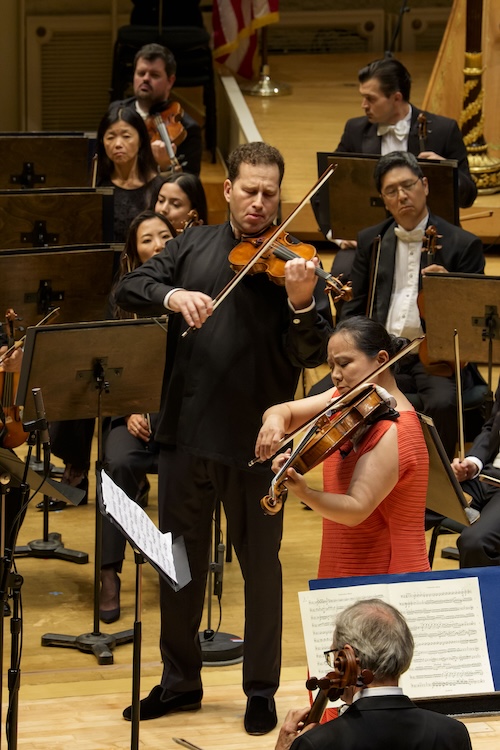
The Danish conductor-violinist is an engaging presence, popular with the audience and, seemingly, a plurality of CSO musicians. Following a low-key rendition of the National Anthem, Szeps-Znaider was in bipodal mode as soloist as well as conductor, partnering with principal violist Teng Li in Mozart’s Sinfonia concertante in E flat.
Even by Mozart’s standard of achievement in the genre, the composer excelled himself when writing concertos for unusual combinations of instruments—as with the Flute and Harp Concerto and the Sinfonia Concertante, K. 364, The balancing of the two solo voices in this double concerto for violin and viola is ingeniously crafted, seamless and masterful in a work that balances high spirits with ennobled tragedy.
It must have seemed like an inspired idea to pair Znaider with Teng Li in this work, giving the CSO’s newish principal viola her first opportunity in the solo (or duo) spotlight. The playing of each musician was spirited, technically polished and cohesive in terms of timing, entrances and coordination.
Yet too often the soloists seemed to be playing in different spheres, stylistically and expressively. Znaider, who did double duty with the CSO last season in the Bruch G minor concerto, is a stylish and idiomatic Mozartian, and his refined violin playing brought a hushed intimacy to the somber reflection of the slow movement.
Teng Li is a strong player but her musical personality seemed less suited to this repertoire. While she played sensitively with her colleague in the Andante, Li failed to match the violinist’s yielding expression and dynamic nuance. Too often her playing sounded merely emphatic and literal, playing the notes without giving us the music.
The violist’s aggressive playing along with the orchestra in the introduction and elsewhere in tuttis also proved a distraction. The final movement is one of Mozart’s most delightful and witty closers but no one would guess that from this performance, with little charm, humor or musical camaraderie evident.
Szeps-Znaider’s sort-of conducting when not playing his solos coaxed a mostly responsive accompaniment, though the opening movement would have benefited from more pep and momentum.
The standing ovation and repeated curtain calls brought the soloists back out for the obligatory encore. Szeps-Znaider introduced the Adagio from Mozart’s Duo for Violin and Viola in G major, K.423, by saying that “A new season is a good time for new beginnings.” Some partisans in the audience instantly applauded, leading a surprised Znaider to add “I didn’t mean it in any political way.” Regardless, the ruminative feeling of both players in this interior music seemed to reflect something of the current, unsettled national spirit.
Elgar’s Symphony No. 2 completed the evening. The English composer’s vast canvas is a pinnacle of Late Romanticism, running nearly an hour and blending a striding Edwardian confidence with an elegiac quality aligned to Elgar’s introspective melancholy.
It’s been 15 years since Elgar’s Second Symphony was last played by the CSO, led on that occasion by Sir Mark Elder. Unfortunately, Thursday night’s performance was not on that level.
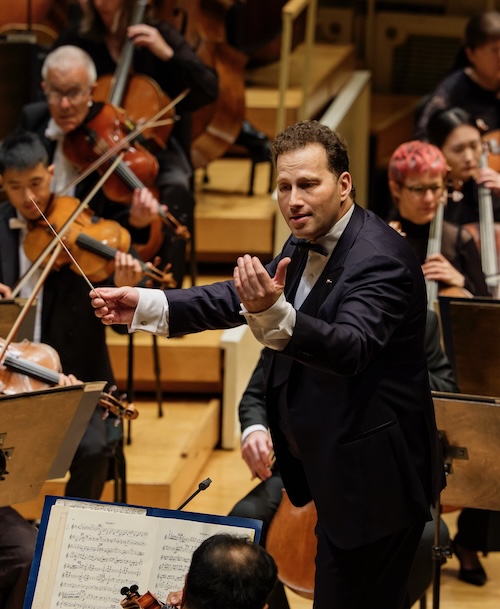
Szeps-Znaider is an intelligent and capable musician and there were some good things in this Elgar. He seemed to have the general shape of each movement in hand, as well as the broader architecture. The conductor elicited dynamic and committed playing from the orchestra, including Tim Higgins in his first appearance as the CSO’s new principal trombone.
Unfortunately, Znaider gave the impression of a lack of crucial experience in this work and too often he seemed to be feeling his way through the score. Balances seemed fitfully off with the conductor highlighting the horns in the first movement like it’s a Strauss tone poem, rather than blending them more idiomatically with the strings.
Maintaining a consistent pulse in this volatile music with its restless tempo changes is a challenge and one in which the conductor proved lacking. But the main problem was Szeps-Znaider’s extreme slowing for Elgar’s inward sections. The conductor repeatedly dragged slow passages down to a crawl that approached stasis, sacrificing momentum and diluting the overall impact of the performance.
Despite the wayward direction from the podium, the musicians managed to keep things together and their playing was consistently inspired across all sections. There was a fine edgy punch to the bumptious Rondo and William Welter’s oboe solos nicely highlighted the striving stoicism of the slow movement.
Still, despite worthy moments, this was not the kind of prime Elgar that CSO audiences have come to expect. The next time the orchestra programs an Elgar symphony, best to keep Mark Elder on speed dial.
The program will be repeated 1:30 pm. Friday.
Nikolaj Szeps-Znaider leads the CSO in a gala concert with mezzo-soprano Joyce DiDonato 6:30 p.m. Saturday. cso.org
Posted in Uncategorized
Leave a Comment


 Subscribe via RSS.