A retrenching IPO opens with mixed evening of Beethoven

One year ago the Illinois Philharmonic Orchestra kicked off its season with an ambitious program of neglected American symphonies that included the belated Midwest premiere of David Diamond’s masterpiece, the wartime Symphony No. 2.
It was back to the tried-and-true as Stilian Kirov and the IPO opened their 2025-26 season with an all-Beethoven program Saturday night at Trinity Christian College in Palos Heights.
Repertorial retrenchment seems to be in the air this season. For the southwest suburban IPO, that means more pops and film music and less substantial classical repertoire—let alone unsung American rarities. Of the orchestra’s five remaining concerts only two are devoted entirely to classical repertoire—and one of those is an hour-long program centered on Vivaldi’s Four Seasons.
The mixed results of Saturday’s performances seemed to reflect the unsettled quality of what is starting to look like a regional orchestra in transition.
The evening opened with The Creatures of Prometheus Overture. Kirov led an effective performance with weighty opening chords heralding a slow and stately introduction that segued fluently into a spirited main section and emphatic coda.
Beethoven’s Violin Concerto is the most challenging of the composer’s seven concertos to pull off successfully—requiring not only polished technical aplomb from the soloist but expressive depth and something to say about the music.
Adé Williams made a valiant attempt at Beethoven’s Op. 61 but this was at best a mixed outing for the young and charismatic violinist.
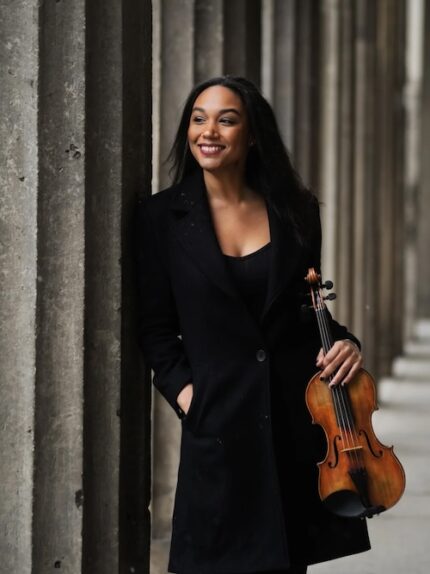
Williams drew a silvery, attractive tone from her c.1700 “Dancia” Rogeri instrument. In the lyrical sections her light, pure-toned playing was often lovely and ingratiating. The Larghetto came off best where Williams’ poised intimacy of expression suited the musing introspection of the music.
Elsewhere, especially in the long opening movement, there was a crucial lack of dramatic fire and incisiveness, with the slow tempos dragging at times. Too often in this cautious performance, the drama and impact of Beethoven’s concerto felt miniaturized. (Kirov, of necessity, scaled down the orchestral sonority so as to not overwhelm his light-toned soloist.) Williams’ technique proved less than airtight as well, with uneven projection, fitful lapses in intonation, and a cadenza in the finale that was a bit of a shambles.
In addition to further polishing her technique, Williams’ intimate style seems like a better fit for Mozart and Baroque repertoire than the big Romantic concertos.
The evening concluded with the not-unknown Symphony No. 5.
Kirov is one of the finest and most underrated conductors on the local scene, often at his best when bringing fresh energy to familiar warhorses. Yet on this occasion, Beethoven’s famous opening movement was surprisingly routine, heavy-footed and lumbering, missing the requisite fire and dramatic bite.
The Andante went better—graceful, lilting and more detailed— and the ensuing third movement had admirable bustle and mystery. Apart from some loss of momentum at Beethoven’s false ending, Kirov and company rounded off the victorious finale with enough dynamism and vitality to spark cheers and ovations from the IPO faithful.
The Illinois Philharmonic Orchestra’s season continues 3 p.m. November 22 at Governors State University in University Park with Holst’s The Planets and John Williams’ film music from E.T. and the Star Trek movies. ipomusic.org
Posted in Performances
Leave a Comment


 Subscribe via RSS.