Apollo’s Fire opens fifth Chicago season with a lively and infectious “Dido and Aeneas”
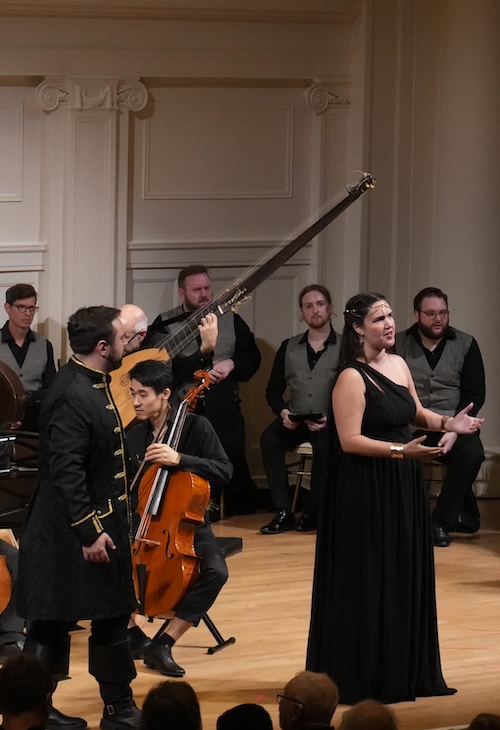
The Cleveland-based period ensemble Apollo’s Fire has long prided itself on marching to a different drummer. The lively “dramatic concert presentation” of Henry Purcell’s Dido and Aeneas that opened the group’s fifth Chicago season Saturday evening at the Music Institute of Chicago’s Nichols Concert Hall in Evanston upheld that tradition in high style.
Although the Globe had been demolished some 40 years earlier, the Elizabethan theatrical tradition was very much alive and well in London in 1689 when Dido had its premiere at a boarding school for girls.
In a refreshing change from the rather stodgy seriousness with which Purcell’s only opera is typically represented, Jeannette Sorrell, the ensemble’s artistic director and conductor—also, on this occasion, stage director—took the miniature tragic opera back to its roots in Shakespearean theater, evoking the energy, casual (even sometimes rowdy) tone and frequent audience interaction that prevailed at the Globe.
Given the opera’s brevity and the fact that the music for Purcell’s original prologue is lost, Sorrell created a new prologue in which four girls from Josia Priest’s School for Girls in Chelsea introduced the main themes of the tragedy: love versus duty, fate versus ambition. The quartet of dancing singers set up the ensuing action of the evening-long performance with abundant charm that never turned cloying.
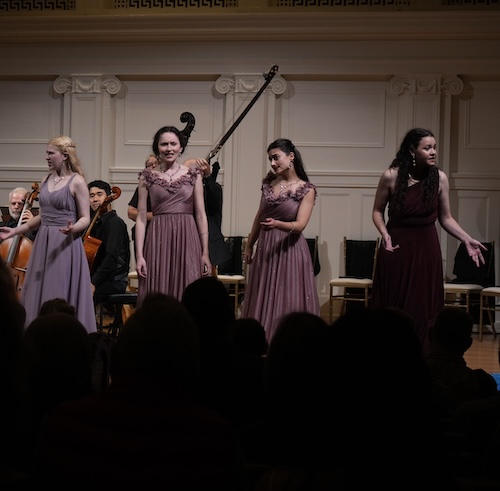
This brief invention ushered in a central drama that was further augmented by other Purcell instrumental music and traditional British sea shanties. The shifts of dramatic tone, from high tragedy to low comedy, meshed beautifully with Sorrell’s urgent musical direction and the crisp responses of an excellent cast and skilled period-instrumentalists and chamber chorus.
If the small stage restricted the wonted interaction between singers and players, the aisles served nicely for processional entrances and exits, opening up the action in appropriate ways. Sorrell encouraged audience participation and Saturday’s packed house gamely entered into the user-friendly spirit of things—booing the duplicitous Sorceress and witches, for example.
Above all, there was an exhilarating sense of ensemble—of conductor, singers, dancers and instrumentalists pulling together to illuminate the varied delights of the music and mini-drama from within. (Sunday’s repeat performance in wide-open Preston Bradley Hall at the Chicago Cultural Center promises to allow quite a bit more audience interaction.)
Sorrell officiated with brisk authority over her crack period band of 18 instrumentalists, whose stylish, energized strings, harpsichord and drums were aerated by the tangy timbres of paired recorders and lutes. Her commitment was as palpable as it was infectious.
The vocalists and chamber chorus were very nearly as good, while Alyssa Leigh Burrs and Edward Vogel, both strong singers, proved well matched vocally as the titular lovers.
The mezzo-soprano drew the listener deeply into the existential dilemma faced by the proud yet vulnerable queen of Carthage. Burrs’ Dido was very much a modern heroine, a strong woman who chooses to take her own life rather than live on, forsaken and humiliated by a lover who cannot take responsibilities for his actions. Penetrating at full volume, her voice soared with voluptuous richness without sacrificing clarity of line or diction. Dido’s lament was all the more affecting because of it; so was the courtiers’ strewing rose petals over her lifeless body.
The role of Aeneas challenges interpreters with its sheer brevity but Vogel made the most of the conquering yet easily manipulated Trojan hero’s limited time on stage with his rock-solid baritone and sure dramatic instincts.
A good Belinda can very nearly walk away with the show, and here Andrea Walker, with her fresh and pure soprano, was sheer delight personified. The capable countertenor Cody Bowers led a cackling coven of witches, and the sea shanties that served as an entr’acte were lustily rendered by a sailors’ octet led by chorus members Sam Kreidenweis, Michael Galvin and Michael St. Peter—each worthy of a raised tankard of grog. The dancers executing Julie Andrijeski’s fluid, dramatically apt choreography achieved minor wonders within the postage-stamp-sized playing area within and in front of the orchestra.
The program will be repeated 5 p.m. Sunday at the Chicago Cultural Center, 78 E. Washington. Apollo’s Fire will continue its Chicago season with Praetorius’ Christmas Vespers, Dec. 14 in Chicago and Dec. 15 in Winnetka. apollosfire.org
Posted in Uncategorized
Leave a Comment
 Subscribe via RSS.