CSO serves up a lean and bracing blast of Stravinsky
Igor Stravinsky was as stylistically restless as he was brilliant. This week’s Chicago Symphony Orchestra concerts provide a fascinating look into the Russian-American composer’s musical evolution over the second half of his long life (1882-1971) and career.
The program, led by conductor Stefan Asbury in an impressive CSO debut Thursday night, also reflected Stravinsky’s development in a practical way—effectively downsizing from the massive orchestral resources of last week’s Berlioz program to a lean-and-mean chamber lineup that never had more than eight musicians on the bare stage.
The all-Igor evening offered a bracing blast of the modernist Stravinsky, with the four works presented in nonlinear reverse chronology yet, logically, in order of increasing scale.
Stravinsky enjoyed international success as a young man with the celebrated trio of ballet scores he wrote for Serge Diaghilev’s Ballets Russes in Paris; a century later The Firebird, Petrushka, and The Rite of Spring remain his most popular works in the concert hall.
Yet the composer felt he had reached a stylistic dead end with the ground-breaking complexities of Rite of Spring, and sharply reversed course, seeking a fresh approach that cleared away the excess and hearkened back to purer, more transparent musical forms.
The Octet of 1923 baffled most contemporary listeners yet is regarded as a signpost of Stravinsky’s turn towards a Neo-Classical style, one that characterized his music for the ensuing three decades. Scored for winds and brass (flute, clarinet, and pairs of bassoons, trumpets and trombones) this 14-minute score was long viewed as dry and forbidding.
Yet the CSO front-desk players, under Asbury’s alert guidance, served up such a delightful performance that it seems bizarre that such a lively, bustling score was ever viewed as ascetic. From the clarion trumpet and the beguiling response by flute and clarinet, the players brought out the Sinfonia’s buoyant main section as well as the mordant humor in jaunty fashion. The central Tema con variazioni was especially winning, the waltz-like theme yielding a plethora of characterful, ear-ticking variants, from the low gamboling bassoons of Keith Buncke and William Buchman, to Emma Gerstein’s calliope-like flute and the pensive interior clarinet soliloquy by Stephen Williamson.
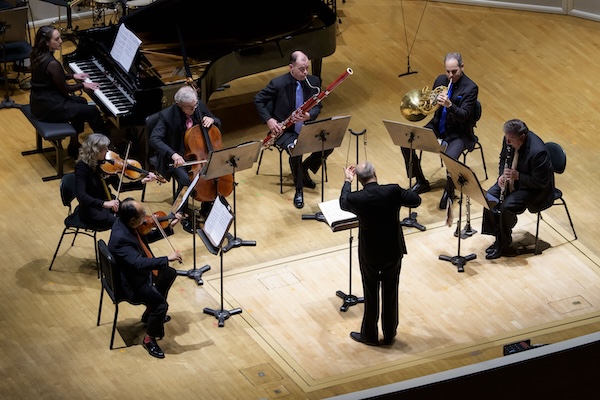
Exactly three decades later (1953) Stravinsky composed his Septet, which marked the composer’s late embrace of serialism, albeit in a typically individual manner with ample backspin. This closely argued work is scored for string trio, clarinet, bassoon, horn and piano.
As in the Octet, Asbury elicited great transparency, exploring an amiable quality beneath the gnarly surface of the opening movement. Here too, the central slow movement was striking, an angular Passacaglia most sensitively played by all. The Septet is rounded off with a double-fugue, and Asbury’s clarifying direction in the knotty contrapuntal thickets brought every rambunctious line into clear relief. Superb contributions by all, not least violinist Robert Chen and pianist Kelly Estes, the sole non-CSO member among the players.
Written for the opening of Lincoln Center’s New York State Theater in 1964, Stravinsky’s late Fanfare for a New Theatre likewise hails from his 12-tone period (and like the Septet was being heard in its CSO debut). Stationed in the balcony behind the stage, Esteban Batallán and John Hagstrom made this 40-second work for two trumpets a clarion summons to the evening, both players sailing effortlessly through this microbial showpiece with its dizzying atonal blizzard of notes.
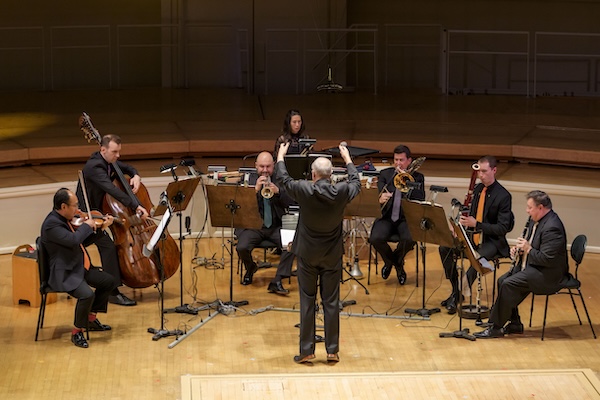
The second half was devoted entirely to Stravinsky’s Histoire du soldat or The Soldier’s Tale, his 1918 theater piece for actors, narrator, and chamber ensemble of seven players (violin, clarinet, bassoon, cornet, trombone, percussion and double bass).
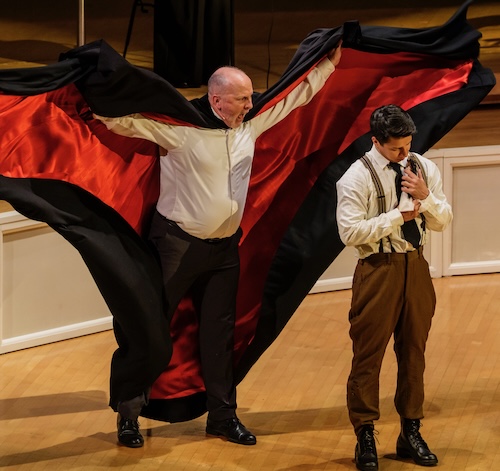
Stravinsky’s wry theatrical work tells of Joe, a soldier who trades his violin (and his soul) to the Devil in exchange for worldly fortune. The postwar cynicism of the narrative is belied by the acerbic yet engaging and often ingenious quality of the music, Stravinsky mining a variety of influences from military marches to ragtime and tangos in proto-Neoclassical idiom.
Performances of The Soldier’s Tale invariably rely on the success of the theatrical element. And, sad to say, this collaboration with the Goodman Theatre wound up being worse than most.
The main problem was that the tone of the theatrical element was unidiomatic with the piece, as well as being starkly unfunny (and fatally undermined by Liz Diamond’s shallow and colloquial English translation). There was little wit, irony or any sense of a wider context for the bleak tale in this presentation.
Cindy Gold proved grievously miscast as the Narrator, her loudly earnest and literal manner grating and all wrong for the piece.
Worse was Joe Dempsey who proved more silly-ass than sinister as the Devil. In his manic performance, Dempsey seemed to be channeling Johnny, the flamboyantly fey air traffic lunatic from the Airplane! movies. Dempsey’s Devil was miles over the top and consistently unamusing for all his relentless muggery. (Director Steve Scott must take some blame as well for not reining his actor in.) Only in the “Devil’s Song” near the end did Dempsey evoke something of the character’s malign menace but far too little too late.
Jordan Arredondo was the sole dramatic bright spot, bringing an understated everyman quality to the luckless military protagonist and would-be fiddler Joe.
Ultimately, this lackluster staging reinforced the feeling that Histoire du soldat should either be performed in the original French text with idiomatic French speakers or just with the music and no actors at all.
Too bad the theatrical side showed such a lack of finesse because the music-making was terrific in every way. Asbury’s precise and attentive direction drew out all the variegated elements of this score and the CSO players served up all the edgy brashness, sleazy jazz touches, and whirlwind instrumental flourishes.
Among the highlights were Esteban Batalláns brilliant cornet virtuosity, Robert Chen’s subtle and nuanced violin work, and the playing of clarinetist Stephen Williamson who brought wistful poetry to the melancholy moments of the score. The rest of the ensemble (bassoonist Keith Buncke, trombonist Timothy Higgins, percussionist Cynthia Yeh and bass Alexander Hanna) were on the same high level in this bravura ensemble performance.
The program will be repeated 1:30 p.m. Friday and 7:30 p.m. Saturday. cso.org
Posted in Uncategorized
2 Responses to “CSO serves up a lean and bracing blast of Stravinsky”
Leave a Comment
 Subscribe via RSS.
Posted Oct 27, 2025 at 9:59 am by Steve Roess
You hit the nail on the head saying the music should be performed without the dramatics. So glad, after reading this review that I traded this in for the previous week’s excellent Berlioz night with Klaus Mäkelä.
Posted Oct 31, 2025 at 9:24 am by John
I attended the Saturday night performance. I totally agree with this review. The first half of the concert was magnificently played. All musicians were at the top of their game. My only quibble was the Octet tempi were slow to my taste.
I think the biggest issue with the Soldier’s Tale was the translation. The effort to make it more “contemporary” detracted from the performance. I cannot fault the performance of the narrator (Cindy Gold) since she could only do so much with the material given to her.
The Devil’s performance (Joe Dempsey) was indeed over the top. He consistently broke the 4th wall in order to gain the cheap laugh and I found that very distracting and unnecessary. I found the Soldier’s performance (Jordan Arredondo) a bit bland.
The playing was impeccable. Totally agree with the review on the highlights but would add kudos to Cynthia Yeh for her usual exceptional playing.