Ear Taxi Festival opens with a fractured choral meditation on loss
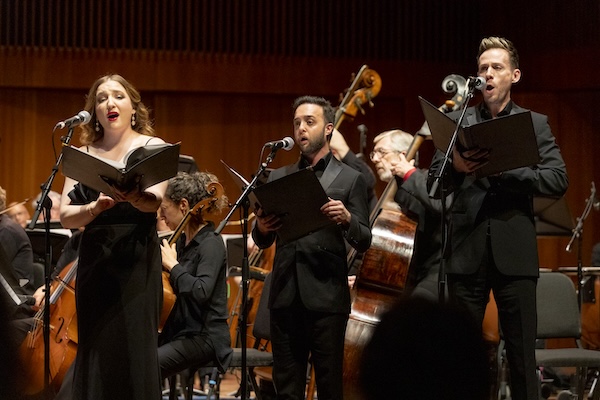
The meter is up once again on the Ear Taxi Festival.
This is the third installment of Chicago’s ambitious contemporary music festival, which launched in 2016 and returned in 2021 (delayed a year by the Covid pandemic).
This year’s festival, helmed by New Music Chicago, is the most ambitious yet, with 507 musicians performing works by 210 composers including 71 world premieres and eight Midwestern premieres across 27 venues through November 2.
That’s a bewildering variety of music to get a handle on. Yet Ear Taxi’s opening event was centered on just a single work with Bella Voce performing Lost Objects Friday night at the University of Chicago’s Logan Center.
A collaborative composition by Bang On a Can founders Michael Gordon, David Lang and Julia Wolfe, Lost Objects is billed by the triumvirate as a contemporary retooling of the baroque oratorio that explores “the meaning of memory.” The eclectic work calls for chorus, three soloists, a rock ensemble and DJ. The last contributes electronic sounds and sonic waves that seem intended as modern-style ritornellos setting off the eleven separate vocal sections of Deborah Artman’s text.
Outwardly, Lost Objects bears some similarity in style and conception to Leonard Bernstein’s MASS, minus the latter’s grandiose pretensions. Like MASS, Lost Objects was originally staged in a theatrical version at its 2001 premiere in Cologne, though Friday night’s performance in Hyde Park was presented in straight concert style with Bella Voce music director Andrew Lewis on a podium stage center directing the large forces.
Lost Objects has its arresting moments. A driving minimalist rhythm animates the faster sections. Hannah De Priest’s pure-toned soprano begins the work singing a cappella, soon joined by the chorus and orchestra in “I Lost a Sock.” The ninth section “Not Our Darkness (Loss of Meaning)” begins in a bright madrigal-like style with all three soloists singing unaccompanied; when an electric guitar steals in, later joined by drums and bass, Lost Objects suddenly succeeds in its cross-genre aspiration, mixing old musical wine into new bottles.
But there are not enough of those striking moments. Themes of loss and existential dislocation dominate the work, which librettist Artman well describes as a “fractured meditation.” There is little compensating lightness, joy, spiritual solace or humor in a downbeat 75 minutes that, cumulatively, has a rather depressing effect. The final section “Amelia, Flying” seems to bestow a more hopeful coda reflecting the cosmic mystery of the vanished aviator, and offers more fine singing by De Priest. Yet that intent is buried in a final fusillade of high-volume electronic thunder that concludes the work.
Ultimately, Lost Objects seems a bit like a lost object itself—a dated and lumbering period piece with music that—despite having three composers’ contributions—doesn’t have enough variety or interest to sustain its length. The electronic component seems even more shopworn now than it must have a quarter-century ago. Finally, Artman’s simple plain-spun texts rarely rise above the mundane. The repetitions of the opening section seem to go on forever to maddening effect. (“I lost a sock/I lost an umbrella/I lost a sock/I lost a tooth/I lost a leg/I lost my dog/I lost an erring” etc.).

The three Bang On a Can composers have undeniable talent but their music invariably seems most successful in shorter bursts. David Lang’s the little match girl passion is the only extended work by any member of the trio to gain a secure foothold in the regular repertory.
Friday’s performance also served to remind one what a problematic venue the Logan Center is for voices. Even when amplified as here and with someone as experienced as Andrew Lewis in charge, the words were largely indecipherable, and one had to constantly refer to the printed text.
That was not the fault of Bella Voce’s fine singers nor any of the soloists. Soprano De Priest provided the most radiant moments of the performance and countertenors Luke Lemmeler and Ryan Belongie blended to grateful effect in their duets.
Unobtrusively placed behind the soloists, Ben Zucker handles the DJ duties adeptly, even if some of his plugged-in contributions went on too long. Also one couldn’t discern whether the fiftul distortion and feedback was a technical glitch or part of the intended sonic design.
Lewis kept this unwieldy beast moving and on track with firm direction and rhythmic incisiveness, balancing as best as could be managed, and drawing energetic singing from the chorus and committed playing from the musicians of the Bella Voce Sinfonia.
It’s somewhat ironic that Ear Taxi’s opening program began with music by composers with a decidedly New York state of mind. With the festival’s strong emphasis on local musicians and composers, it will be interesting to see what Team Chicago can accomplish in the coming days and weeks.
The Ear Taxi Festival continues 2 p.m. Saturday with the Chicago Composers’ Consortium at the Logan Center Penthouse. eartaxifestival.com
Bella Voce performs Handel’s Messiah November 22 & 23. bellavoce.org
Posted in Performances
Leave a Comment
 Subscribe via RSS.