East Meets West in colorful Sinfonietta program
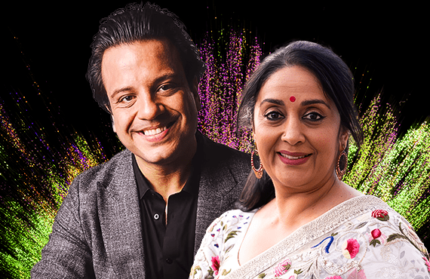
The Chicago Sinfonietta is known for crafting eclectic programs with music from diverse composers, but Saturday’s concert at the Studebaker Theater took this approach to another level, globetrotting from the Indian subcontinent to East Asia to France and back.
With Diwali, the Hindu festival of lights, just a few days away, India was the main focus of the program, entitled “Bollywood & Beyond.” The first half featured selections from Symphony Masala, a reimagining of Bollywood songs arranged for the first time for symphony orchestra. The work was created and performed by North American Bollywood singer Anuradha “Juju” Palakurthi and Indian American conductor Roger Kalia, a former Chicago Sinfonietta Freeman conducting fellow.
The ten selections, drawn from 70 years of Bollywood history, aptly highlighted the diverse musical influences to be found in Bollywood music, from Indian classical ragas to swing, disco, hip-hop, tango, golden age Hollywood musicals, and even klezmer. This diversity of influences is reflected in the title, “masala” being a rich spice blend.
Layering Palakurthi’s Bollywood singing on top of the Westernized orchestral arrangements provided interesting juxtapositions throughout. One of the most unexpected contrasts was in “Shola Jo Bhadke,” which featured a jaunty brass band march that could have been taken from The Music Man. Some of the other songs sounded like they could have been James Bond themes.
While the surprising stylistic mishmashes were novel at first, some of the orchestral writing became a bit repetitive. This was especially the case in “Chaiyya Chaiyya,” which largely oscillated between two pitches—something that works better in its original pop context. Synth percussion was added to a few of the songs to give the orchestra a more contemporary sound, but it tended to cover the string sections in the hall.
Nevertheless, the orchestra, led by an enthusiastic and animated Kalia, played with such polish that Palakurthi remarked that she felt like she was singing with a studio recording.
If some of the orchestral arrangements were less inspired at times, Palakurthi’s gentle, clear tone and impressive vocal agility brought the work to life. She shone especially in the bubbly final movement, “Aaya Diwali,” and the first movement, “Asato Ma,” a dreamy, incantatory rendition of an ancient Sanskrit peace mantra.
Palakurthi gave some helpful spoken context for the songs between movements, though supertitles or printed texts would have been helpful. (As is becoming increasingly common these days, the full programs were only accessible online by following a QR code. Unfortunately, it was difficult to retrieve them in the cell-reception desert of the Studebaker; and even so, the online program did not include the song texts.)
During these spoken interludes, Kalia and Palakurthi encouraged the audience to join in on songs they knew. They overestimated the audience’s familiarity with Bollywood music, as only a handful of people chimed in at one moment. That said, the audience was enthusiastic and willing to learn, rising for a standing ovation before the piece had even finished.
Chicago Sinfonietta music director Mei-Ann Chen took the podium for the second half, which paid homage to her roots with the orchestra and continued on the theme of East meets West. Tyzen Hsiao’s lushly lyrical The Angel from Formosa began the second half. Hsiao wrote the short orchestral elegy as a tribute to Taiwan, whose Portuguese name, “Formosa,” means “beautiful island.” Again, in the dry acoustic of the Studebaker, the strings were overpowered slightly, this time by the brass.
We returned to India with Reena Esmail’s Teen Murti, which sets three Hindustani ragas within the context of a piece for Western string orchestra. Meaning “three statues,” the work depicts a trio of musical figures, each drawn from a different raga. Layered over a low drone in the basses came quasi-improvisational decorations in the upper strings. These moments of stasis alternated with grooves in complex time signatures. The piece revealed some ragged unison playing in the violins and moments of questionable intonation, but it also allowed principal cellist Lindsey Sharpe to shine in an extended solo in the middle section.
While it might seem a strange choice at first, Ravel’s Mother Goose proved a nice foil to the other selections on the program, particularly in its nod to the East in the third movement, “Laideronnette, Empress of the Pagodas.” Chen led the Sinfonietta enthusiastically throughout the suite, bringing Ravel’s masterful orchestral coloring to the foreground.
Ending the evening was An-Lun Huang’s Saibei Dance—the first piece Chen ever conducted with the Sinfonietta. Akin to a Chinese Carmen excerpt mixed with the cinematic writing of John Williams, the piece provided an exuberant close to the colorful program.
The Chicago Sinfonietta presents “Holidays of Hope” on December 19 and 20. chicagosinfonietta.org
Posted in Uncategorized
Leave a Comment


 Subscribe via RSS.