Jordan leads CSO in a lively and lyrical Central European journey

For those who like their European repertoire center-cut, the Chicago Symphony Orchestra is offering a choice lineup this week with a musical journey from Budapest to Prague to Vienna.
Philippe Jordan was on the Orchestra Hall podium Thursday night in his third CSO appearance. Music director of the Vienna State Opera for the past five seasons, the Swiss conductor will take up a new post at the Orchestre National de France in 2027.
The concert led off with music of Hungary. Zoltán Kodály’s Dances of Galanta is a 16-minute tone poem, rather than the suite the title seems to indicate. The work is a free-form rondo based on the verbunkos, a Hungarian dance of military origins, which is first announced in an extended clarinet solo.
Jordan led an attentive performance that was most successful in the lyrical passages, where the conductor drew out Kodály’s child-like naiveté and moments of wry humor. Yet this performance overall seemed too politesse, smoothing over the violent contrasts of material, and lacking an essential thrust and Magyar fire. The most idiomatic moments came from the CSO winds, with a florid oboe solo by William Welter and, especially, clarinetist Stephen Williamson’s characterful rendering of the serpentine verbunkos theme, as well as the quirky individuality he brought to his latter solos.
Antonín Dvořák wrote one great concerto for cello, a good one for violin, and a not-so-good one for piano. But there is much inspired music in the Czech composer’s Violin Concerto, enough that a resourceful and imaginative soloist and top conductor and orchestra can make Dvořák’s Op. 53 seem like one of the finest concertos in the repertory.
Augustin Hadelich was the evening’s soloist and largely succeeded in accomplishing that feat though his performance took some time to gel. The violinist’s playing was typically polished and technically immaculate, Hadelich playing with an easy, confiding quality well suited to this melodic score.
Orchestra Hall’s 1997 renovation proved damaging for high frequencies, and the resulting inhospitable acoustic seems to affect some string soloists more than others. In the first movement, Hadelich’s violin sounded lightweight and even wan at times; one wanted greater body and presence from the soloist in the stentorian opening theme and the more dramatic solo material.
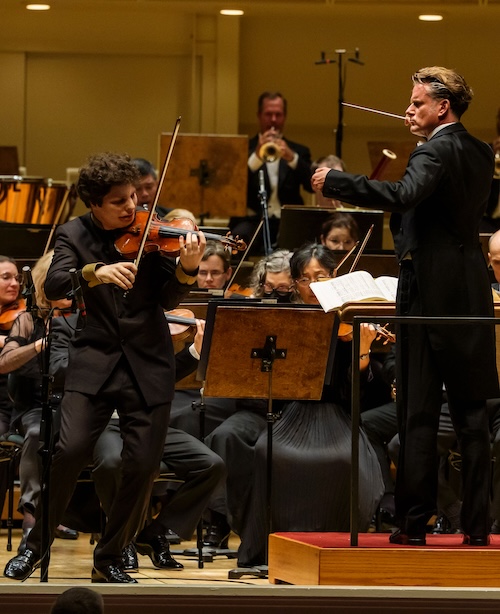
Yet Hadelich was clearly in synch with the sweet-sad qualities of Dvořák. The violinist was at his best in the Adagio, bringing great sensitivity and nuanced dynamics and expression to the slow movement’s main theme—one of the composer’s most ineffably beautiful inspirations. Hadelich was given fine support by Jordan and the orchestra, with flutist Jennifer Gunn and the CSO horns providing lovely descants around the solo line.
The finale was duly energetic, even if some scoring effects and the off-the-beat accents of the main theme went rather underplayed on this occasion. Still, Hadelich’s expressive poise and spirited virtuosity won the day, rounding off the closing bars with apt excitement and bravura.
The enthusiastic ovations brought the violinist back out for an encore of Carlos Gardel’s “Por una cabeza.” Hadelich’s own transcription nicely conveyed the tango song’s slinky essence, rendered with nuanced half-tones and delicacy.
Music of Brahms gets played plenty by the CSO and, following the first half, one expected a respectable traversal of the orchestra’s standard Brahms house rendition.
In fact, there was no sense of routine or being on autopilot, and Jordan and the orchestra delivered a performance of Brahms’ Second Symphony that was fresh, dynamic, compelling and even illuminating.
Jordan clearly knows something about this much-played repertoire, and this was richly idiomatic and distinguished Brahms by any measure. The conductor directed a well-paced opening movement that nicely balanced the bucolic qualities with dramatic weight. He showed a sure sense of the movement’s scale—the repeat observed in exemplary fashion, bringing a degree of mystery before the recapitulation that heightening expectation and momentum. The pastoral Brahms was there, but also the restiveness, both qualities conveyed by the superb playing of the orchestra with especially fine work from principal horn Mark Almond.
The orchestra plumbed a deep vein of Brahmsian feeling in the Adagio with playing of natural eloquence fully in synch with the composer’s stoic introspection. The Allegretto was fully grazioso with the CSO winds providing a fresh, rustic bonhomie to the music, and Jordan deftly handling the segue into the fleeter middle section.
Rather than merely pumping up the speed and volume as many do, Jordan took his time in the finale, giving breathing room to the nostalgic reminiscences, and building anticipation to the coda, which concluded in a confident and exhilarating blaze of brassy D-major triumph.
The program will be repeated 7:30 p.m. Friday at Wheaton College and 7:30 p.m. Saturday at Symphony Center. cso.org.
Posted in Uncategorized
One Response to “Jordan leads CSO in a lively and lyrical Central European journey”
Leave a Comment
 Subscribe via RSS.
Posted Oct 11, 2025 at 7:12 am by Randy W
The Brahms was truly special.