Mäkelä returns to CSO for a brilliant and blazing night of Berlioz
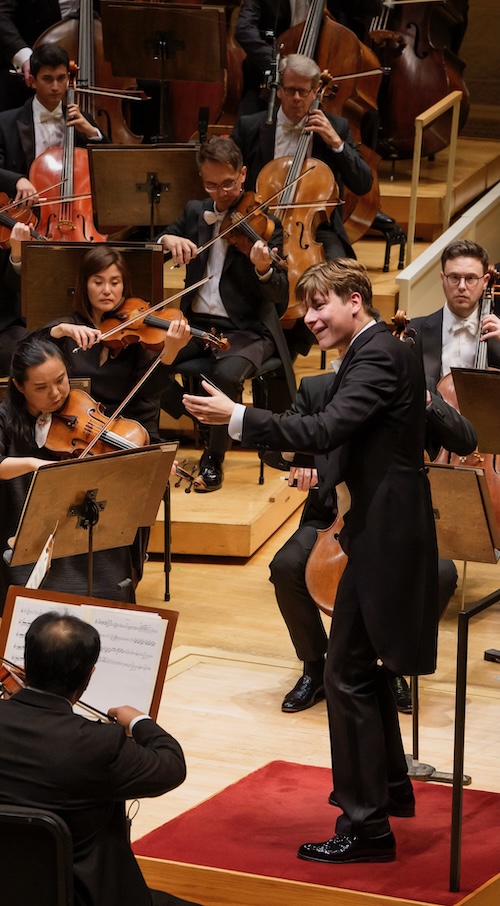
Berlioz’s Symphonie fantastique Thursday night. Photo: Todd Rosenberg
The burgeoning partnership of Klaus Mäkelä and the Chicago Symphony Orchestra seems to be growing closer, musically tighter and stronger and more effective overall with each successive performance.
The CSO’s music director designate made his first appearance of the 2025-26 season Thursday night at Orchestra Hall leading an all-Berlioz program. And if at times the French composer’s penchant for sonic bombast had one thinking that one Berlioz work on a program is plenty, it was still impossible not to enjoy the intensely committed, richly layered and exuberant performances by the orchestra under their young and charismatic Finnish maestro.
The first half of the evening was devoted to Harold in Italy. This unwieldy work was famously commissioned by fiddle virtuoso Niccolò Paganini who wanted a flashy concerto to show off his new Stradivarius viola. Yet Berlioz’s oddball hybrid proved less a showy viola concerto than a programmatic symphony with obbligato passages for solo viola. When Berlioz showed Paganini a draft of the first movement, the celebrated musician made no attempt to hide his baffled disappointment. “There’s not enough for me to do!” he complained.
Paganini wouldn’t have said that had he been in attendance at Thursday’s night’s performance, which made Harold in Italy into a compelling theatrical event—partly due to an imaginative staging, partly by the polished virtuosity of the CSO, and partly by the sheer, outsized musical personality of soloist Antoine Tamestit.
You knew this was not going to be your grandfather’s Harold in Italy when Mäkelä came out alone and gave the downbeat without a soloist in sight. Tamestit soon entered from the back of the stage, walking slowly and gazing around as if embodying Byron’s wandering hero that served as inspiration for the piece. Standing next to harpist Emily Levin (Dallas Symphony Orchestra), the French violist played his opening music as an uncommonly gentle, barely audible reverie in duet with the harpist.
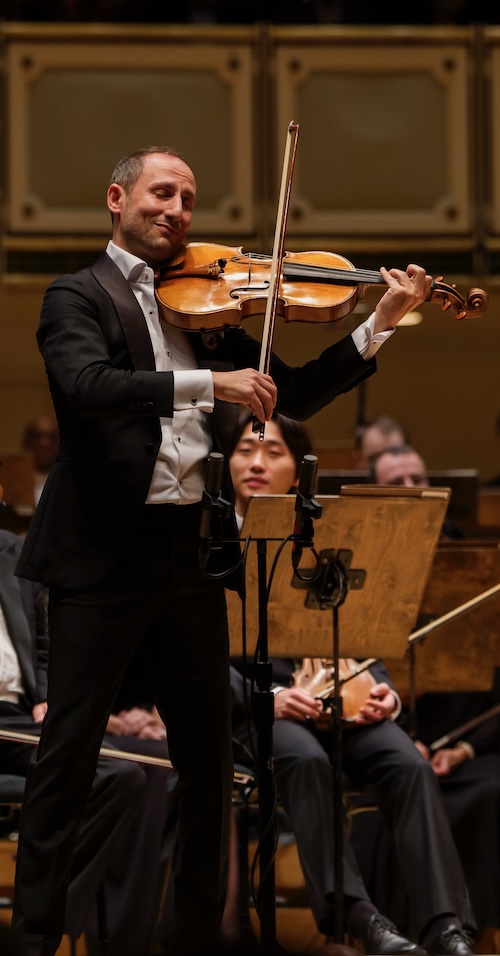
As the work unfolded, Tamestit eventually made his way over to the traditional left side of the podium but soon continued his Childe Harold roving around, behind the horns during the March of The Pilgrims and then over on the far right behind the cellos.
Yet it was not just the unusual visual of the restless soloist, but the degree of idiomatic empathy Tamestit brought to the score with his burnished dark tone, playful touch and natural eloquence. Tamestit often joined tutti passages with the orchestra, which can be distracting in Classical-era rep, but here served to bolster the soloist’s profile in his underutilized stretches. Reacting in shock to the crash of the final movement’s opening chord, Tamestit left the stage, deftly avoiding the long period of inactivity in the finale. The violist returned to join a split-off CSO string trio at the back of the stage for the beautiful quartet music before the clamorous coda.
This was the most involving Harold in Italy one is ever likely to encounter—not just because of the peripatetic Tamestit but for the romping, massively committed playing of the orchestra under Mäkelä’s direction. Rarely will this awkward work come across with such blazing commitment as the CSO served up Thursday night with notably emphatic climaxes.
Yet Berlioz’s subtle moments—there actually are some—came across with pastel hues and expressive precision. Scott Hostetler’s English horn solo lent an aptly Alpine air to the Abruzzi serenade of the third movement, with equally fine contributions by William Welter’s oboe and the flute playing of guest principal Herman van Kogelenberg (Munich Philharmonic). The “Brigand’s Orgy” finale is over the top but so is Berlioz, and Mäkelä drew powerful, acutely focused brass tuttis without blare or distortion.
The enthusiastic ovation brought Tamestit back out for a stylish and nuanced encore of the Prelude from Bach’s Cello Suite No. 1 in G Major, showing how supremely well Bach’s solo music for other instruments works on the viola.
And so on to the inescapable Symphonie fantastique, which concluded the evening.
As on his recent recording with the Orchestre de Paris, Mäkelä brought a fresh approach, vast dynamic range, and richly colored palette to Berlioz’s phantasmagorical, autobiographical symphony, inspired by his stalker-like obsession with Irish actress Harriet Smithson (who he eventually married and divorced).
The conductor’s podium style may seem merely flamboyant to the casual observer but was most telling and communicative in this brilliantly bizarro work—whether cueing entrances, fixing balances or doing quick dynamic or tempo adjustments on the fly.
In the first movement Mäkelä built anticipation to the initial appearance of the serpentine idée fixe in the violins, with excellent firm counterpoint by the basses here and throughout the performance. Even in this work, scored for massive forces, the conductor’s balancing was meticulous. Berlioz’s uninhibited moments were grandly scaled and imposing, yet the more restrained sections registered a myriad of nuance, as with the gracefully balletic waltz and in the “Scène aux champs.”
That slow movement can meander, but Mäkelä brought a focused concentration to its pastoral introspection. The opening dialogue between English horn and oboe was magical, with Welter’s offstage oboe seeming to emanate from miles away. Hostetler’s English horn playing was equally inspired here and, especially, in his atmospheric solo near the end of the movement over the ominous distant rumble of thunder in the timpanis.
In the final sections, the CSO musicians served up the requisite sonic spectacle and excitement with an eruptive March to the Scaffold, thrown off with equal parts swagger and malignity. The concluding bacchanale managed to hit all the bases: full-on crazy with antic clarinet solos, thrilling in its mercurial, frenzied bravura, and yet cathartic in Berlioz’s exhilarating final burst of triumphant brass.
The applause was long and clamorous and the CSO’s genial music director-in-waiting displayed characteristic gracious collegiality, walking halfway into the orchestra ranks to generously acknowledge individual players and sections.
The program will be repeated 7:30 p.m. Friday and Saturday. cso.org
Posted in Performances
10 Responses to “Mäkelä returns to CSO for a brilliant and blazing night of Berlioz”
Leave a Comment
 Subscribe via RSS.
Posted Oct 17, 2025 at 3:59 pm by Michael Brannan
A terrific concert, in my opinion. The review is spot on. Watching and listening to Antoine Tamestit on viola was a most enjoyable introduction to Harold in Italy for this listener, can’t imagine anyone doing a better job.
Symphony Fantastique is a personal favorite and Makela found ways to highlight and enhance the details. The outstanding playing of the CSO, across the board, made this night special. A partnership worth watching in the years to come.
Posted Oct 17, 2025 at 4:55 pm by stickles
This was Makela’s best effort yet. Previously I had the impression that he was merely riding along with the orchestra, but last night he put his personal stamp on the Symphonie. From the beginning, the wispy vibrato-less string playing immediately tells you this will not be a run of the mill performance. He had his own vision of the score, and it paid off. The balance was spot on, creating many exciting colors, one example being the bassoons blowing little bubbles in the witches’ brew right after the E-flat clarinet solo. A section of the 3rd movement that reminded me of Beethoven’s Pastoral symphony.
Now I wonder what kind of Beethoven these forces might bring. I am now actually a little excited about this appointment, especially in the French repertoire.
Posted Oct 17, 2025 at 9:00 pm by CSOgoer
It was somewhat exciting that people were excited about the excitement… nice to see an almost full house for a change, especially on a Thursday. The Harold was interesting, good to hear something of substance that has not been overprogrammed in recent years. Oto Carillo did very well in the first horn seat.
Previously I’ve had the impression that Klaus can take any piece and sap it of any feeling of forward momentum…. last night he spent a lot of time in “faster, faster, faster” mode, which was somewhat refreshing. He let the brass play as loud as they wanted, which is fun now and again. Lots of raggedy string entrances, particularly first violins, kinda weird as he ought to be able to bring the strings in cleanly as a string player himself. Some places where he oddly chose not to beat time where some of the orchestra was depending on cues….
I find myself wondering quite a bit whether there’s any path to improvement for him, and what it would be.
Posted Oct 17, 2025 at 9:32 pm by Peter Borich
My Mäkelä CSO concert experiences had gone from a slow and plodding Shostakovich 10 (a la Muti), to a very good Mahler Third, to a fantastique night of Berlioz. Obviously, excited for what’s to come.
Bravo Maestro Makela. Bravo CSO.
Posted Oct 18, 2025 at 10:37 am by Steve
A loud and crass performance that bordered on kitsch. The entire interpretation was built on cheap thrills from blaring volumes, which seems to be enough to satisfy the audiences here… This was by far one of the worst performances I’ve ever heard in this hall.
Posted Oct 18, 2025 at 2:36 pm by Hugh
What an amazing concert and night! It was literally many many years that we did not experience a night like this one … so much energy on the podium and in the orchestra! I am so happy the boring Muti era is over and we are starting an amazing adventure.
Posted Oct 19, 2025 at 12:13 pm by niloiv
Harold in Italy in the first half was refreshing with exquisite playing from both the orchestra and the soloist. Second half was fast and loud as other comments mentioned.
For me the best Makela performance in town remains the Mahler 5th before his appointment. Let’s hope this is not the best Klaus could offer.
Posted Oct 20, 2025 at 9:13 am by Mike T
Enjoyed Saturday’s concert very much. First time ever seeing Harold in Italy live and the performance was wonderful. Loved the more theatrical approach by Tamestit.
The Fantastique was a bit shaky in spots in terms of ensemble, but it had a driving energy, enthusiasm and excitement, which is pretty much what you would want from a young conductor.
When was the last time the CSO did an all-Berlioz program? Makela deserves cheers just for that alone.
Posted Oct 22, 2025 at 6:51 am by Andy Dogan
We attended Friday night. Berlioz, and especially Fantastique, is music of outburst, contrast, and excess with some incredible textures and just enough great melody thrown in for good measure. Makela was up to the task in these scores.
I for one am glad to see an era of joyous music-making dawn upon the CSO between Makela and other excellent guests like Hrusa.
Posted Oct 24, 2025 at 9:57 am by paula
Totally agree with your review. It was a joyful evening.
Had the good fortune to hear both soloist and conductor speak the next day at Friday’s The League annual luncheon.
Such energy and charm.