Muti returns to lead fresh, rewarding Hindemith, Dvořák with CSO
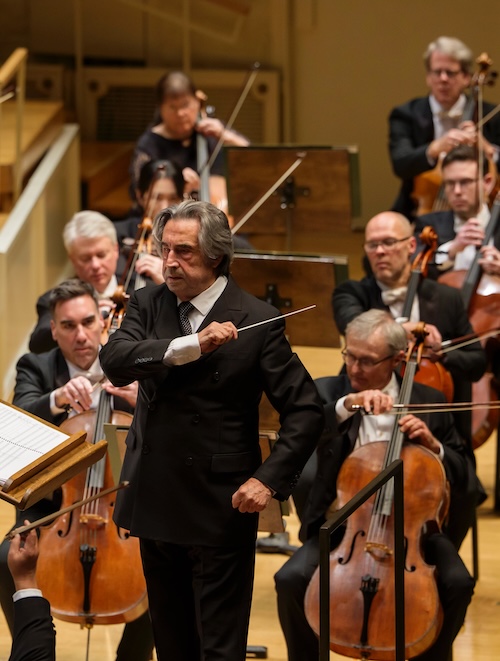
Sold-out concerts at Orchestra Hall may be rarities these days. But one can invariably count on Riccardo Muti, the Chicago Symphony Orchestra’s music director emeritus for life, to fill the seats at 220 S. Michigan.
Muti returned to town Thursday evening for the first of two fall weeks with his former ensemble. And while only the opening overture was new to his Chicago repertory, the program, centered on a pair of contrasted symphonies, proved fresh, rewarding and beautifully played—a testament to the continuing close artistic relationship between the Italian conductor and the CSO musicians.
Apart from Die Fledermaus, Johann Strauss Jr’s fifteen other operettas are infrequently staged on this side of the Atlantic. That’s unfortunate, for the consummately crafted, tune-packed Overture to The Gypsy Baron, which opened the evening, showed what musical riches we’re missing out on.
Muti has been a regular collaborator with the Vienna Philharmonic for most of his long career, including as a frequent conductor for the orchestra’s popular New Year’s Day concerts. That experience was on full display in this finely balanced and uber-Viennese rendition of Strauss’s curtain-raiser, with Muti underlining the Hungarian flavor, playfully teasing out the waltz rhythms, and building to a high-stepping coda. Stephen Williamson brought a tangy zigeneur quality to his clarinet solo, and William Welter’s languorous, long-breathed oboe narrative was on the same level.
Paul Hindemith was perpetually in conflict with the Nazi cultural commissars for his politics and modernist musical tendencies, and the premiere of his opera, Mathis der Maler about the 15th-century artist Matthias Grünewald wound up being banned. While the symphony he adapted from music for the opera was able to be debuted by Wilhelm Furtwängler, the conductor was later reprimanded by the Nazis for championing Hindemith.
Muti led performances of Hindemith’s symphony seven years ago but Thursday night’s boldly projected and insightful performance of Mathis der Maler built on the success of that previous outing. Indeed, anyone who still thinks of Paul Hindemith’s music as dry or dour would surely have their mind changed by this performance.
The three movements of the symphony were inspired by Grünewald’s masterpiece, the multi-paneled altarpiece at Isenheim. In the opening movement (“The Angelic Consort”), Muti and the CSO strings imbued the opening and closing phrases with a radiant spiritual glow. The contrapuntal Hindemithian bustle was strikingly transparent, and the lyrical episodes went with a gentle, singing quality, enhanced by the superb playing of guest principal flute Matthew Roitstein (Houston Symphony). In the meditative slow movement (“The Entombment”) Roitstein and Welter played raptly in solos and together, with Muti again bringing a benedictory quality to the final bars.
The finale (“The Temptation of Saint Anthony”) reflects not just the saint’s spiritual conflict but Grünewald’s own struggles with the church and his attempts to maintain his artistic freedom in time of war. Muti and the orchestra delivered the roiling drama with playing of sonorous weight, yet brought great clarity of articulation to the fugue, and rose to the spiritual triumph of the brass’s concluding “Allelujah” with majestic splendor.
Antonin Dvořák’s Symphony No. 9, “From the New World” is one of those cornerstone works that tend to suffer from overfamiliarity as well as too many routine performances (as was the case at the last CSO outing two years ago).
Muti and colleagues served up a performance that was just what the Czech composer’s final symphony required—a fresh, highly polished and illuminating reading that was akin to removing centuries of grime from an old painting to reveal the bold colors, craft and originality beneath.
Muti, at 84, remains as energized a podium figure as ever, and this performance had ample drive and drama in the outer movements—even with more stately tempos than one often hears. Yet that bit of extra breadth brought a gentle, vernal freshness to the bucolic episodes in a way that made Dvořák’s pastoral qualities blossom anew.
In the Largo, Scott Hostetler rendered the famous English horn theme with a plaintive, folk-like simplicity that conveyed its elegiac nostalgia more affectingly for its understatement. Likewise, Muti drew great delicacy in the hushed string playing at the coda. The third movement went with incisive rhythmic drive and the spacious take on the rustic trio section again made striking contrast.
The implacable main theme of the finale had worthy energy and dramatic impact, yet here too, the music benefited from not being overdriven, with contrasting lyric episodes given room to resonate. Muti maintained momentum through Dvořák’s multiple endings, building to a powerful rendition of the closing tutti statement and the held winds of the final chord.
The program will be repeated 1:30 p.m. Friday and 7:30 p.m. Saturday. cso.org
Posted in Performances
2 Responses to “Muti returns to lead fresh, rewarding Hindemith, Dvořák with CSO ”
Leave a Comment





 Subscribe via RSS.
Posted Nov 01, 2025 at 9:22 am by Steve
This was undoubtedly the best concert of the season so far. Muti is the only one who can get this orchestra to play as beautifully and refined as they did this week.
Posted Nov 02, 2025 at 6:14 pm by Peg
The review is perfect. A night of exquisite music and magic. There is something beautiful about the relationship between Maestro Muti and the CSO. The exchange between them is a joy to behold. My heart is filled with peace and happiness when I see them together.