The dawn of opera, celebrated in style by Haymarket Opera, Newberry Consort with Peri’s “Euridice”
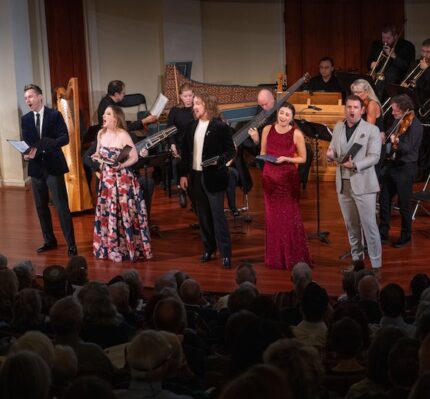
From the Florentine court at the dawn of the Baroque era, to downtown Chicago on Friday night, Jacopo Peri’s Euridice looks and sounds remarkably spry for an opera that’s 425 years old.
Presented at the Art Institute of Chicago in a splendid concert realization marking the first official collaboration of the city’s foremost early music ensembles, Haymarket Opera Company and the Newberry Consort, this oldest surviving opera revealed deep Chicago roots. (Newberry artistic director Liza Malamut and some colleagues have informally participated as members of the pit band in previous Haymarket productions.)
The charming pastoral retelling of the classic myth of Orpheus and Eurydice received its U.S. premiere in 1967 at the University of Chicago, in an edition prepared by U. of C. musicologist and Newberry Consort co-founder Howard Mayer Brown (a print is housed at the Newberry Library).
A practicing musician as well as eminent preclassical music scholar, Brown would have been exceedingly pleased by the performance, the first of two Euridice concerts opening the Consort’s 39th season and concluding Haymarket’s 15th anniversary.
Their Euridice brought together ten excellent period vocal specialists, most of them Haymarket stalwarts, and a terrific period-instruments ensemble of 16 players equally versed in early Baroque style. The 1600 print specifies no instrumentation, so Brown was free to supply his own scoring of violins, recorders, lute, harpsichord and organ (plus viola da gamba in his printed edition). Friday’s performance was further enriched by harp and three sackbuts representing Plutone’s underworld.
With performers this musically sensitive and dramatically engaged, no staging was necessary—clear projection of the music and poetry was the chief priority, as it must have been at the Medici court wedding in 1600 for which Peri created his landmark sung-drama.
The presentation—complete with fluid and colorful video projections by Shawn Keener that combined a running translation with a contemporary gloss on Baroque artistic imagery related to the myth (think gods, nymphs and shepherds)—was perfectly suited to the intimate physical and sonic dimensions of Fullerton Hall.
If later Italian opera composers like Monteverdi and Cavalli would push opera into richer harmonic and deeper dramatic realms, Peri and his Florentine colleagues left them splendid models on which to build.
Unlike most later operas inspired by the Orpheus myth, this Euridice ends happily. Having brought his beloved back to life and reclaimed her from the underworld, Orpheus rejoices in their reunion—a joyous conclusion perfectly in keeping with the late Renaissance ideal of harmony between the human and divine spheres.
Peri’s revolutionary “speech in song” consists of vocal solos interspersed with contrasting vocal choruses and instrumental ritornellos. Friday’s performers, including Malamut on sackbut, made certain that Peri’s austere monody never devolved into aural monotony.
The luminous soprano Hannah De Priest brought affecting intensity to Dafne’s music, particularly her dialogue with tenor Scott J. Brunscheen’s Orfeo in which the nymph described the fatal snake bite suffered by the latter’s beloved Euridice.
As the lyre-playing hero, Brunscheen poured out his lament with vocal security and welcome expressive restraint, his strong tenor crystal-clear in enunciation and alive to every emotional shift in the vocal lines and Italian text.
The dulcet-voiced tenor Michael St. Peter nailed the extended solos of Aminta with such musical and dramatic acuity that Peri might have named the opera after Orfeo’s sympathetic friend. Completing the strong tenoral component was Brian Skoog as Tirsi.
The superb countertenor Ryan Belongie was equally affecting in his delivery of Arcetro’s long narrative in which he described Orfeo’s inconsolable grief following the death of his beloved.
As the ill-fated heroine, Erica Schuller, another Haymarket veteran, made the most of her scant solo opportunities with the fine glow of her lyric soprano in the concluding ensemble.
Soprano Veronique Filloux (Proserpina) and baritone Evan Bravos (Caronte) joined Brunscheen’s shepherd in their eloquent pleading for Plutone (the firm bass-baritone Jonathan Woody) to restore life to Euridice in the aboveground world.
Mezzo-soprano Christine Boddicker was an entrancing presence in the prologue in which La Tragedia ushered listener into the mythic drama.
The solo singers doubled as a delightful chorus of nymphs and shepherds, accompanied by the harmonic and timbral shifts of the crack instrumental band assembled for this occasion. Everything perked along crisply and precisely—no conductor needed. Recalling period practice, the concert presentation included four additional instrumental interludes by composers closely associated with Peri.
All told, this collaboration by Haymarket Opera and the Newberry Consort aptly celebrated the world’s first opera and Chicago’s distinguished 60-plus-year history of early music performance.
Peri’s Euridice will be repeated 3 p.m. Saturday at Nichols Concert Hall, Music Institute of Chicago, Evanston; newberryconsort.org, haymarketopera.org
Posted in Uncategorized
Leave a Comment

 Subscribe via RSS.