Chicago Chorale revisits Rachmaninoff’s “All-Night Vigil” with spiritual insight and fervor
This is the time of year when Handel’s Messiah begins to beckon from every musical corner of Chicago, continuing for the next four weeks until Christmas.
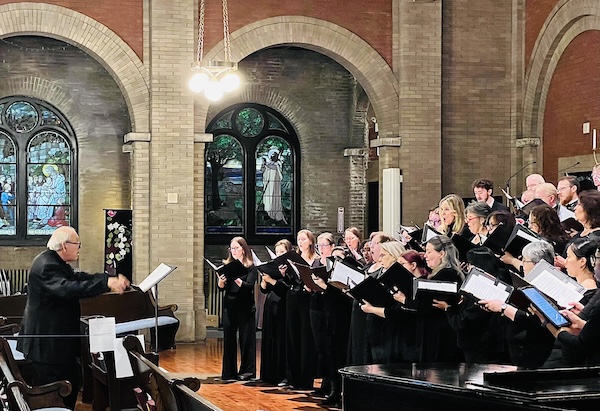
Give credit to the Chicago Chorale for bucking the Handelian seasonal trend. Bruce Tammen’s ensemble opened its 24th season not with holiday fare but with Rachmaninoff’s All-Night Vigil, performed Sunday afternoon at Hyde Park Union Church.
The All-Night Vigil—also known less accurately as the Vespers—is an a cappella liturgical setting that is an outlier in Rachmaninoff’s oeuvre. Nine of the fifteen movements are based on chant, as the Russian Orthodox church required, for which the composer drew on the dominant triumvirate of modes (Znameny, Greek and Kiev). Rachmaninoff composed his own music for six sections, imbuing his themes with such idiomatic and convincing Orthodox flavor that most would find it difficult to discern between the ancient and new.
Along with his choral symphony, The Bells, the All-Night Vigil was among Rachmaninoff’s favorites of all his music. One can easily understand why since this outwardly austere, mass-like setting is one of the most masterful, richly melodic and sheerly beautiful of all the Russian composer’s works.
Sunday’s performance displayed many of the same virtues of the ensemble’s last rendering of the All-Night Vigil nine years ago at the same venue. There was an additional valedictory sense on this occasion, as this is the final season for Tammen, the Chorale’s founder and artistic director, who will retire next spring.
Tammen took the opening section, “Come, let us Worship,” at a crackling pace—no doubt much quicker than would have been impossible at the uber-resonant St. Vincent de Paul Parish in Lincoln Park the previous evening.
Throughout the fifty-minute work, Tammen’s nonprofessional singers provided the finest possible advocacy, singing the Church Slavonic text with polish, full-throated fervor and expressive nuance without ever straying outside ecclesiastical bounds.
Among the highlights were the rich spiritual confidence of “Blessed is the Man,” the clarion affirmation of “Rejoice, O Virgin,” the spiritual joy of “Praise the Name Divine” and the extraordinary “The Great Doxology.” Tenor Mike Byrley capably handled his cantor-like solos.
The performance gained immensely by the addition of Glenn Miller to the ensemble. The singer is an oktavist, the lowest and rarest of male bass voices. Miller proved the genuine article and his rich, even and rounded subterranean notes were a highlight of the performance, firmly anchoring the low end of the ensemble and resonating at the hushed ending of many of the sections.
Bruce Tammen once again showed his striking sympathy and idiomatic feel for this challenging score, drawing fluently blended textures, and varying tempos and dynamics adroitly.
The search committee members have their work cut out for themselves, finding a successor to Tammen, the Chicago Chorale’s founder, artistic director and longtime guiding spirit.
The Chicago Chorale performs Advent Vespers 5:15 p.m. December 6 at the Monastery of the Holy Cross. chicagochorale.org
Posted in Uncategorized
Leave a Comment
 Subscribe via RSS.