Muti, CSO serve up graceful mix of Stravinsky, Brahms, and Spanish guitar
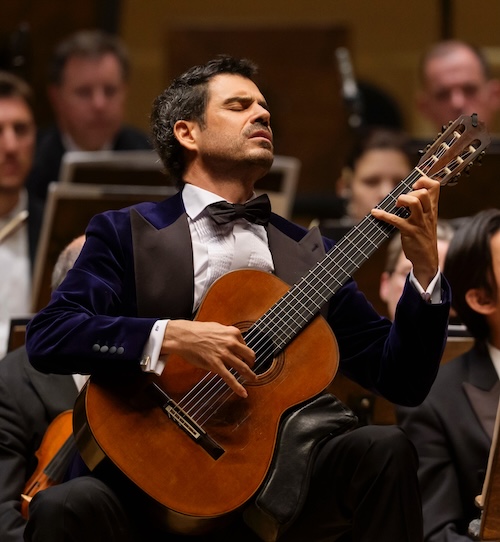
For his final Chicago Symphony Orchestra concerts of 2025, Riccardo Muti led a program that gracefully blended music of Stravinsky and Brahms with a centerpiece of Iberian sunshine Thursday night at Symphony Center.
There are few, if any, guitar concertos that can equal the profound depths and expressive range of the greatest concertante works written for violin, cello, or piano. Yet the best of them offer ample charm as well as opportunities to vary the concerto lineup with a less-often-heard solo instrument.
Such was the case Thursday night with the return of Pablo Sainz-Villegas as soloist with the CSO in Joaquin Rodrigo’s Concierto de Aranjuez.
Guitar soloists may be relative rarities with orchestra, yet this week’s concerts mark Sainz-Villegas’s third CSO appearance in six years, most recently in 2023.
Rodrigo’s concerto takes its name from the town where he and his wife spent happy hours during their honeymoon. While the blind Spanish composer would write ten other concertos—his Fantasía para un gentilhombre gets occasional outings—the Concierto de Aranjuez remains not only Rodrigo’s most popular work, but is still the most performed guitar concerto by any composer 86 years after its debut.
After some initial humorous stage business—Muti had to step onto and over the soloist’s platform to get to the podium—Sainz-Villegas showed why he is one of the leading exponents of his instrument today in his compatriot’s greatest hit.
The somewhat steely timbre of his guitar was projected by the soloist with great clarity throughout, eschewing the usual need for discreet amplification in this repertoire. The Spanish guitarist showed seamless technical aplomb and dexterity in the buoyant first movement with Muti lending an extra kick to Rodrigo’s accents.
Muti appeared to ask Sainz-Villegas to retune before the Adagio, which he did to mutual benefit. This justly famous music has come to personify a brand of Spanish-flavored nocturnal languor. The guitarist’s wide dynamic range and spacious phrasing was fully in synch with Rodrigo’s evocative moonlit music, aided by Scott Hostetler’s poetic English horn solos.
The finale is the weakest part of Rodrigo’s concerto with a main theme that could be charitably called trite. Muti and Sainz-Villegas disguised the weak joins skillfully, and the soloist’s fluent articulation and Muti’s colorful and attentive accompaniment made a spirited closer with a nice humorous take on the throwaway coda.
The vociferous ovations and repeated curtain calls brought the soloist back out for Tarrega’s Gran Jota de Concierto, which seems to have become Sainz-Villegas’s signature piece.
The guitarist introduced the encore as based upon a swaying dance tune from his hometown of La Rioja, wine country in Northern Spain. Tarrega’s showpiece makes all kinds of insane demands, which the guitarist dispatched in dazzling style, from dizzyingly fast articulation to coaxing an uncanny snare drum-like sound, to drumming the front of his guitar with his right hand while simultaneously playing a melody with the left.
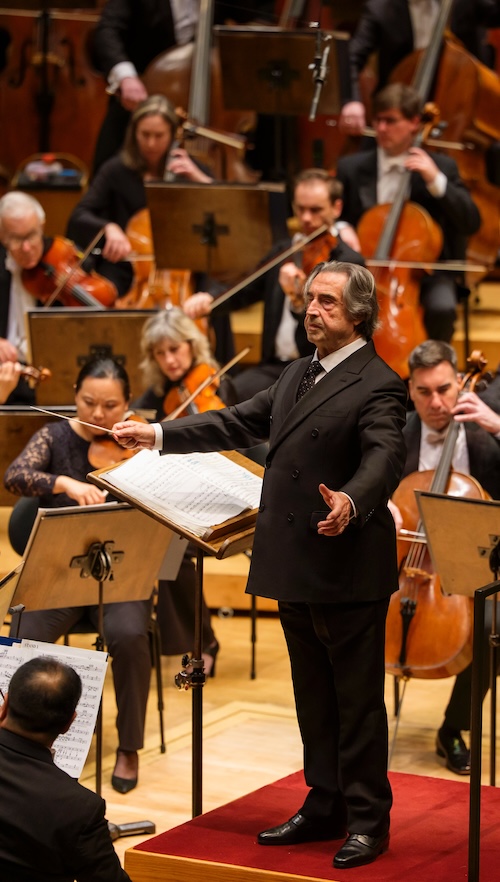
Brahms Thursday night. Photo: Todd Rosenberg
The evening led off with the Divertimento from Stravinsky’s ballet The Fairy’s Kiss. Stravinsky’s witty ballet music is hard to resist as he draws on some lesser-known Tchaikovsky pieces, retooling them in his own acerbic style.
As in previous performances of the Divertimento, Muti was fully in synch with this off-kilter confection, bringing out the mercurial tempo switches, snappy rhythms, sly humor and gracious charm. Cellist John Sharp led the fine solo contributions of the CSO musicians with Muti acknowledging all of them individually and by section.
Music of Johannes Brahms has counted among Muti’s most consistent performances of the great composers in Chicago and so it proved again with the evening’s concluding work, the Symphony No. 4.
This Brahms Fourth was a statelier affair than in previous Muti outings, but none the worse for that. If the opening movement emphasized the non troppo more than previously, the Allegro still moved with compelling vigor. Muti’s flexible pulse found a wealth of detail in this relatively mellow account with nuances and bits of expressive color that consistently paid rewards, and an organic acceleration to the movement’s coda.
The Andante is one of Brahms’ most affecting inspirations, and Muti’s acute balancing and pacing brought forth a beautifully played and lovingly detailed rendering of this introspective music. Perhaps the Allegro giocoso could have gone with greater verve for better contrast but the quasi-scherzo was still graceful and effective, apart from a jarring horn lapse in the middle section.
Muti began the finale in an almost low-key manner, but built the drama with each successive variation of Brahms’ epic passacaglia. The crucial flute solo, while well played, was a bit superficial, but otherwise each section rose to the challenges, and the fiery coda concluded Brahms’ last symphony with apt strength and stormy defiance.
The program will be repeated 1:30 p.m. Friday and 7:30 p.m. Saturday. cso.org
Posted in Uncategorized
3 Responses to “Muti, CSO serve up graceful mix of Stravinsky, Brahms, and Spanish guitar”
Leave a Comment





 Subscribe via RSS.
Posted Nov 07, 2025 at 1:01 pm by Dave
The first half was a complete delight. The Brahms was magnificent at times but the third movement scherzo was lethargic and bland. The first movement had awkward moments because Muti appeared exasperated with the horns at times. The maestro isn’t the most subtle when it comes to his displeasure with things like audiences and musicians.
Posted Nov 09, 2025 at 6:17 am by Joseph Gibes
The Saturday evening concert was marvelous. In the first movement of the Rodrigo, the guitar’s sixth string is tuned down to D rather than to the usual E. I believe the reason Sainz-Villegas stopped to tune before the Adagio was to re-tune the sixth string to E.
Posted Nov 10, 2025 at 1:04 pm by Mike T.
Enjoyed Saturday’s concert very much. Great program, and nice to see a full house for it. Muti’s tempos were slower than I usually like, but I was able to roll with them, without much problem, since those tempos sometimes brought out a greater sense of transparency, letting me hear things I hadn’t heard before.