Viet Cuong’s energetic music in the spotlight at Northwestern
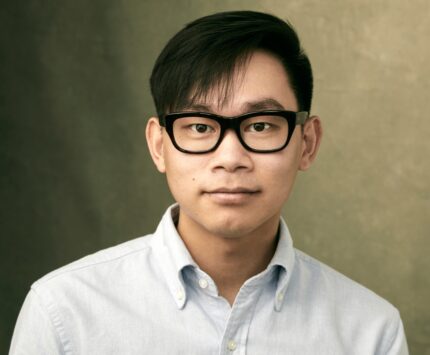
Northwestern University’s Symphonic Wind Ensemble teamed up with acclaimed Chicago-based ensembles Third Coast Percussion, Eighth Blackbird, and ~Nois Quartet for a program showcasing the work of Viet Cuong on Friday night. The concert, titled “Vital Currents: The Music of Viet Cuong,” kicked off a weekend recording project of the Vietnamese-American composer’s work.
As Robert Taylor, Northwestern’s director of bands, noted in his opening remarks, the concert was a celebration not only of Cuong’s music but also of the excellence of the Bienen School of Music, as the program at Pick-Staiger Concert Hall brought together prominent new music groups in Chicago that are largely made up of Northwestern alums.
The ambitious program was a massive undertaking. Not only did it bring together three ensembles who have busy performing schedules themselves, but it also recorded from every angle for a behind-the-scenes documentary to accompany the recording. Plus, each piece required a different stage setup, necessitating two intermissions and other pauses to reset instruments, chairs, stands, and mics. This slowed down the evening’s proceedings, but Cuong’s music proved well worth the wait.
The first piece, John and Jim, was scored for the Symphonic Wind Ensemble alone. It was written to celebrate the tenth anniversary of the Obergefell v. Hodges Supreme Court decision, which granted marriage rights to all same-sex couples. The piece humanizes the couple at the center of the case, Jim Obergefell and his partner of 22 years, John Arthur, who was in the end stages of ALS when they flew to Maryland to be married. When John passed shortly thereafter, Jim had to challenge their home state of Ohio in court so he could be listed as John’s surviving spouse on his death certificate. The case eventually made it to the Supreme Court, which ruled in Jim’s favor. The timing of this performance—just four days after the Supreme Court decided to not overturn its 2015 decision—made the piece especially poignant.
In John and Jim, Cuong reframes melodic fragments and harmonic progressions from Pachelbel’s Canon in D, a popular wedding piece that Cuong used to improvise over as a kid, which he thought he’d never get to have at his own wedding as a young gay man. The piece unfolds gradually out of a solitary flute line, before piano doubled by pitched percussion adds a bubbling quality on top—a technique Cuong would revisit throughout the evening.
Even without knowing the backstory, John and Jim would have packed an emotional punch in its sweeping hopefulness. The symphonic band was augmented with seven brass players in the balcony, which made the climax a bit overwhelming in the intimate space of Pick-Staiger.
Third Coast Percussion joined the stage for Re(new)al, a piece Cuong describes in his program note as “celebrating everyone who is working together to create a cleaner, more efficient world.” The concerto for percussion quartet is constructed of three continuous movements, each inspired by different types of renewable energy: hydro, wind, and solar.
Hydro power was manifested by a set of crystal glasses, which Third Coast Percussion clinked together to create different chords. As in John and Jim, Cuong built up the texture gradually, adding tinkling piano, blowing air, and fluttering piccolo scales on top of the glass sonorities. The second movement brought Third Coast to a deconstructed drum kit, where they played intricate ’90s-inspired drum and bass rhythmic patterns. The choreography was as dazzling as the music, the quartet at one point circling a single snare drum like a wind turbine while triggering compressed air cans. In the third movement, Third Coast moved to a set of vibraphones. Unfortunately, the complexity of the musical lines got a bit lost as the symphonic band crescendoed to evoke the sunrise.
The second half began with Vital Sines, featuring the sextet Eighth Blackbird. At this point in the program, Cuong’s compositional voice was firmly established. All the works on the program were characterized by an effervescent, sometimes frenetic rhythmic drive, paired with sweeping, cinematic brass. Vital Sines was no different. The peaks of the sine wave the piece was intended to mimic were well represented, but one wanted more time spent in the valleys, particularly as the members of Eighth Blackbird were sometimes covered in the tutti sections despite being miked. The moments of reprieve were brief, with a lyrical duet between violinist Maiani da Silva and cellist Aaron Wolff providing some welcome contrast before the energy ramped back up.
After another intermission came Second Nature, featuring the ~Nois Quartet. Imitating complex electronic delay effects, the saxophone quartet plays each note four times to “capture the infectious exuberance of House music,” Cuong writes. This fiendishly difficult textural effect—executed impressively by ~Nois—provided sufficient differentiation from the rest of the program. Written as a means of getting out from underneath the pall of grief following his father’s death, Second Nature bubbled with joy.
Northwestern’s Symphonic Wind Ensemble proved solid as a rock under the assured command of Robert Taylor, who deftly negotiated Cuong’s constantly changing time signatures and the different setups required by each piece. The students demonstrated a unified sound and utmost accuracy and professionalism throughout.
The evening proved an exciting and intensely personal showcase of Cuong’s distinctive compositional voice while also spotlighting three major groups at the forefront of new music in America. Northwestern University should be applauded for this bold undertaking—the recording will surely be one to look out for.
Posted in Uncategorized
One Response to “Viet Cuong’s energetic music in the spotlight at Northwestern”
Leave a Comment

 Subscribe via RSS.
Posted Nov 15, 2025 at 12:42 pm by DAvid
I attended. totally agree with your remarks. What a stupendous undertaking, exceedingly well performed.