Noseda, Ehnes make successful CSO returns in musical rarities
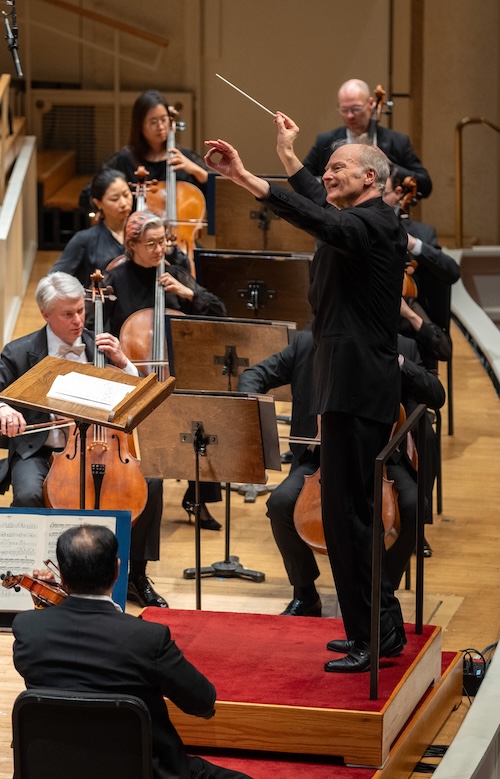
It has been 14 years since Gianandrea Noseda last led a Chicago Symphony Orchestra concert and that’s been our loss.
Granted, the Italian conductor has been busy. For the past nine seasons, he has served as music director of the National Symphony Orchestra in Washington DC, where he has, by all accounts, raised the home ensemble of our nation’s capital to new heights.
Noseda’s two prior downtown CSO stands (and one at Ravinia) were highly impressive. He also brought the Teatro Regio Torino to Chicago on tour for an extraordinary concert performance of Rossini’s Guillaume Tell in 2014.
For his CSO return Thursday night, Noseda eschewed the easy rewards of populist blockbusters, with a program centered on two lesser-known works that need all the help they can get.
But first, as they say in radio, came Prelude to the Afternoon of a Faun. Debussy’s ten-minute tone poem is a challenging work to program and made even more so for an orchestra that is currently without a principal flutist, Stefán Ragnar Höskuldsson having departed the CSO to become principal of the Berlin Philharmonic. (Officially, he is on a “leave of absence” this season as listed in the program.)
As has become recent custom to fill the growing number of empty positions on the roster, the CSO booked a guest for the chair this week. Patrick Williams, associate principal flute of the Philadelphia Orchestra, played capably yet his polished blandness failed to evoke much of the score’s atmosphere. (The loud, unmuffled coughs of several audience members didn’t help.) Oboist William Welter sensitively conveyed more of the mystery and languor, and Noseda directed a skillfully layered performance but this was not a Debussy Faun for the ages.
Some of Benjamin Britten’s oeuvre can seem rather dour, like the musical equivalent of English cooking. The British composer’s Violin Concerto is a pensive, brooding work that is about as far removed from the virtuosic fiddle showpieces as one can get. Orchestras warily poke Britten’s concerto with a stick every ten years or so to see if it’s still alive.
Inspired in part by Berg’s Violin Concerto, the late 1930s work has a similar elegiac mood, reflecting the pacifist composer’s disillusion about the Spanish Civil War outcome and the impending European hostilities. Cast in three unbroken movements, Britten reverses tradition with two slow sections framing a central Vivace.
Fortunately, James Ehnes is just the kind of communicative musician that Britten’s concerto requires to convey its worthy qualities to a receptive audience. From the flickering vibrato of his opening statement, the Canadian violinist brought a compelling human quality as the narrative’s solo protagonist via his intimate style and pure tone.
Ehnes brought faultless technique to the Spanish-tinged fast sections as well as the driven, nerve-wracked middle movement, making a compelling soliloquy out of the cadenza. The soloist was at his finest in the finale, the first of Britten’s many passacaglias, with the violinist’s final threnody fading away like hope for the future in the closing bars.
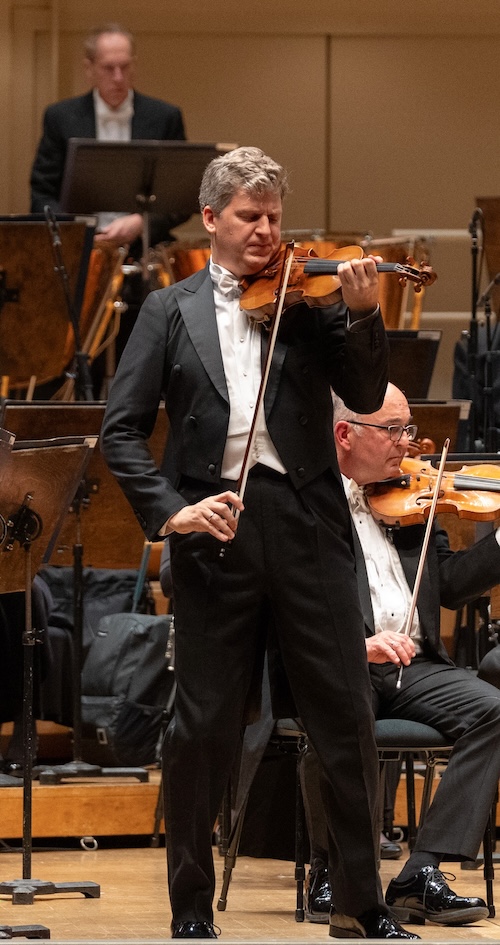
Noseda and the orchestra were full partners in this outstanding performance. The conductor consistently illuminated Britten’s individual scoring touches, as with the trombones’ belated first appearance and the jarring passage for two piccolos and tuba.
This concerto is not usually a crowd-pleaser but proved so on this occasion with Ehnes and colleagues earning enthusiastic ovations and the violinist repeatedly recalled to the stage.
Ehnes obliged the audience with an encore of Eugene Ysaÿe’s Sonata No. 3 (Noseda took a chair on the left side of the stage to hear his colleague as well.) One doesn’t think of Ehnes as a power player but he showed impressive chops with a staggering performance of Ysaÿe’s showpiece, begun in a mere wisp of tone and segueing from a spacious first part to the blistering speed and fiery virtuosity of the final section.
That stoked another round of applause and Ehnes responded with a rare second encore, to “lighten the mood,” the violinist said. Ehnes delivered a musing and inward rendering of the Largo from Bach’s Sonata No. 3 in C major, BWV 1005.
Sergei Prokofiev’s Symphony No. 4 was one of several major commissions by the Boston Symphony Orchestra for its 50th anniversary season in 1930. (Others were Albert Roussel’s Symphony No. 3, Howard Hanson’s Symphony No. 2, Hindemith’s Concert Music for Strings and Brass, and Stravinsky’s Symphony of Psalms.)
Prokofiev’s Fourth, which recycles material from his ballet The Prodigal Son, was one of the least successful of that esteemed group of premieres. Its failure nagged at Prokofiev and he extensively revised the score 17 years later, enough to give it a new opus number. He kept the ballet material but expanded the orchestration and dimensions, making the work 15 minutes longer than the original.
The revised version of Prokofiev’s Fourth Symphony, performed Thursday night, is an improvement on the original. But that’s kind of like saying that it’s better to be mugged on the Blue Line than the Red Line.
The second version eliminates the bitty feel of a repurposed ballet suite and makes the Fourth more grandly symphonic with greater weight and sonic impact. Yet despite the surface glitter and souped-up scoring, the piece still doesn’t convince as a unified entity, another example of Prokofiev’s rather facile brilliance. As Shostakovich noted of his compatriot, “Prokofiev sacrificed essential things too often for a flashy effect.”
Noseda is a seasoned hand at making a case for problematic Russian symphonies, as with his previous inspired advocacy for Rachmaninoff’s long-neglected Symphony No. 1 in its belated CSO debut.
Likewise, Noseda and the CSO provided the strongest possible advocacy for this rather vacuous work. The conductor has toned down the hyperkinetic podium style of his younger years, yet his firm leadership still draws responsive, laser-focused playing. He elicited a full, top-to bottom sonority in the opening movement, segueing fluently from the Andante introduction into the motoric Allegro. And while the buildup to the clamorous coda was powerfully played, the effect is still one of sound and fury signifying little.
The ensuing Andante tranquillo, which accompanies the return of the Prodigal Son in the ballet, offers the most engaging music of the work, an arching lyrical theme that could have come from the composer’s Romeo and Juliet. The opening flute solo would have benefited from richer tone from guest principal Williams, but the orchestra brought impassioned lyricism to the music, Noseda judging the ebb and flow with great skill. The third movement, largely unchanged, went with apt airy grace, Noseda making the most of the revised ending.
The finale remains an unconvincing muddle from the lumbering main theme to the bombastic final bars. Noseda charted the development with impressive focus and finesse, bringing fine clarity to even the most cacophonous moments, with the CSO brass and percussion giving their all.
Still, hearing this work every 15 years or so seems about right. But let us hope that Gianandrea Noseda returns to Chicago sooner than that.
The program will be repeated 1:30 p.m. Friday and 7:30 p.m. Saturday. cso.org
Posted in Performances
Leave a Comment


 Subscribe via RSS.