Salieri’s “Falstaff” proves delightful fun in COT’s clever updating
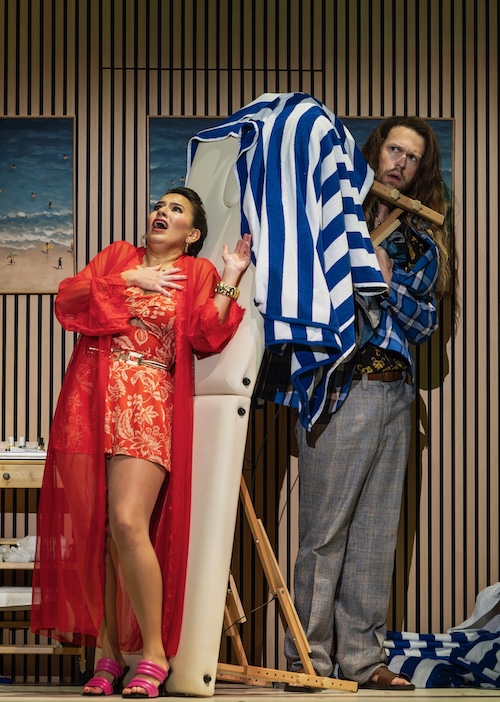
Verdi’s Falstaff of 1893 is a bona-fide masterpiece. Antonio Salieri’s stage work of the same name, composed nearly a century earlier, is a droll, lighthearted blend of Italian opera buffa and Viennese late-classicism, with no pretensions to greatness.
As long as you don’t draw pointless comparisons between two such fundamentally different pieces, you will find much to enjoy in the sparkling Chicago premiere of the Salieri Falstaff that Chicago Opera Theater opened at the Studebaker Theater Wednesday night.
The tuneful entertainment updates the Shakespearean comedy of The Merry Wives of Windsor to a modern-day “Windsor Resort,” a leafy spa where Falstaff—here, a vain, fatuous lowlife given to picking pockets—puts the moves on female guests, perhaps less for carnal sport than to gain access to their rich husbands’ wallets.
As executed by a terrific young vocal ensemble, supported by crisp conducting and orchestral playing, the updating by stage director Robin Guarino and her crack production team is clever without calling unwanted attention to its cleverness.
The basic plot elements are there—the merry wives Mrs. Page and Mrs. Slender scheme to give their would-be seducer his comeuppance—but dressed up in contemporary contrivances such as pot-smoking and cross-dressing. Gone from Carlo Prospero Defranceschi’s libretto are the young lovers Anne (Nannetta in the Verdi) and Fenton, and there is no Mistress Quickly. The Windsor Forest masquerade becomes, in Falstaff’s mind, a marijuana-induced bad trip.
So skewed has been our estimation of Salieri’s gifts as a composer by the play and film Amadeus that it will surprise many audience members to discover what an inventive delight his score is. Many passages sound like they could have been composed by Mozart, even if they lack the latter’s emotional depth. The five main characters are nicely characterized through their music. Salieri’s colorful music enables the action to move briskly and pointedly, with dry recitatives driving home key narrative elements (fine work from Yasuko Oura at the harpsichord continuo).
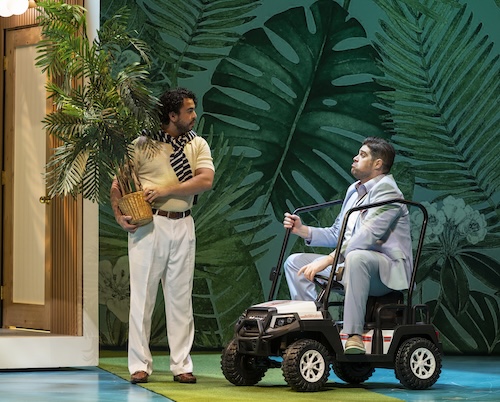
In her COT podium debut, singer-turned-conductor Christine Brandes brought her considerable expertise in the Baroque and Classical repertory to bear on her interpretation, supporting the singers through crisp pacing, adroit balances and a respect for this Falstaff as a light entertainment very much of its time and place—there was no attempt to turn it into something it is not. The orchestra played beautifully for her, the tangy woodwinds in particular.
It was hard to imagine a better cast than the group of fresh, engaged young voices COT assembled for this occasion. All contributed lively characterizations, boasted excellent Italian diction, and interacted with a vivacious sense of how each fit into the comic drama of jealousy and reconciliation.
Turning the Bard’s fat knight into a reasonably attractive young lothario was a smart touch, and the robust baritone Christian Pursell as Falstaff earned one’s sympathies as he suffered multiple indignities at the hands of the merry wives, including being dunked in an offstage swimming pool. (“Who invited that slimeball?” sneered one of the resort guests, per Cori Ellison’s slangy translation in the surtitles.)
Vanessa Becerra and Tzytle Steinman were also wonderful as the merry wives Alice Ford and Mistress Slender, respectively. As the carefree sparkplug of the deception, Becerra got to display the richness and range of her soprano in her “Come scoglio”-like opening aria. She also made much of the scene in which she visited Falstaff dressed as a German girl speaking a comic mixture of Italian and German.
Andrew Morstein brought genuine Italianate timbre and technique to Master Ford. With a secure high extension, his sweet, agile, perfectly placed tenor was heard to moving effect as the character lamented his wife’s supposed infidelity—thrilling in his mock-rage aria later on. The sturdy baritone Laureano Quant had less to sing as Master Slender but he, too, was in healthy vocal fettle and fully in the dramatic picture.
Both Peter Morgan (Bardolfo) and Denis Velez (Betty) made the most of their supporting roles, particularly bass-baritone Morgan as Falstaff’s pothead of a servant, his intriguingly dark, sappy voice a great pleasure to listen to.
The set pieces of scenic designer Andrew Boyce were moved around by choristers with reasonable precision, although making Falstaff’s room at the resort a cramped utility closet made no dramatic sense.
Chicago Opera Theater’s Falstaff will be repeated 3 p.m. Saturday and Sunday at the Studebaker Theater. cot.org
Posted in Uncategorized
Leave a Comment


 Subscribe via RSS.