CSO opens a chilly new year with warming comfort food of Beethoven and Bruckner
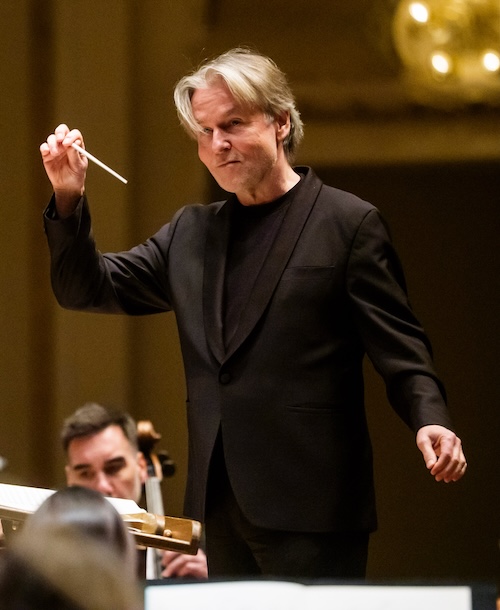
As the single-digit winter freeze continues in Chicago, there is something welcoming about a meaty, center-cut serving of Austro-German repertoire.
Back in town following a West Coast tour led by Riccardo Muti earlier this month, the Chicago Symphony Orchestra belatedly opened its 2026 concerts at home with music of Beethoven and Bruckner making up the bill of fare.
Thursday night’s concert was conducted by Esa-Pekka Salonen in the first of the conductor’s two consecutive CSO weeks. Yet the emphasis in the first half was, inevitably, on Daniil Trifonov as solo protagonist in Beethoven’s Piano Concerto No. 2.
The celebrated pianist’s CSO programs to date have tended to concentrate on showy blockbuster Romantic concertos by Brahms, Rachmaninoff and Mason Bates—works in which Trifonov’s power and astounding virtuosity can be given full rein.
Beethoven’s Op. 19 showcased a different but no less impressive side of the pianist’s artistry. The composer’s Second Piano Concerto—the first to be written but second to be published—is the most Classical of Beethoven’s seven works in the genre. While there are fleeting glimpses of the striding iconoclast to come, the concerto largely inhabits a more gracious, even Mozartean style of the late 18th century.
Set up nicely by Salonen’s trim introduction, Trifonov kept his playing in an idiomatic scale apt for this early Beethoven work, never attempting to inflate the concerto beyond its dimensions. Yet even within his clarity and light-fingered touch, Trifonov managed to provide some individual backspin, as in a forthright cadenza and the extra bit of insistent edge in accents and running passages.
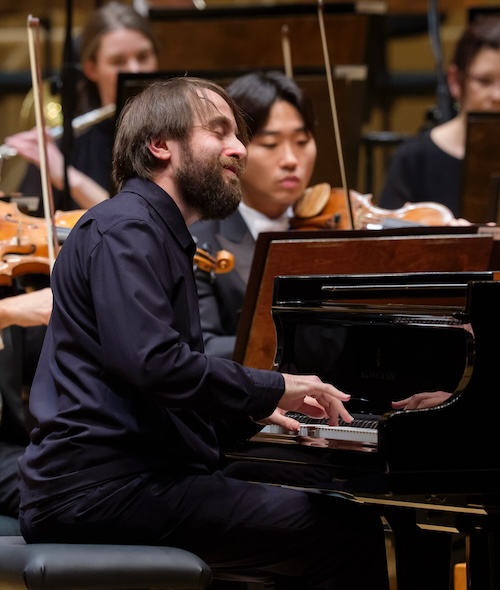
with the CSO Thursday night. Photo: Todd Rosenberg
Trifonov played the limpid main theme of the Adagio with a poised expression and luminous tone that underlined the melody’s folk-like simplicity, with a nice, lingering rubato in the closing section. The pianist brought bristling incisiveness to the finale’s off-the-beat main theme, slightly spacing his quiet final notes before the buoyant coda. Salonen and the orchestra provided their star soloist with refined and simpatico accompaniment.
The ovations brought Trifonov back out repeatedly until he sat down for an encore. This week’s concerts are the pianist’s only Chicago appearance this season, and Trifonov’s encore of Osvaldo Golijov’s Levante offered the pianist’s many local fans some of his patented razzle-dazzle. Trifonov threw off this four-minute showpiece with syncopated swagger, apt Latin flavor and flame-throwing virtuosity in a tour de force bonus.
For most of the past century Bruckner’s Symphony No. 4 (redundantly titled “Romantic” by the composer) was his most performed work, thought in recent decades it seems like the Seventh Symphony has taken that mantle. Still, the melodic riches and more concise length (by Bruckner standards) of the Fourth help to maintain it as the gateway drug of choice for Bruckner aficionados.
Esa-Pekka Salonen’s forays into Bruckner have been selective over his career and rare in Chicago. A Seventh Symphony with the CSO in 2011 was the conductor’s only previous local Bruckner outing.
As was the case 15 years ago, there was much to admire in Thursday evening’s performance of the Fourth Symphony. Salonen’s balancing was exemplary even in Bruckner‘s most cacophonous passages and his direction and pacing typically clear and purposeful. The conductor knew where he wanted to go in each of the four movements, and held the broader architectural span of the 66-minute journey in view. Climaxes were duly imposing and brass tuttis daunting in their sonic blasts.
And yet. While there was greater fire and more excitement than in Salonen’s 2011 Bruckner outing—and his 1998 recording of the Fourth with the Los Angeles Philharmonic—the Finnish conductor remains a cool and rather technocratic Bruckner interpreter.
Yes, there was ample brassy power and the performance built to a majestic coda with cumulative weight and impact. But powerful brass and volume are only half the story in Bruckner’s music.
In the middle movements, especially, Salonen’s clear-cut style seemed most wanting. The Alpine idyll of the Andante requires something deeper and more spiritual than boldly outlined structural facility. The Scherzo had a nice revisionist touch—more darkly driven than the usual chivalric pomp—but Bruckner’s repetitions soon began to pall. (When you find yourself thinking, “I thought we already heard the last repeat of the trio,” something is amiss.)
The spiritual quality may be subtle in this music but it is an essential element if Bruckner’s vast canvases are not to come off sounding prolix, superficial and overblown. It was that element that was largely missing in action Thursday night.
Even with reservations, this performance served to show that the CSO’s Brucknerian bona fides remain in impressive fettle, even if the opening horn solo lacked something in mystery and atmosphere. Among the crucial contributions was the playing of the brass section en masse, the evocative dynamics and intensity of timpanist Vadim Karpinos, and unfailingly sensitive and expressive playing from guest flute Chelsea Knox, principal of the Metropolitan Opera Orchestra.
The program will be repeated 7:30 p.m. Friday and Saturday and 3 p.m. Sunday. cso.org
Posted in Uncategorized
4 Responses to “CSO opens a chilly new year with warming comfort food of Beethoven and Bruckner ”
Leave a Comment

 Subscribe via RSS.
Posted Jan 30, 2026 at 2:45 pm by Peter Borich
It is amazing that one of the great Bruckner orchestras in the world barely plays his music anymore, and when it actually does, half the principals are AWOL.
Having said that, Thursday night’s performance was simply superb. Bravo!
Posted Jan 30, 2026 at 3:14 pm by Mike Fischer
Teng Li seemed surprised and borderline bashful when Salonen signaled that she and the violas should stand and be acknowledged Thursday night. She shouldn’t have been. The viola is crucial to this piece — not least in helping establish the spiritual dimension alluded to in the review. She and they channeled it, movingly. We are so lucky that she has made the CSO her home.
Posted Feb 02, 2026 at 9:16 am by John Humanski
I attended the Friday night concert, seated in the terrace. I concur with Mr. Johnson’s review.
I am not a piano aficionado, but I was very impressed with Mr. Trifonov’s technique. Both soloist and orchestra worked well together.
As for the Bruckner, it was a lot of good to great moments but there was a lack of cohesion between them. My concert-going partner and I both agreed that it was not a good interpretation. Odd tempi changes had us scratching our heads.
All sections of the orchestra shined. The brass in particular were in fine form, no surprise. Kudos to Mark Almond – his revelatory playing enlisted handshakes from several of his colleagues at the end of the performance.
Hopefully this is an audition for Chelsea Knox. She was splendid.
Posted Feb 04, 2026 at 6:15 pm by John Schroeder
The Salonen recording of the Bruckner 4th with the LA Phil is outstanding. I heard the live performance, before it was recorded, and hoped for a recording. Nothing beats a live performance, but a recording is a nice souvenir.