Glover leads MOB in a program of Mozart and Bach en famille
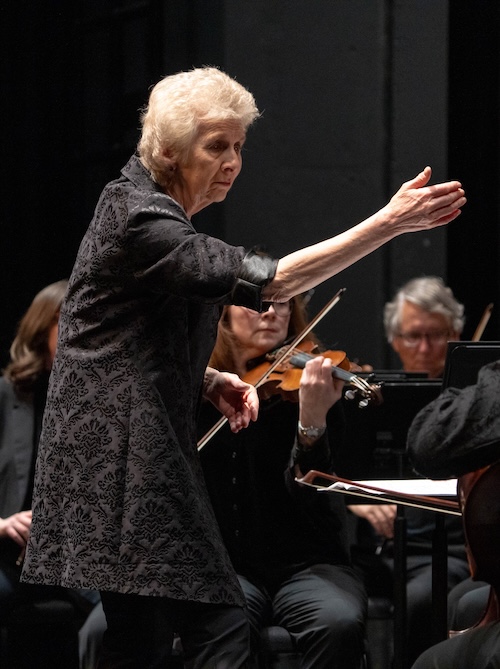
Music often runs in the family. Saturday’s Music of the Baroque program at the Harris Theater offered a view of two of the most prominent historical instances of this truth, pairing works of Mozart with his father Leopold, and Bach with his son Carl Philipp Emanuel.
Leopold Mozart’s Symphony in F is scored for strings, two horns, and continuo, and each of its three compact movements follows a single affective thread. The outer Allegros project a bucolic hunting atmosphere punctuated with horn calls, framing a more wistful, slightly tentative Andante. The music is comely enough but certainly needs a little help, which it received from Glover, who emphasized the few and fleeting moments of contrast.
The Flute Concerto No. 2 in D Major by Mozart fils began life as an oboe concerto. While it was known that Mozart had written an oboe concerto for Salzburg virtuoso Giuseppe Ferlendis, this work was considered lost for the entire 19th century. The 1920 discovery of a set of parts of the Oboe Concerto in C Major in the Salzburg Mozarteum archives led to the conclusion that Mozart had reworked this original 1777 score into a flute concerto a year later to satisfy part of a commission from the Dutch flutist Ferdinand Dejean, transposing the music up a whole step and making minor alterations to the solo part to better suit the instrument.
Whatever Mozart’s original intentions, this sunny score was an ideal vehicle for flutist Demarre McGill’s MOB debut. Principal flute of the Seattle Symphony, McGill played with a resonant, gleaming tone and was fully in sync with the work’s comic sensibilities. He danced with untroubled fluency through the Allegro aperto, with Glover lending conversational support from his colleagues. McGill was attentive to the fleeting shadows of the operatic Adagio, contrasting darker timbral hues with glowing moments in this sustained aria, before dashing off the effervescent acrobatics of the closing Rondo-Allegro with ease.
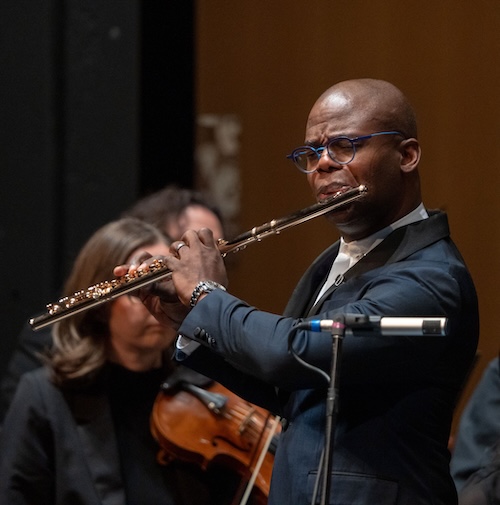
McGill was back after intermission for the Flute Concerto in G Major of C. P. E. Bach, another substantial concertante work rich with Classical grace, though without the pathos that typifies Mozart. McGill brought the same virtuosic poise to the Allegro di molto, and plumbed his rich low register to great effect in the focused expression of the Largo. The closing Presto was fleet and angular, though by this point the overgenerous helping of 18th-century flute writing began to wear thin.
The evening closed with Bach’s Orchestral Suite No. 4 in D Major, BWV 1069. Glover led an expansive introduction to the Ouverture, and brought propulsion to the bounding triplet figures of its central section, adorned with gleaming trumpets and piping oboes. The Bourées were light on their feet, with guest principal bassoon Galina Kiep providing assured support to her double reed counterparts. Glover led a gallant Gavotte and courtly Menuets, before closing with the night with the ebullience of the final Réjouissance.
Ultimately, one was left with a sense of two different sorts of father-son relationships. Creatively speaking, C. P. E. Bach clearly felt his father’s influence, but moved on from it in a generative direction of his own, much as one would hope in any parental context. Juxtaposing Wolfgang’s brilliance with his father’s pallid composition, as was done Saturday, tells a different story, one of a son surpassing his father in an oedipal rout.
The program will be repeated 7:30 p.m. Sunday at the North Shore Center for the Arts in Skokie. www.baroque.org
Posted in Uncategorized
Leave a Comment


 Subscribe via RSS.