Strong voices, conducting deliver a superb “Salome” at Lyric Opera
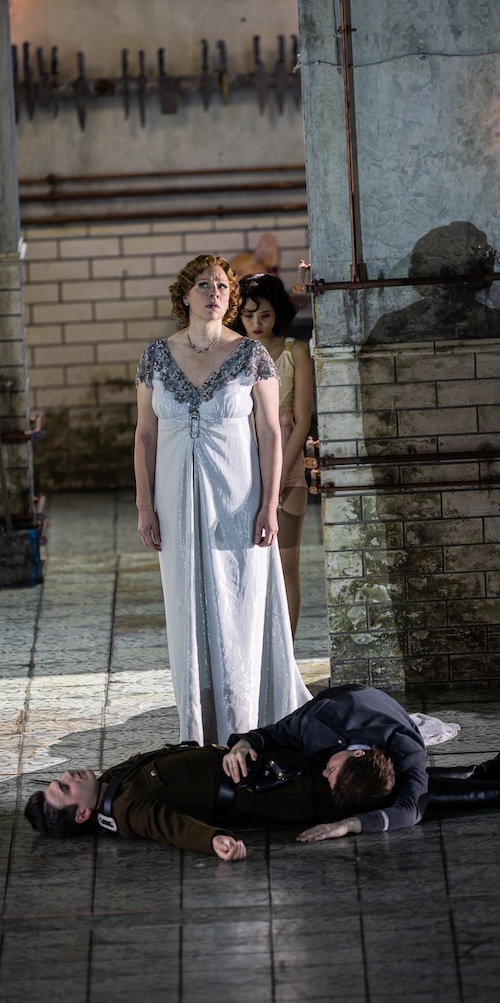
Who says Salome has lost the capacity to shock in 2026?
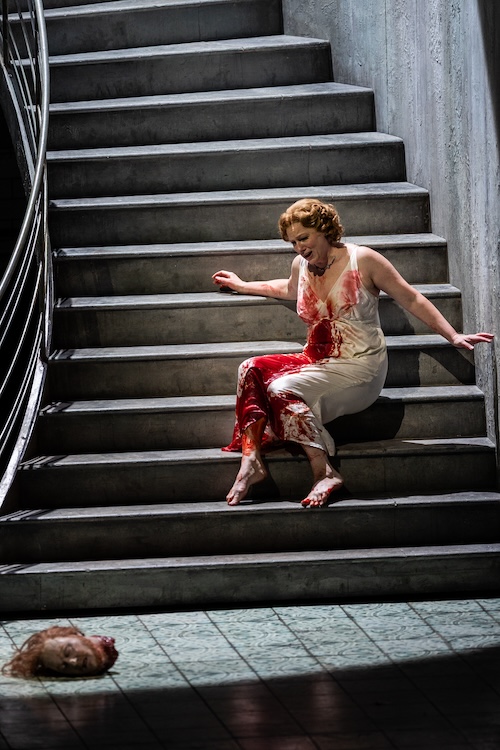
At Lyric Opera’s opening performance at the moment when an executioner presents the bloody decapitated head of John the Baptist, a man in my row loudly shouted,“No!!”
That vocal audience member may have been new to Salome—and perhaps opera as well—but it’s heartening to know that Strauss’s lurid opera can still pack a punch for the uninitiated.
Richard Strauss’s 1905 one-act returned to the Lyric boards Sunday afternoon after an absence of 20 years. And, as if Salome isn’t tricky enough to pull off, practical difficulties made things even dicier—late substitutions in the intensely demanding title role as well as the key role of Herod.
Yet despite the backstage drama, a strong cast and impressive conducting debut largely delivered the Straussian goods.
Adapted from Oscar Wilde’s forgotten French play, Salome proved an international scandal following its 1905 premiere—as much for its sexual frankness and aura of decadence as the chromatic, tonality-pushing nature of Strauss’s modernist score. The opera was initially banned in England and the Met premiere was abruptly cancelled after a single performance, with the opera not being revived at the house for 27 years.
The scenario spins off the biblical tale of the title Judean princess whose dubious upbringing by her unhinged stepfather Herod and equally winsome mother, Herodias, has produced a spoiled offspring of similarly unbalanced psychology. Salome becomes fascinated by the imprisoned John the Baptist (Jochanaan), whom she tries unsuccessfully to seduce, callously causing the suicide of her admirer Narraboth in the process. Incensed by Jochanaan’s vehement rejection, Salome tricks Herod into executing the prisoner by sensually dancing for him in exchange for killing the prophet and serving his severed head to her in a silver charger (plate, not Dodge).
Salome is one of the most difficult roles to cast in the repertoire, calling for a soprano with a voice powerful enough to soar over Strauss’s large orchestra yet still be physically graceful and dramatically credible as a young girl.
The scheduled Elena Stikhina bowed out of the title role due to her pregnancy, and was replaced by Jennifer Holloway.
Holloway, who sang the title role in Samuel Barber’s Vanessa with the Boston Symphony Orchestra earlier this month, proved an admirable exponent of the demanding title role. Ideally, the role calls for a voice of greater power than Holloway possesses, and that lack of tonal opulence (and a fitfully wide vibrato) was felt at times in the long final scene. Still, the soprano largely displayed vocal strength and flexibility, and was able to ride the punishing lines of Strauss’s score with facility. Holloway handled the dramatic demands of the staging capably and brought uninhibited relish to the final scene with her uninhibitedly lascivious kissing of Jochannan’s head.
No reservations need be made for the performance of Nicholas Brownlee as Jochanaan. Even singing offstage from the “underground cistern,” Brownlee’s huge bass-baritone made a resounding impact. The young singer completely inhabited the role of the half-crazed holy man, spitting out his denunciations of Herodias with venomous scorn, yet bringing spiritual nobility to his prophecies of the coming of the Lord. Brownlee also coped gamefully with the excessive pushing and shoving to the ground of Jochanaan by the Israelite soldiers.
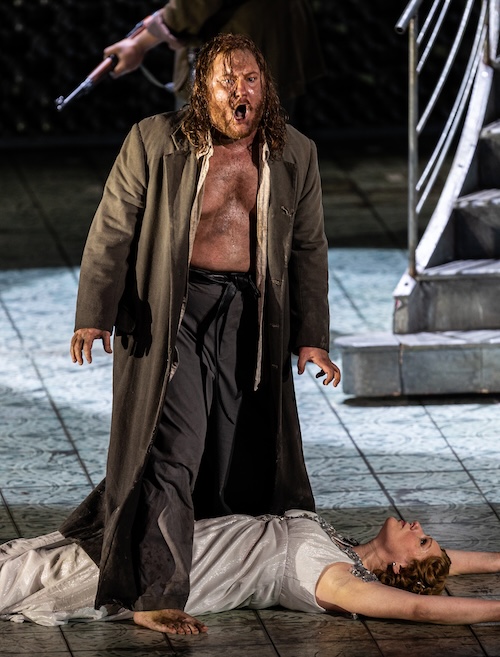
Booking Brandon Jovanovich for the role of Herod looked like a bit of luxury casting. Unfortunately, the American heldentenor exited the production at the start of rehearsals for “personal reasons.”
Alex Boyer proved an excellent replacement as the corrupt king of Israel. Despite the rather simplistic staging with Herod as a smug, tuxedoed capitalist, Boyer sang with a penetrating tenor and conveyed Herod’s capricious, unbalanced nature, not least his perving on his young stepdaughter.
Tanja Ariane Baumgartner was similarly inspired as Herodias, his equally odious spouse. The German singer was elegant in her formal gowns and sang with a rich mezzo-soprano.
As the lovelorn Narraboth, Ryan Capozzo brought a vibrant and youthful tenor to the ill-fated soldier.
Other standouts among the large cast were Aleksey Bogdanov as a sympathetic, imposingly sung First Nazarene; mezzo Catherine Martin as a rich-toned Page; and Scott Conner and Christopher Humbert Jr. as stentorian-voiced Soldiers. The quintet of Jews was less caricatured than usual and sung with lively disputation by Bille Bruley, Travon D. Walker, Daniel Luis Espinal, Zhengyi Bai, and Benjamin R. Sokol.
Revival director Julia Burbach capably helmed the David McVicar production with some jarring lapses. The opening scene was so darkly lit and confusingly blocked that it was difficult even for Strauss aficionados to identify the characters amid the murk.
Worse yet, Burbach wholly botched the crucial suicide of Narraboth by throwing it away upstage in the shadows while Salome and Jochanaan are actively engaged at the front. The result was that most of the audience appeared to miss it—feeling much like Herod when he asks “What is this body doing here?”
McVicar’s grim modern-dress staging was the British director’s usual mixed bag with a split-level set and long winding staircase. After serving as space for Herod’s swanky dinner party, the top half was under-utilized, while the granite main part of the stage suggested the lower level of one of the Grant Park parking garages.
Still, the production proved largely serviceable, except for the opera’s most celebrated scene, the Dance of the Seven Veils. The staging attempts to deconstruct Salome’s mind with the character stepping through a series of cascading frames painting her psychic devolution and ending with her compulsively washing herself. (New video images added little.) The result proved ineffective, overly complicated, and wholly unerotic. Sometimes less is more. The visual of a white-gowned Salome and tuxedoed Herod dancing together like Fred and Ginger in hell was a bit of unhelpful McVicar kitsch.
The only nudity in the staging came not with Salome’s dance but with the executioner in the climatic finale, a stocky naked man who descends to decapitate Jochanaan, later emerging covered in blood (as well as dispatching Salome at the curtain), another bit of dubious McVicar camp.
The unsung star of this performance was conductor Tomáš Netopil who was making his Lyric Opera debut. Chief conductor of the National Theatre in Prague since 2010, the Czech conductor led the clearly engaged Lyric Opera Orchestra members (plus extra musicians) in an extraordinary performance of Strauss’s roiling score that moved with crackling momentum and incisive dramatic impact.
At times one wanted a bit more of Strauss’s brilliance and brassy edge to emerge from the string-dominated textures. That apart, Netopil’s meticulous balancing allowed one to notice crucial scoring details usually missed—the subtle organ tones in the final scene or the bit of celesta when Herod creeps on the little bite-marks that Salome’s teeth will leave in a fruit.
Salome runs through February 14. lyricopera.org
Posted in Uncategorized
One Response to “Strong voices, conducting deliver a superb “Salome” at Lyric Opera”
Leave a Comment

 Subscribe via RSS.
Posted Jan 31, 2026 at 12:41 pm by Evan
I saw the Thursday evening performance and second the praise for Nicholas Brownlee. The production and direction, though, undermined the strong singing. I’ll just echo Mr. Johnson about the opening scene – it was blocked so incompentently that it was often hard to know who was singing (the pointless crossdressing didn’t help on this front).
I thought the Dance was not just unerotic but sinister, transposed from the banquet to a bizarre sequence of Blackshirt torture chambers. And the simplistic choreography totally inverted the scene’s agency. What was an anguished seduction was now a straightforward assault. Burbach evidently refused to see Salome as anything more than a victim of her stepfather.
A side note: at least in my section, there was chattering and laughter at almost any mention of a body part and any unironically passionate line of text–like elder millennials watching modernist opera through a Marvel’s Avengers lens. Bleak.