Trio Mediæval brings glowing warmth to ancient music
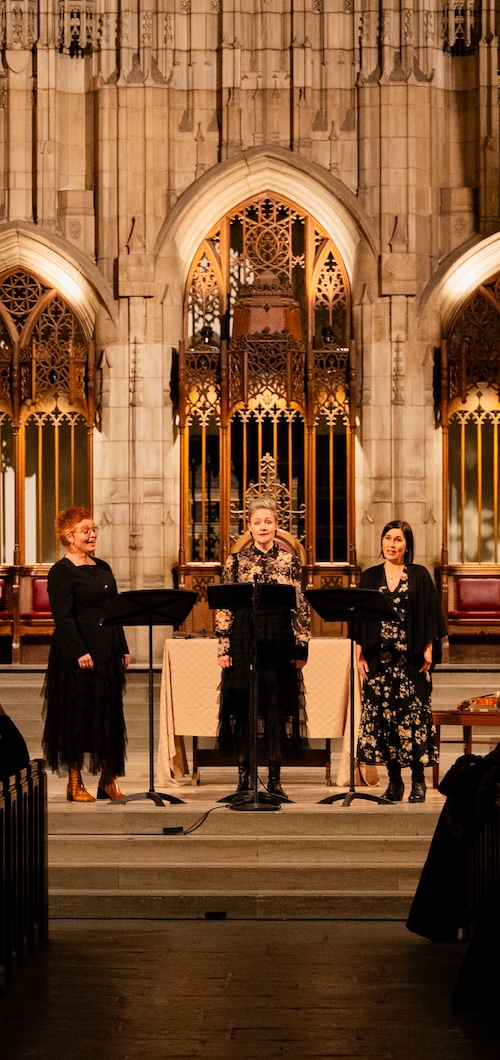
It’s a testament to Chicagoans’ love of classical music and the drawing power of Trio Mediæval (singers Anna Maria Friman, Linn Andrea Fuglseth, and Jorunn Lovise Husan) that the pews were full at their concert at Rockefeller Chapel on Friday night, despite outside temperatures reaching -25ºF with wind chill.
The program from the trio—currently the Don Michael Randel Ensemble-in-Residence at the University of Chicago—was titled “Between Two Worlds: On the Cusp of the Ars Nova.” This describes the evening’s main piece: the Messe de Tournai, a 14th-century French mass compiled from a selection of pre-existing settings of each movement. As the concert’s title indicates, some of these settings reflect the ars antiqua style of the 13th century while others are more in line with the burgeoning ars nova of the 14th century.
The trio’s performance of the mass was filled with tight ensemble rhythms and a wide dynamic range. Their playful darting through the syncopations in the Kyrie had an almost jazzy bounce to it that contrasted with their earnest and direct delivery of the Sanctus. They modulated their timbre in the Gloria so that the counterpoint sounded at times like bells tolling and at other times like a chorus of chirps.
Rather than singing the mass straight through, Trio Mediæval interspersed it with other songs. Most of these were taken from Hildegard of Bingen’s anthology Symphonia armonie celestium revelationum.
Whereas all other items on the program were performed a cappella by all three singers, most of the Hildegard songs were sung as solos, accompanied by different combinations of instruments. Friman played the Hardanger fiddle (a Norwegian folk violin), Fuglseth played the shrutibox (a portable Indian harmonium), and Husan played the MelodyChimes (a contemporary type of bell).
Contrasting with the polyphonic pieces on the program—which call for small vocal ranges and set short, common texts—the Hildegard songs are rangy, rhapsodic settings of long, idiosyncratic poems. All three singers seemed to relish the opportunity to flawlessly execute the vocal acrobatics that Hildegard demands.
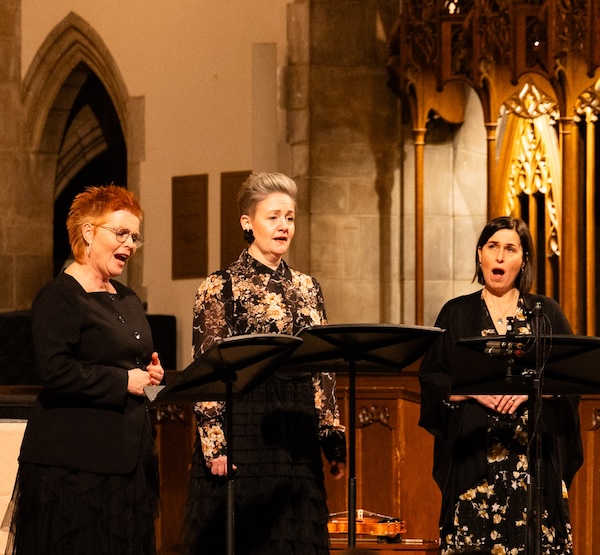
In the middle of the concert, the Trio Mediæval broke from their habit of hopping from piece to piece to instead sing four excerpts in a row from a single source: the Berkeley Castle collection of motets and sequences. These performances were “in the middle” not only chronologically, but also spatially, as the trio left the choir and sang in the nave instead, arranged in a triangle formation.
This created an entirely different tone color. When they sang from the choir, their voices frequently seemed to merge into one. But at such close range, one could continuously hear the differences between their individual timbres, making them sound like three soloists.
Rounding out the program were three contemporary pieces written specially for Trio Mediæval. Two of these were chant settings of Ave Maris Stella and Regina Caeli, arranged by Andrew Smith. Both arrangements begin with straightforward monophonic deliveries of the chant melody, before introducing crunchy three-part harmonies (peppered with major and minor seconds) of the kind one encounters only in contemporary choral music. The closing piece of the concert was the final movement, Benedicamus Domino, from Gavin Bryars’s A Worcester Ladymass, which is recognizably a modern pastiche of the medieval style.
The choice to include these pieces worked on two levels. On the one hand, this contemporary sound world contrasts with the world of most of the other music they performed. On the other hand, the Messe de Tournai has its own startling sonorities—chord progressions that were allowed by the implied rules of ars nova counterpoint, but would soon disappear from Western art music until the 20th century. Juxtaposing the contemporary music with the mass brought out these unexpected connections between the medieval and the modern.
As an encore, Trio Mediæval sang an excerpt from their 2007 album of Scandinavian folk songs: Tone Krohn’s arrangement of the wedding march “Bruremarsj fra Gudranbsdalen.” The multiple passes through the repetitive melody served as yet another demonstration of the many subtle variations in articulation and dynamics the trio is capable of producing.
The UChicago Presents series will continue 7:30 p.m. February 6 in Mandel Hall, with musicians from the CSO playing contemporary music inspired by climate change. chicagopresents.uchicago.edu
Posted in Performances
Leave a Comment

 Subscribe via RSS.