Trio Seoul debuts at Winter Chamber Fest with weighty program
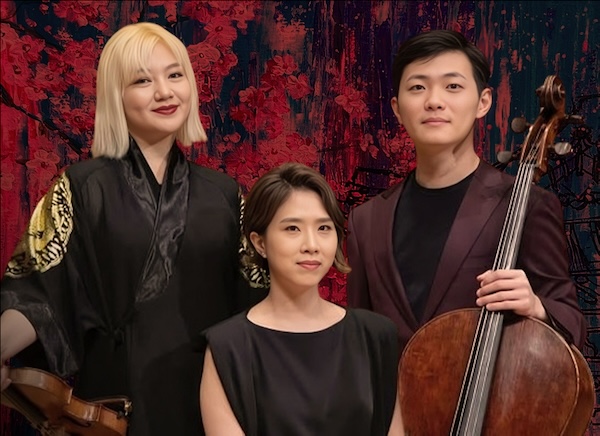
Trio Seoul made a superb debut at the Winter Chamber Music Festival Sunday afternoon at Pick-Staiger Concert Hall. Founded in 2022 by violinist Jinjoo Cho, cellist Brannon Cho, and pianist Kyu Yeon Kim, the ensemble has multiple ties to the presenter, Northwestern University: Brannon Cho is an alum, and Jinjoo Cho is the Bienen School of Music’s newest violin faculty member, hired in 2024.
At the heart of the program were two works that contemplate grief: Juri Seo’s July Mountain and Franz Liszt’s Tristia (after Vallée d’Obermann). Korean-born American composer Juri Seo composed July Mountain in response to the 2024 Jeju Air crash, which killed all passengers and crew on board, an event that deeply affected the composer.
Seo invokes a different plant for each of the three movements as a reminder of the cyclical nature of life. The first movement, “Metasequoia,”captured the grand scale of the redwoods in its declamatory opening with stacked fifths in the piano and long, sustained drones in the violin and cello. The movement was an exploration of contrasts, alternating between athletic, physical playing and intense stillness. The second movement, “Golden Bells,” was a short character piece, featuring string harmonics and tinkling piano that evoked the cacophony of birds at dawn. While dramatically effective, the high harmonics verged on screechy at times.
The third movement, “Sonamu”(Korean red pine) was more folk-like in character, yet no less emotionally weighty. A mournful duet between the cello and violin cast a haunting pall for the strikingly still ending.
In the program note, Seo is quoted as saying, “July Mountain is summer music composed in winter.” Given the frigid temperature on Sunday afternoon, one could definitely feel the winter chill in the piece, though the promise of warmth was harder to believe.
Liszt’s Tristia (after Vallée d’Obermann) is a piano trio arrangement of Vallée d’Obermann, the sixth piece of Liszt’s piano collection Années de Pèlerinage. This final version of the arrangement dates from 1880, when the composer was nearing 70 and increasingly contemplating his own mortality.
The work began in a mood of melancholy stillness, similar to the ending of July Mountain. Yet here, the piano played more of an accompanimental role than in the Seo, while the violin and cello took on more soloistic functions as they passed the melody between each other. Highlights included an incandescent violin solo by Jinjoo and virtuosic playing from Brannon, who had been more in the background until this point. Led by Jinjoo’s engaging physicality, Trio Seoul’s playing was expressive but never overwrought, and the climaxes of the piece were well paced. However, their intonation and blending became slightly less pristine in the concluding agitato section.
After these two emotionally hefty pieces came Ravel’s Piano Trio in A Minor, a shimmering, exotic dreamscape composed amid the onset of World War I. Ravel’s transparent textures were refreshing after the density of the Liszt, although some of the muscularity from the Liszt seeped into the trio’s interpretation of the Ravel. The charmingly snappy pizzicatos of the second movement, “Pantoum,” provided a nice textural contrast, and the muted cello and violin duet in the stately third movement (“Passacaille”) was especially poignant. Kim’s feathery keyboard arpeggios were well balanced with moments of power and heft in the rhapsodic finale.
Fortunately, the program was not all emotionally wrought. The concert opened with Haydn’s intimate Piano Trio No. 39 in G Major (“Gypsy”). The only balance issue of the afternoon came in the first movement, when the piano overpowered the violin in their frequent doubling passages. Phrasing and dynamic shapes were sensitively rendered throughout, and the spirited “Gypsy Rondo” finale was charmingly rustic.
The Winter Chamber Music Festival continues with the Isidore Quartet 7:30 p.m. Friday at Northwestern University’s Pick-Staiger Concert Hall. The program includes Haydn’s String Quartet Op. 76, no. 4 (“Sunrise”), Ligeti’s String Quartet No. 2, and Brahms’s String Quartet No. 3. music.northwestern.edu
Posted in Uncategorized
Leave a Comment


 Subscribe via RSS.