Huff leads Lakeview Orchestra with assurance in ambitious Nordic program
When Gregory Hughes announced last summer that he was stepping down as artistic director of the Lakeview Orchestra, he set the bar high for his successor. The ambitious non-professional orchestra likes to tackle big, challenging repertoire, and Sunday’s program at the Athenaeum Center was no exception.
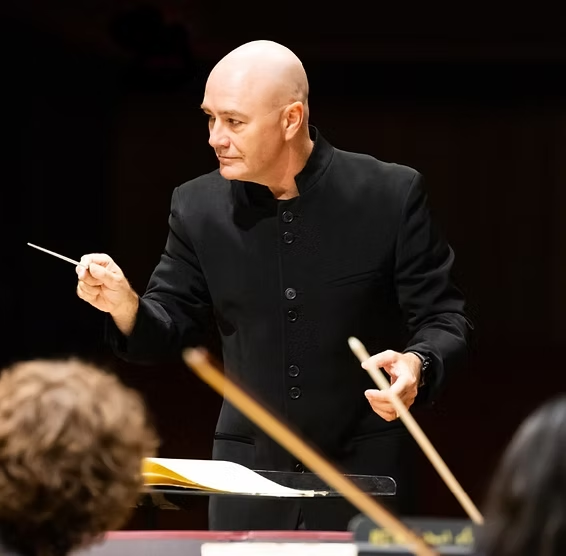
Silas Huff—the second candidate of three finalists to audition for the director position—led a program featuring two epic Nordic works: Jean Sibelius’s Violin Concerto and Carl Nielsen’s Symphony No. 5.
No stranger to Illinois, Huff served as director of orchestras at Northern Illinois University until 2025. He currently acts as visiting director of orchestras at the University of Texas and music director of the Clinton Symphony Orchestra in Iowa. In 2011, he secured a position as a US Army music officer, which involved conducting concerts at high-profile venues across Washington, DC. Huff brought this military precision to his conducting on Sunday, leading the ensemble with clarity and steady assurance.
The program opened with Samuel Coleridge-Taylor’s Overture to The Song of Hiawatha, a melodically appealing piece of late Romanticism. In the overture’s atmospheric beginning, the strings and winds provided a lush bed of sound for harpist Jennifer Ruggieri’s dreamy arpeggios. The strings demonstrated a sonorous unison sound in the folksy main melody that followed, but this melody sometimes overshadowed the winds.
The set-up on the Athenaeum stage—a tight space for a nearly 70-piece orchestra—was largely to blame for this, as the strings were seated on the apron of the stage, while the winds and brass were placed far upstage behind faux stone pillars from a concurrent theatrical production.
Sibelius’s highly virtuosic Violin Concerto followed, featuring violinist Dylana Jenson. Jenson toured internationally as a soloist for 50 years but has turned most of her energies to teaching in recent decades, most recently serving on the violin faculty at the University of Notre Dame. There was much anticipation for her performance, as her 1980 recording of the Sibelius Violin Concerto with Eugene Ormandy and the Philadelphia Orchestra is considered a touchstone.
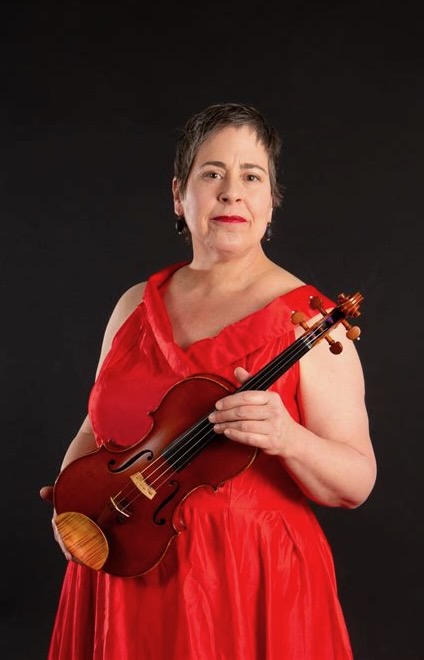
Jenson brought a gleaming tone to the melancholy opening melody, while the orchestral strings provided a quietly shimmering bed of sound underneath. After the heartfelt opening statement and luminous double stops, Jenson attacked the fiendishly difficult passagework with determination. Huff did well to keep the orchestra in balance and follow her throughout. Sometimes Huff and the orchestra could have better anticipated Jenson’s cadences and tempi, but any rhythmic untidiness was soon corrected.
As the concerto wore on, Jenson’s playing became a bit harried and muscular, losing some nuance in the virtuosic a capella passages. The soloist’s extensive retuning between movements indicated a degree of dissatisfaction or nervousness. That said, it was an impressive rendition of the technically and expressively demanding concerto.
The second half opened with Elena Sprecht’s We Will Soar, commissioned in 2020 to commemorate the 100th anniversary of the 19th Amendment. In a nod to Copland’s Fanfare for the Common Man, the hopeful work features an ascending three-note trumpet motto, depicting the title words. Following a poignant trumpet solo by Benjamin Siff, answered by the horns, colorful percussion added textural interest to the appealing score.
The next meaty piece on the program was Carl Nielsen’s idiosyncratic Symphony No. 5. While often ignored in the standard orchestral canon, Nielsen has found an advocate in the Lakeview Orchestra. In 2014, the orchestra presented the Chicago premiere of Nielsen’s opera Maskarade and has since played two other Nielsen symphonies (No. 2 and No. 4).
In his opening remarks, Huff connected the fraught context in which Nielsen wrote Symphony No. 5 to that of today. Composed just after World War I, the work captures the angsty, chaotic, unsettled feeling of the era. In the first movement, an extensive snare drum solo, in which the player is invited to go rogue and improvise, threatens to destabilize the orchestra, but their resolve to stay the course ultimately prevails over the one loud voice.
Huff and the Lakeview Orchestra took this dramatic and challenging piece by the horns, presenting a solid, committed interpretation. Principal percussionist Nathan Ankrom was steely in his determination to disrupt the orchestra in his snare drum solo. Other standout moments in the densely constructed first movement included a sonorous horn hymn and delicate interplay between pairs of wind instruments. A tender clarinet solo expertly rendered by Richard Zili closed out the first movement.
The second movement begins with a diabolical waltz reminiscent of Shostakovich. One could have done with a slightly leaner, more transparent string sound in the mournful lyrical section, and some of the loud sections were a bit overpowering in the small theater. However, difficult rhythmic cross-relations were well-negotiated, and the wind section was particularly tight throughout. The Lakeview Orchestra should be commended for its ambition and execution of this difficult, lesser-known repertoire.
Michael Lewanski, the final artistic director candidate, will conduct Shostakovich’s Symphony No. 1 April 12 at the Athenaeum Center. lakevieworchestra
Posted in Uncategorized
Leave a Comment


 Subscribe via RSS.