Illinois Philharmonic returns to form with inspired Schumann, concert rarities

In an Illinois Philharmonic Orchestra season with nearly as many pops programs as classical events, the southwest suburban ensemble returned to what it does best Saturday night in Palos Heights—an inspired performance of a cornerstone German symphony coupled with an exploration of distant corners of the repertoire.
But first, the not-so-good news. IPO executive director Christina Salerno opened the Valentine’s Day concert by addressing the impending closing of Trinity Christian College, the orchestra’s home base, this spring. While she assured the audience that the IPO’s three remaining season concerts will take place as scheduled at its usual home at Trinity’s Ozinga Chapel, she said the orchestra is exploring options for new venues in its 2026-27 season.
Ozinga Chapel is a fine concert hall with a decent acoustic, excellent sight lines and plenty of parking. Might some consortium of southwest arts organizations, area colleges, local townships and villages, and a few generous philanthropists come together to save this venue? It would be a shame if one of the few professional-grade performance spaces in the southwest suburban area wound up getting bulldozed for condos.
Saturday night’s concert led off with a real rarity, the Overture in C major by Fanny Mendelssohn Hensel. The music of Felix Mendelssohn’s talented older sister has been undergoing a revival in recent years. Writing privately and mostly in more intimate genres, her output includes three chamber works, 125 compositions for piano and over 250 songs, most of which were unpublished in her lifetime.
Fanny’s sole work for orchestra, the nine-minute Overture is well crafted and full of melody if fractionally overlong for its material. Stilian Kirov led the IPO musicians in a vital reading that put across the work’s engaging style. One can only imagine the music that Felix’s beloved sister might have written had she lived in a more enlightened era for women composers.
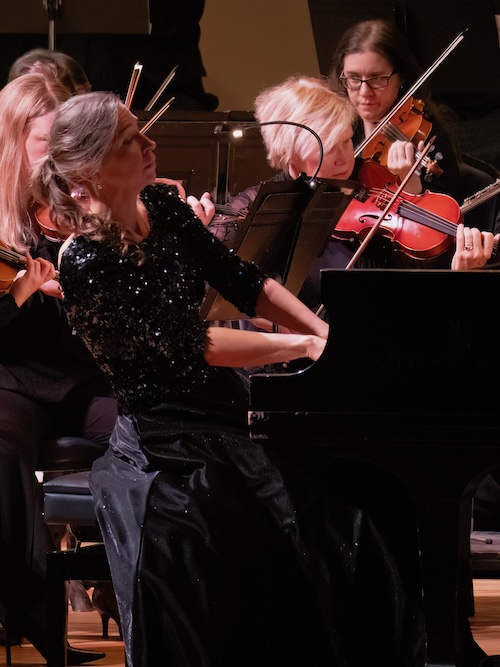
The orchestra’s centerpiece was rarer still, Selim Palmgren’s Piano Concerto No. 2 with Anastasiya Poff as soloist.
The obscure Finnish pianist, conductor and teacher (1875-1951) was also a prolific composer, writing five piano concertos, a violin concerto and over a hundred songs and vocal works.
Palmgren may have lived nearly into the rock era but his musical style harkens back a half-century or more to the Late Romantic style of Rachmaninoff. Subtitled “The River,” Palmgren’s single-movement concerto winds—like the Kokemäenjokihe River through the city of Pori that inspired it—through several varied passages in a concise 20-minute span.
The hushed, impressionistic opening was obliterated by an audience member’s loud and unmuffled hacking cough. The music soon accelerates into a scherzo-like section where Poff proved a fleet and nimble-fingered solo presence. The music continues in its amiable fashion, culminating in a big romantic melody, solo cadenza, and somewhat herky-jerky final section before a bravura coda.
There may be a masterpiece lurking somewhere in Palmgren’s oeuvre awaiting rediscovery but, on the basis of Saturday’s performance, this ain’t it. Palmgren’s Second Concerto is attractive in its light, rippling style but stronger on lyricism and atmosphere than structural rigor. His thematic material is engaging without ever quite being memorable—a kind of Rachmaninoff without the tunes.
Palmgren’s concerto might have made a stronger impact if it had a more assertive soloist. Poff, wife of music director Kirov, was a game protagonist, playing with consistent polish and technically immaculate throughout.
Yet her performance was sorely lacking in power and the kind of strong musical personality needed to make a convincing case for this uneven work. Poff was often inaudible whenever playing with orchestra and such bravura moments as the cadenza and final section were wanting in fire and virtuosity.
Still kudos for Kirov and the IPO for bringing us something different than the standard barnstorming keyboard warhorses.
The evening concluded with Schumann’s Symphony No 4.
The IPO’s music director is invariably at his best in Romantic symphonies and so it proved once again. Schumann’s Fourth Symphony (the second in chronological order) showed Kirov’s affinity for the composer in a skillfully directed and well-balanced performance.
The introduction to the opening movement was flowing and atmospheric, leading into the vital main section, aptly lively (“Lebhaft”) as marked. In the ensuing Romanze, Kirov drew out the folk-like essence of the main theme with gracious contributions by principal cellist Jacob Hanegan and concertmaster Azusa Tashiro.
Kirov deftly pointed the contrasts in the Scherzo between the vigor of the main theme and the nostalgic lilt of the trio section. The transition into the finale was surely handled, building anticipation from mystery to a majestic swing into the assertive main theme. The finale was spirited and exciting, well played by the IPO musicians, and culminating in an emphatic payoff of the final bars.
The Illinois Philharmonic Orchestra performs Dvořák’s Serenade for Strings and Vivaldi’s The Four Seasons with violinist Esme Arias-Kim March 14 in Palos Heights. ipomusic.org
Posted in Uncategorized
Leave a Comment

 Subscribe via RSS.