Salonen, CSO deliver masterful Debussy, compelling Smith concerto
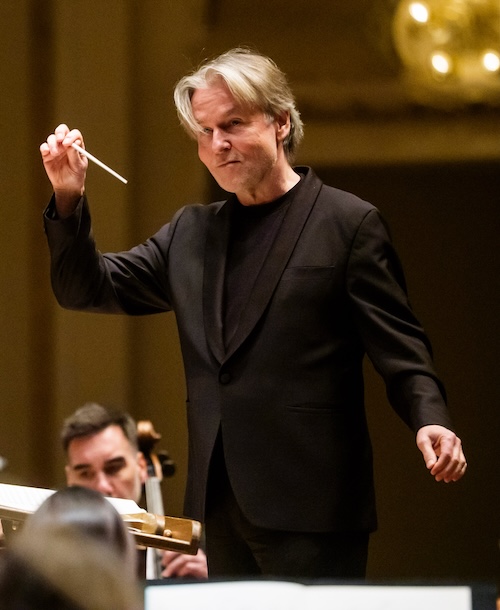
Unlike Mozart, Brahms or Beethoven, Claude Debussy rarely gets a symphonic program to himself—or even mostly to himself.
The Chicago Symphony Orchestra is bucking the trend this week with two-thirds of Thursday night’s concert, led by Esa-Pekka Salonen, devoted to Debussy and featuring his two largest works for orchestra.
Over a century after Debussy’s death, he remains one of the most individual stylists in musical history, a singular voice whose quietly revolutionary handling of harmony, scoring and tempo still sound like no one else. Though Debussy hated being called the first “impressionist” composer, it’s not an inaccurate term for his subtle, flowing, and allusive music. The French composer’s music often feel like aural counterparts of the great painters of his day, not least J.M.W Turner, who Debussy revered, calling the British impressionist the “finest creator of mystery in art.”
The evening led off with a rare complete performance of Debussy’s Images. This epic work is a kind of Russian Easter egg, composed of three separate individual works with “Iberia” further made up of three sections (the last two played without pause).
Salonen remains one of our finest Debussy conductors. He led a haunting, unforgettable concert performance of the composer’s opera Pelleas et Melisande with the CSO in 2015. Salonen’s Sony disc of Images and other Debussy works—recorded 30 years ago to the day!—remains a touchstone of the catalog.
Hearing Images complete in the hands of the CSO and an inspired Debussy interpreter like Salonen makes one appreciate the individual parts even more. “Gigues,” the opening section, was suffused with a pensive melancholy—sensitively conveyed by Scott Hostetler’s plaintive oboe d’amore solo—only partially dispelled by a Scottish folksong that builds to antic brass fanfares. Salonen and the musicians likewise conveyed the alternating playful and subdued qualities of “Rondes des Printemps” where Salonen’s precision and transparency allowed the interior expression to register in subtle hues.
Salonen moved “Iberia”—the centerpiece of Images—to last for a flashier, more effective finale to Debussy’s quasi-suite. Even with its passages of colorful scoring for castanets and tambourine, Debussy’s lively depiction of Spain never descends to pastiche. In the spirited opening section, Salonen nicely brought out the slightly subversive quality of the music and individual contributions shone from clarinetist Stephen Williamson and oboe William Welter, with a brief but impassioned viola solo by Teng Li.
The middle section of “Iberia” was duly atmospheric with Welter’s oboe solo fully conveying the nocturnal languor. Here too Salonen’s balancing allowed all the iridescent hues to register. The sashaying finale went with high-stepping idiomatic spirit. A slightly smudged final chord was a small blot on a richly idiomatic and beautifully played rendering of Debussy’s score.
The evening’s centerpiece brought Lost Coast by Gabriella Smith. The California composer’s 2023 work for cello and orchestra was inspired by a solo hiking trip that Smith took on the Lost Coast Trail in northern California.
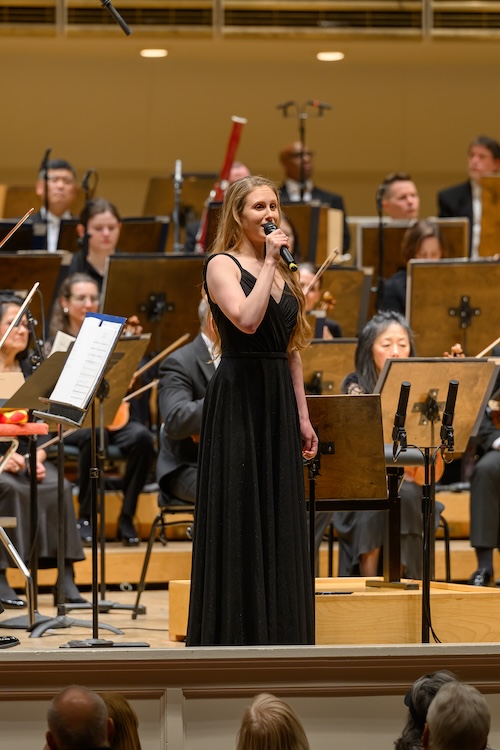
Smith was having an impressive night. At the same time the CSO was playing Lost Coast, the Boston Symphony Orchestra was performing Smith’s Bioluminescence Chaconne.
In a rare spoken introduction by a composer at a CSO concert, Smith decried the “criminally inadequate climate action from our leaders.” Likewise in the program notes she says Lost Coast was inspired by her “grief, loss, rage and fear experienced as a result of climate change.”
Cellist Gabriel Cabezas was the evening’s soloist. The Chicago native and friend of the composer is the dedicatee of Lost Coast and premiered the work in 2022, repeating it in 2024 with the New York Philharmonic, conducted by John Adams.
Like other Smith works, Lost Coast is cast in an edgy, rolling style with a strong metallic edge. Smith stated that the cello represents the trail and the orchestra reflects the surrounding nature elements, notably the high, rocky cliffs on one side and the ocean that fitfully comes crashing in on the other.
The cello begins the work with a quiet solo statement yet fragmented sounds by winds and brass soon enter, with swelling brass chords that seem to represent the rushing waves of the ocean. The orchestra is more or less on an equal footing with the soloist throughout, with striking brilliance in the ensemble music. There are prominent parts for two percussionists (the hard-working Cynthia Yeh and Vadim Karpinos) who played almost nonstop on a variety of unorthodox instruments.
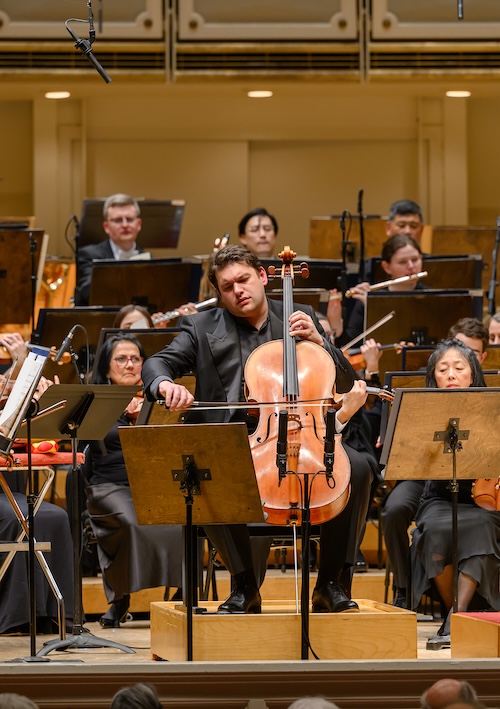
Cabezas, who Smith credits as a co-composer in this final version of the piece, was fully up to all the demands of this quasi-concerto. The cellist played with a clear, often purposefully edgy tone throughout in his demanding part, at one point tackling glissandos and bowed notes simultaneously. The orchestral writing is elaborate and at the end of the long first movement ascends to a controlled cacophony before an abrupt silence.
The final movement commences with percussionist Yeh coming forward and playing a solo on conga drums before moving back to her set. A majestic brass statement seems to suggest something imposing and mythic about the landscape yet the striding orchestral music grows increasingly gnarly as does the cellist’s increasingly wild lines, before the work ends in mid-cry.
Cabezas gave whirlwind advocacy to Lost Coast as did the orchestra under Salonen’s lucid and exacting direction. Smith’s score and the composer and all musicians received an enthusiastic ovation, unusual for a new and challenging work.
The theme of music inspired by natural elements continued with La mer, which concluded the evening.
Any worries that the roiling Smith concerto would make Debussy’s ode to the sea seem low-key or dull by familiarity were quickly dispelled. Salonen in fact led an account of Debussy’s tripartite work that proved fresh and bracing, giving some sense of the impact this extraordinary music had on the audience at its 1905 premiere in Paris.
Salonen and the orchestra put access a strikingly dramatic La mer, the conductor’s fluent momentum and scrupulous balancing making one wonder anew at the ingenity of Debussy’s score. The middle section was more edgy and tense than usual and the storm-tossed finale built inexorably to a cataclysmic finale.
Superb playing across all sections once again including Welter’s oboe work and the flute playing of guest Alison Fierst, associate principal of the New York Philharmonic.
The program will be repeated 1:30 p.m. Friday and 7:30 p.m. Saturday. cso.org
Posted in Performances
3 Responses to “Salonen, CSO deliver masterful Debussy, compelling Smith concerto”
Leave a Comment


 Subscribe via RSS.
Posted Feb 06, 2026 at 6:31 pm by tws
A fabulous evening of shimmering, beautiful music. The Smith was a particular triumph: just a few years ago it sometimes felt like the orchestra was a bit baffled by contemporary music, but last night was full of confidence and avid enthusiasm.
Posted Feb 06, 2026 at 8:59 pm by Steve Roess
A thoughtful review of the excellent performances. I was surprised Smith’s spoken political introduction prompted no reflection, as that framing noticeably altered the concert-hall experience for some listeners and made it harder to hear the music on its own terms.
Posted Feb 08, 2026 at 11:46 am by Jeff R
Excellent performances. The Smith was compelling and innovative. I do think leaving the politics at the door would have given some of the audience more latitude to focus on the music in and of itself. That said, those days are gone everywhere.
Salonen brings the best out of the CSO.