A “Rite” to remember with Mäkelä, Chicago Symphony
Is anyone hurt?
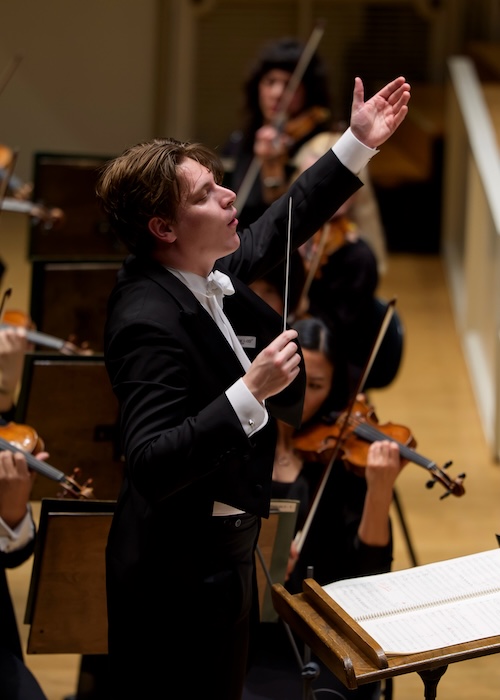
Such were one’s thoughts following the violent intensity of the playing in The Rite of Spring’s closing section Thursday night, with Klaus Mäkelä leading the Chicago Symphony Orchestra in a powerful and extraordinary performance of Igor Stravinsky’s groundbreaking ballet.
The CSO has just returned from an East Coast tour—Mäkelä’s first with the orchestra—which received enthusiastic if relatively scant reviews. It seems that management’s self-defeating policy of keeping Mäkelä hermetically sealed off from interviews—allowing nothing but the puffiest of carefully curated press profiles—is having a negative media impact before the CSO’s music director designate even takes up his post.
For his final CSO appearance of the current season—a special non-subscription event—Mäkelä led a Paris-centered program, with a first half of George Gershwin and Darius Milhaud followed by the less whimsical Stravinsky after intermission.
It was the premiere of Le Sacre du Printemps 113 years ago that famously shocked the first-night audience and caused a riot at its Paris debut—to the extent of discombobulated Frenchmen clubbing each other with umbrellas.
The notoriety of this scandale du jour may have passed but the audacity, originality, complexity, and sheer sonic force of Stravinsky’s score remain. Le Sacre had a seismic impact on music and composers that is impossible to overstate, one that continues well into the 21st century. As Michael Tilson Thomas put it, Rite of Spring “redefined what music could be as much as what the ‘Eroica’ Symphony had done a century before.”
For all its familiarity, Stravinsky’s “Scenes of Pagan Russia in Two Parts” can still pin an audience’s ears back as was surely the case Thursday night.
The performance did not begin in stellar fashion with Keith Buncke uncharacteristically shaky in his opening notes but quickly recovering to deliver a striking rendition of the eerie bassoon solo introduction.
Mäkelä led the first part (“The Adoration of the Earth”) with focus and a full-bodied, forward presence to the sonority. As is so often the case with this conductor, not a note or passage felt casual or overlooked, with the various preparatory dances to the sacrifice leading naturally from what has come before.
Mäkelä avoided peaking too soon, building inexorably to a primitive pounding “Dance of the Earth” that was stunning in its sheer assaultive force. Yet it was not the volume and power that most impressed but the astounding clarity the conductor achieved, even with the dizzying multitude of contrapuntal lines and massive forces (including nine horns). I heard wind lines and string notes that I didn’t even know existed in this score, even after decades of listening and dozens of live performances.
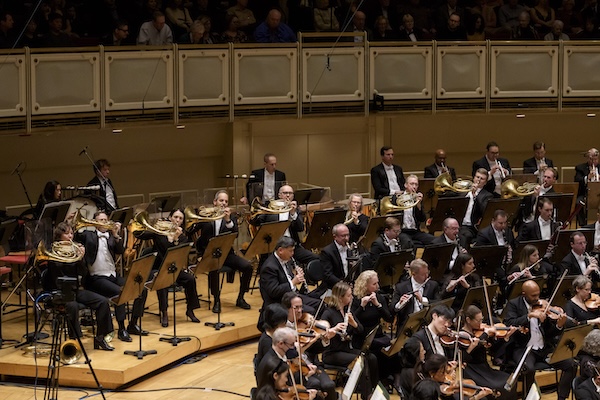
Part Two (“The Sacrifice”) took a bit more time to come into focus Thursday night. While just as well played and dexterously balanced, the opening section here seemed more about the notes and balancing than the expressive possibilities of the music. Halfway through, the performance took wing and Mäkelä directed the primitive rhythms up to a final sacrificial dance of alarming sonic intensity and orchestral fury.
All sections excelled in the uncompromising demands of Stravinsky’s score, the CSO musicians once again playing at their considerable finest for their incoming music director. The sole regret is that this program is only being repeated once.
The first half of the evening was cast in a considerably lighter mode yet gracefully aligned with the Parisian theme, presenting two works written in the 1920s, each drawing on populist music forms.
The concert led off with Darius Milhaud’s Le Bœuf sur le toit (The Ox on the Roof). Originally written as cinema music for silent film comedies, the music was repurposed as a surreal comic ballet in which form it enjoyed great success. So much so that the Paris cafe where the composer and his Les Six colleagues hung out—owned by Jean Cocteau—was renamed Le Bœuf sur le toit. (After many moves to different addresses, the cabaret still exists today in the city’s 8th arrondissement.)
Mäkelä has conducted mostly serious works in Chicago so it was intriguing to see him cut loose a bit in lighter-weight showpieces. The conductor led a lively, high-stepping performance of Milhaud’s confection, drawing out the Brazilian dance influences, with Esteban Batallán and John Hagstrom serving up wonderfully sassy trumpet playing in the samba-like opening theme.
Still, this is pretty thin potage and at 15 minutes, even that catchy trumpet tune starts to pall with repetition. Mäkelä adroitly kept the score moving with deft handling of the rapid tempo shifts and contrasting episodes.
A different take on the City of Light brought Mäkelä’s first Chicago conducting of homegrown music with Gershwin’s An American in Paris. The composer’s celebrated, jazz-inflected tone poem about a homesick American’s ruminations while on vacation in Paris was performed by the CSO less than a year ago on the same stage.
Thursday night’s performance was predictably brilliant and vivacious with Mäkelä drawing out Gershwin’s individual and kaleidoscopic scoring. Yet the performance ultimately proved more mixed. The taxi horns sounded decidedly anemic and, for all the bracing energy and high polish, Mäkelä skated over Gershwin’s opportunities for humor. Robert Chen’s nostalgic violin solos were a standout while some of the jazzy brass solos could have used more of the vitality manifest in the Milhaud.
At these performances Mäkelä is using the 2017 “critical edition of the restored final version” of Gershwin’s score. Whatever the historical provenance, some of the pared-down orchestration in the latter sections of the work seemed less effective than that heard in the more familiar arrangement.
The program will be repeated 7:30 p.m. Friday. cso.org
Posted in Uncategorized
5 Responses to “A “Rite” to remember with Mäkelä, Chicago Symphony”
Leave a Comment
 Subscribe via RSS.
Posted Mar 06, 2026 at 3:49 pm by Randy Wilson
The reviewer gets it absolutely right here. The clarity and intensity of The Rite were overwhelming at times, and the tension was palpable throughout the audience. The beginning of Part Two did feel like a slackening of tension (as well as the penultimate Ritual Actions), but overall this was a powerhouse performance where every voice seemed audible in the chaos, and it will linger in memory for a very long time.
The Gershwin was indeed gorgeous even if some of the bigger moments left you wanting a little more. And the Milhaud was charming but repeated its themes just a time or two too many.
I’ve had my doubts about Makela up til now and still do, but last night’s Stravinsky went a long way toward making me an enthusiastic fan.
Posted Mar 06, 2026 at 4:10 pm by Peter Borich
The entire concert was tremendous, but the Rite was shockingly great.
If there ever could be an heir apparent to Sir Georg with the CSO, Makela might be it. The clarity, excitement, precision he brought to the piece was completely Solti-esque.
Posted Mar 07, 2026 at 6:48 am by Lawrence Eckerling
I did the piece with the new taxi horns a year ago. One of the horns has a low enough pitch that it just doesn’t cut through the orchestra. It didn’t for me, and it didn’t at this concert either.
Regardless of Gershwin’s intentions, decisions need to be made.
Posted Mar 07, 2026 at 8:58 am by Steve Roess
I got the impression the bulbs on Cynthia’s horns might have been stiff and may need to be broken in.
As for the piece itself, the more I hear it, which is too often, the more it seems cloying and too cutesy. With so much great jazz out there, it would be a real treat to hear the CSO play more in that genre.
Posted Mar 07, 2026 at 10:26 am by Rosalind Britton
You’ll be pleased to hear the bassoon entry for the Rite on Friday night was flawless.n And the entire performance was extraordinary, with a clarity to sections I too had not been so clearly aware of. My last noteworthy performance of Rite was with Salonen at Disney Hall under Salonen,in an acoustic which served the piece wonderfully.
I too barely heard the horns in the Gershwin, and I was waiting for them. Shame.