Bach in the City resurrects a lost work with the “St. Mark Passion”
Few composers left a richer or more varied musical legacy than Johann Sebastian Bach. He composed voluminously and excelled in nearly every genre: instrumental, chamber, concertos, and some of the most profound and extraordinary choral works ever set to paper.
And yet vast as Bach’s oeuvre is, one can’t help wanting more.
The knowledge that hundreds, perhaps thousands, of his works are lost to history is agonizing to musicians and Bach aficionados. The rare discovery of any previously lost work is always cause for international celebration. When two Bach organ Chaconnes were unearthed in the 1990s (confirmed as authentic only last year), it created considerable excitement and media interest around the globe.
Among the works by Bach that haven’t survived are several concertos (for viola, violin, and violin and oboe), about one hundred sacred cantatas and nearly two-dozen secular cantatas. But no music of the composer stokes more interest than his lost choral Passions.
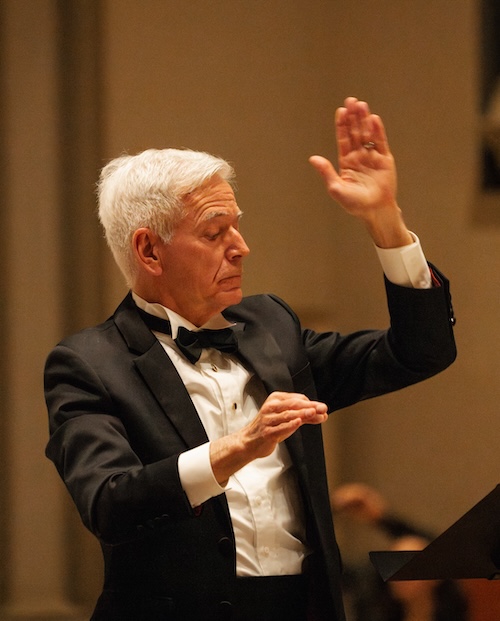
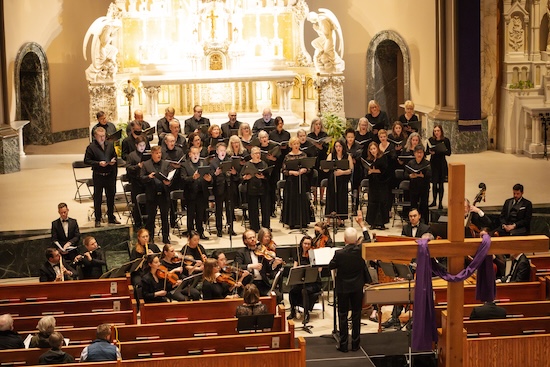
Kudos to Bach in the City—formerly Bach Week Festival—for presenting the Chicago premiere of Bach’s lost St. Mark Passion. Richard Webster conducted this conjectural completion in the ensemble’s final season concert Friday night at St. Vincent de Paul Parish Church in Lincoln Park.
While Bach is believed to have written as many as five Passions only the St. John and St. Matthew have survived.
Bach’s music for the St. Mark Passion is completely lost, yet Picander’s libretto is intact. That provided enough reasonable clues for musicologist Malcolm Bruno’s attempt at reconstructing the score in 2019 (the most recent of several such attempts over the past 150 years). Also helpful is that the St. Mark was likely a “parody” mass, meaning Bach recycled music from his previous compositions for it.
In his version, Bruno draws primarily from Bach’s Cantata No. 198, the “Trauer-Ode” (Funeral Ode), culling four additional arias from Cantatas 54, 120a, 73, and 159. There is also a neat bit of Bachian symmetry in that each of the four soloists sings two arias each.
The result, presented Friday night, was a St. Mark Passion that was fascinating to hear and largely successful. The narrative of Christ’s passion and death moved with convincing flow, dramatic intensity and musical variety. While Bach’s hand is instantly discernible, what was most surprising was how effectively the composer’s music and the new additions melded together.
Bach in the City’s music director Webster took upon himself the daunting task of composing music for all the missing recitatives and turba choruses. The first sing-songy recitative for the Evangelist was unconvincing but after that Webster’s new music—which amounts to at least half of this retooled score—proved masterful. The new recits and turba choruses blended gracefully with Bach’s arias and choruses. Nothing was jarring or incongruous, the keys always lined up, and Webster found a nice stylistic middle ground, writing the recits in Passion style without slavishly copying Bach. All credit to Webster, as well as his skillful editor Jason Moy, BITC’s associate music director and harpsichordist.
Presenting the narrative in English, while keeping Bach’s arias and choruses in German, was also an inspired touch. The domestic vernacular gave greater immediacy to the drama, since audience members could follow the passion story with their own ears and eyes rather than having their faces buried in a program book.
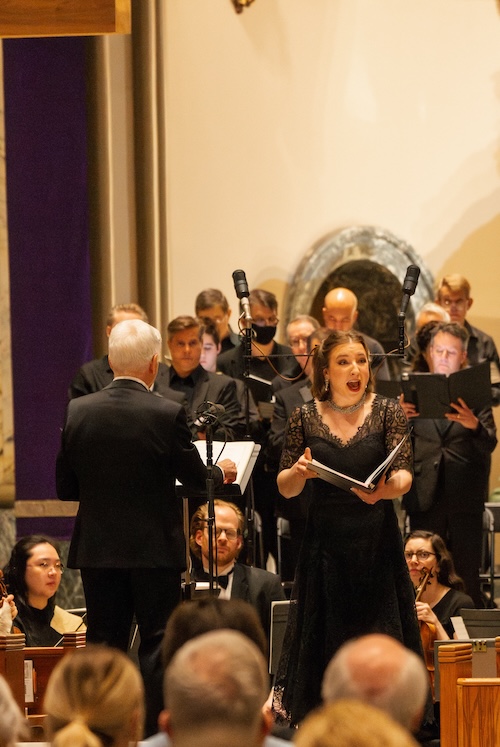
The evening’s soloists proved a mixed Bachian bag, yet the best of the solo singing was extraordinary.
Dividing the Evangelist’s music between male and female singers looked on paper like a dubious and wholly unhistorical nod toward contemporary gender politics. As it turned out, that proved an inspired decision since Hannah de Priest provided the finest moments of the performance.
Her Evangelist narration was ideal—pure of tone, rhythmically nimble and always attentive to the text. The soprano was fully alive to the essential storytelling nature of the role, and starkly put across the dramatic moments of the passion and crucifixion sections.
In her arias, de Priest displayed a first-class Bach style. She delivered an expressive “Er kommt, er kommt er its vorhanden” and a moving, luminous rendering of “Welt und Himmel nehmt zu Ohren”, which proved the vocal highlight of the evening.
With his rich, burnished baritone, David McFerrin proved ideal casting as Jesus, singing with noble tone and a natural gravitas. McFerrin brought out the drama of Jesus’s prayer in “Herr, so du willt” and an affecting acceptance of his fate in “Es its vollbracht” (It is finished). We need to hear this Boston-based singer more often in Chicago.
Ryan Belongie was a worthy Peter yet seemed to take some time to warm up. In “Falshe Welt, deine schmeichelnd Küssen,” the countertenor’s vocalism was fitfully pitchy and unevenly projected. After intermission Belongie fared better in “Mein Heiland, dich vergess ich night,” singing with greater security, and naturally conveying the spiritual hope of the text.
Oliver Camacho seemed ill at ease in this assignment. In the shared Evangelist role, the tenor’s singing felt unsettled, veering from a generalized expression to a belated, over-the-top hectoring in the crucifixion section. Likewise in his arias, Camacho seemed taxed at times by the demands of “Mein Tröster ist nicht mehr bei mir” and conveyed little of the inward essence of “Erbarme dich!” (Taya König-Tarasevich’s sensitive obbligato flute solo in the latter aria was exceptional.)
Webster’s long Bach experience was manifest in his skillful and idiomatic direction of the nearly two-hour score. Tempos may have been more stately than some historically minded advocates adopt these days, but the music never dragged and Webster’s judicious pacing was always mindful of the greater arc. He allowed the soloists space for their arias and consistently conveyed the spiritual dimensions of the music.
The playing of the 18-member orchestra (four of whom were continuo players) was stylish and well-blended, the period-instrument timbres adding a nice, raspy edge to the performance. The choral singing was superb across all sections, warmly blended, expressive and imbued with fine Bach style—as with the heart-easing consolatory glow they brought to “Betrübtes Herz, sei wohlgemut.”
There was one not-insignificant blunder. Unfortunately, no allowance seems to have been made at all for lighting, and the soloists’ faces as well as the chorus were shrouded in shadow for virtually the entire performance. Worthy as the program and performance were, Bach in the City needs to step up its game on the presentation side if they want to play in the majors.
If you missed this fine performance of an intriguing Bach work rescued from oblivion, fret not. Music of the Baroque is presenting the St. Mark Passion in the same Bruno version next season.
Bach in the City’s 2026-27 season has not yet been announced. bachinthecity.org
Posted in Performances
2 Responses to “Bach in the City resurrects a lost work with the “St. Mark Passion””
Leave a Comment
 Subscribe via RSS.
Posted Mar 22, 2026 at 10:16 am by Bruce Tammen
I agree that Hannah DePriest’s singing was the high point of the evening. She is vocally and expressively very appropriate for this repertoire.
Posted Mar 25, 2026 at 12:40 pm by Hannah De Priest
Thank you for this really supportive review of Bach in the City’s first performance! I was touched to read your kind words about my singing. I was nervous to take on an Evangelist role for the first time.
And thank you Bruce for the kind comment above. I didn’t realize you were in attendance but I’m so glad to know you were there!