Directorial conceits undermine singers and Puccini in Lyric’s muddled VR “Butterfly”
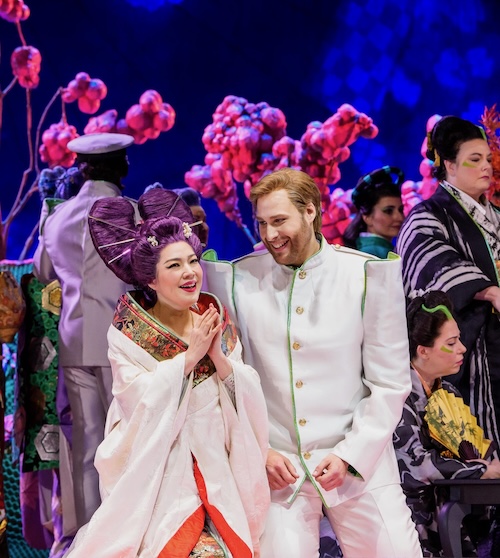
Povero Butterfly. Povero Puccini.
Trying to get a firm handle on Lyric Opera’s new production of Puccini’s Madama Butterfly, which opened Saturday night, would give anyone a severe case of whiplash—enough to rival Faye Dunaway in Chinatown (“She’s my sister! My daughter! My sister! My daughter!”).
For extended stretches, this Matthew Ozawa production—which debuted at Utah Opera last year— followed a fairly straightforward path. Writing at intermission, I was blocking out a largely positive review. Yet after the curtain went up for Act II, the revisionist production proceeded to go completely off the rails.
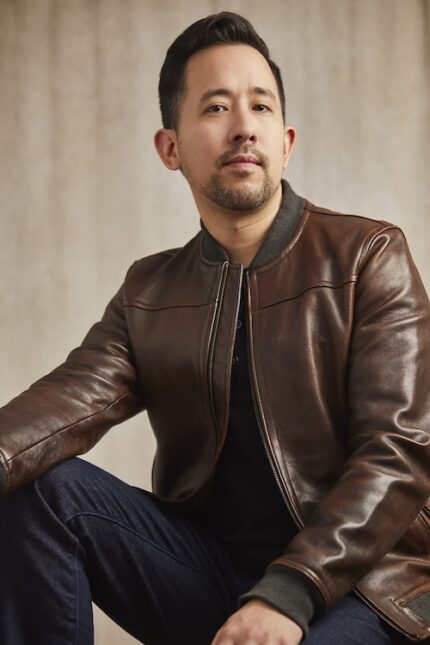
The motivation for this staging, says Ozawa in his personal director’s note, is, essentially, to rescue Puccini’s celebrated opera from white men. When experiencing Butterfly, Ozawa says, we must all “consider through whose lens we are viewing this opera.”
The director goes on to talk about about how his being biracial (Ozawa’s father was Japanese) has affected his life and career. “I am often one of the only artists of color in the spaces where I work. . . . Like Butterfly I have yearned for acceptance but never felt truly at home in any single culture or place.”
Ozawa claims his “boldly relevant” production “rescues the opera’s narrative” by employing “an entirely female [and] Japanese design collective,” which solves the problem of the story being seen “through the lens of a white man, Pinkerton.” Finally Ozawa professes his love for Puccini’s opera yet modestly states that the opera has “made me, as an Asian American, feel ostracized, and I have felt a duty to reclaim its narrative.”
It takes a certain brand of jaw-dropping hubris and solipsism to cast oneself in the role of a courageous hero who will “rescue” an operatic masterpiece from itself. How did millions of opera lovers ever enjoy Puccini’s Butterfly before Matthew Ozawa came along?
I hate to break it to the director but It’s not about you!! Nobody buys a ticket to see Butterfly because the stage director is half-Japanese or to see him work out his personal identity issues onstage. And no one in the audience cares about your background, biography, where you grew up, or why an opera makes you feel sad and neglected.
Ozawa, not insignificantly, is employed in a top administrative job at Lyric as “chief artistic officer,” a position created especially for him in 2022 by the company’s unlamented former CEO Anthony Freud. Which may help explain some of the bewildering casting and production decisions of recent years.
___________
Ozawa’s modern-dress staging makes Pinkerton into a hoodie-wearing loser living in a crummy apartment. In a silent prelude, he drinks a beer and, bored, amuses himself by retreating into his virtual-realty headset, where he can act out his fantasies as a Navy lieutenant in Nagasaki. (Who knew that was a popular avatar with 21st-century gamers?) Suzuki emerges from his refrigerator and the apartment splits into halves, retreating to the sides of the stage as the Japanese house comes forward, where the rest of Act I plays out more or less traditionally.
One could have lived with the bizarro framing device but Ozawa doesn’t know when to leave bad enough alone. Act II opens with another silent pantomime in which Pinkerton is arguing with his wife. Angry, he takes refuge once again in his VR headset to return to his Nagasaki romantic adventure.
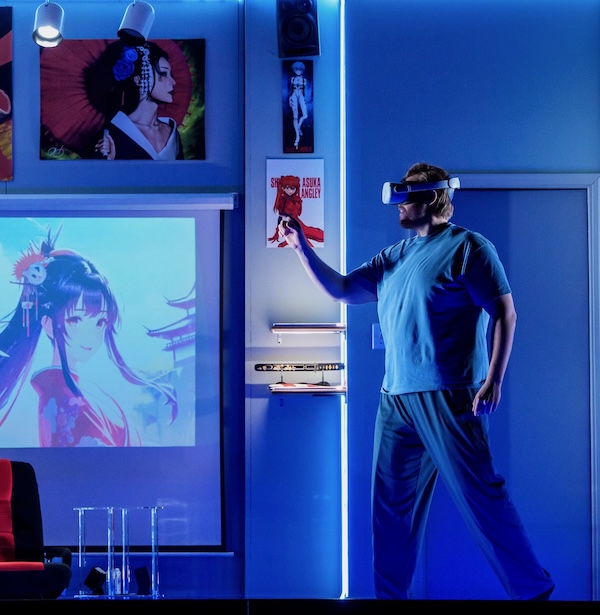
You ain’t heard nothing yet. Because the opera is now only a mere gaming fantasy in Pinkerton’s head, Ozawa proceeds to insert the character, contra Puccini, into nearly all of the first part of the Second Act. So while Butterfly pines for Pinkerton’s return, he is simultaneously a very present silent figure—walking around Butterfly and Suzuki, eyeing their actions with concern, and even attempting to embrace her—as she sings “Un bel di” no less. Not only is this distracting as hell but it completely upstages the principal action in some of the most crucial moments of the opera.
Ozawa saves his greatest, i.e., worst revisionism for the tragic final scene. Cio-Cio-San commits suicide (in Pinkerton’s apartment) with her father’s sword—oddly, after menacing the ever-present Pinkerton with it—and she dies. But not really. She strips off her wig and outer garments and proceeds to stride proudly across the front of the stage—presumably as an ennobled figure of Asian female empowerment. In a final gratuitous middle-finger, she turns and glares at the audience on the discordant final chord, as if to say, “You all killed me, you evil Round-Eyes—but I am Japanese Woman and I emerge victorious!”
Why couldn’t Ozawa just write his own opera and leave Puccini and the rest of us alone?
____________
Singing often seemed like the least important element of this production. But, fortunately, the vocal side was largely well served Saturday with one crucial exception.
Over the past two decades the trend has been to cast Butterflys who may not necessarily have the big dramatic voice to ride over Puccini’s orchestra but who can be more theatrically credible as a teenage Japanese bride.
Karah Son has sung the role of Cio-Cio-San in San Francisco and at numerous European companies and festivals. The Korean soprano makes an engaging stage presence and showed worthy dramatic instincts in a role that has become her signature.
But in this Lyric Opera debut, Son’s singing too often came up short. Even allowing for a lighter-voiced heroine, her lyric soprano seemed two sizes too small for the role. More problematic was Son’s wide vibrato with loud or sustained notes jarringly wobbly.
In the showpiece “Un bel di,” Son’s singing had solid expressive commitment—even with Pinkerton hanging about—but sorely lacked power and tonal richness. Perhaps she was husbanding her resources, since Son rose to the challenge of the death scene with greater volume, dramatic intensity and impassioned singing. (Though Ozawa’s off-putting coda didn’t do much for Son or her character.)
No reservations need be made about the Pinkerton of Evan LeRoy Johnson, who made an impressive Lyric Opera debut. The tall, strapping Minnesota native proved an ideal fit for the caddish American naval officer who casually marries the 15-year-old Cio-Cio-San only to abandon her after the wedding night.
Johnson displayed a robust and penetrating tenor voice. He brought Yankee swagger to the first act as well as greater sympathy than many in the role—endearingly awkward in meeting Cio-Cio-San’s relatives and ardent yet respectful in his interactions with his bride. Johnson brought rich, impassioned tone to the love duet and guilt-wracked torture to “Addio, fiorito asil” when the American officer/gamer belatedly realizes the tragedy caused by his selfishness.
The idiocy of having a sympathetic Pinkerton lurking around in Act II wasn’t the tenor’s fault, of course, though it did serve one useful purpose—for once the singer playing Pinkerton wasn’t vociferously booed at the curtain call.
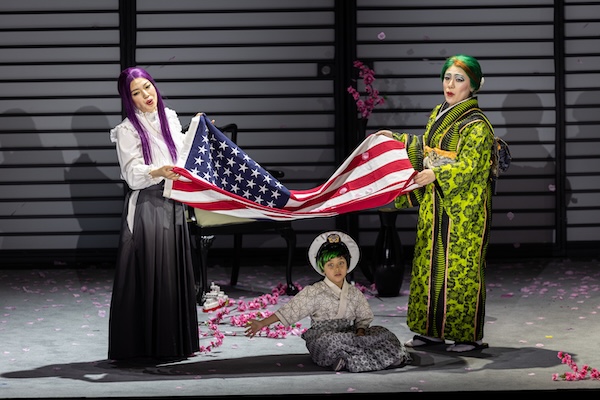
As Suzuki, Nozomi Kato showed a rich mezzo voice and sang superbly, with the Flower Duet and Act II trio proving vocal highlights of a very mixed evening. Dramatically, the character of Butterfly’s friend seemed nebulous, more a result of Ozawa’s muddled revisionism than any dramatic lack on Kato’s part.
Zachary Nelson cut a rather Mephistophelian figure as Sharpless, yet sang well and brought the requisite humanity to the American consul. It was good to have Rodell Rosel back—a reminder of happier Lyric days—to reprise his deliciously odious Goro, the marriage broker.
Sihao Hu unfurled a rich, imposing baritone as Prince Yamadori, Butterfly’s rejected suitor. Alexis Peart was a big-voiced, formidable presence as Kate Pinkerton. Both are first-year Ryan Opera Center members. Child actor Florence Agpalo hit her marks like a seasoned pro as Butterfly’s son.
The all-female Japanese and Japanese-American creative team only proved that adhering to strict gender and racial quotas—even when well-intentioned—is no guarantee of positive results. (Who knew?)
The scenic design by “dots” (a New York-based trio) proved largely successful. Pinkerton’s apartment was a nicely pointed depiction of modern-living banality with wall-hanging manga; the colorful main Japanese house set was basic but serviceable and the fluid movement of the two sets worked effectively. Less happy was the kitschy marital bed that descended from above, festooned with pink Japanese lanterns, suggesting a short-time motel across from the Nagasaki naval base.
The lighting by Yuki Nakase Link was a wildly mixed bag—sometimes quite beautiful in the purples and reds of Act I, but the shadowy noir of Act II suggested an East German interrogation room circa 1972. The abrupt switching of primary light colors at key dramatic moments proved heavy-handed and intrusive. Maiko Matsushima’s costuming was a confounding mix—colorful traditional Japanese gowns vied with garish styles that seemed to have little to do with the characters. (What’s with the purple and green hair for Butterfly and Suzuki?) Ozawa’s stage blocking proved more successful than his concept, the director moving the cast fluidly and efficiently.
In his 2018 Lyric Opera debut—also Puccini with La Bohème—conductor Domingo Hindoyan made an uneven impression. So, of course, he was invited back.
While attentive to the singers, the Venezuelan conductor’s stately tempos and mostly quiet dynamics resulted in a kind of miniaturized chamber version of Puccini’s roiling score. Perhaps some of that tamping down was to accommodate his light-voiced Butterfly, but the results too often took the guts and drama out of the music.
At times Saturday’s opening felt more like a cautious rehearsal than a live performance—Hindoyan going bar to bar without the requisite sweep and surging to Puccini’s big moments. Dramatic tension was sorely lacking, and orchestral climaxes underpowered, wanting in amplitude and impact.
Madama Butterfly runs though April 12. lyricopera.org
Posted in Uncategorized
15 Responses to “Directorial conceits undermine singers and Puccini in Lyric’s muddled VR “Butterfly””
Leave a Comment



 Subscribe via RSS.
Posted Mar 16, 2026 at 1:44 pm by M Kaden
OMG, how I hated this “opera.” Didn’t even make it to intermission, so thank you for the update and letting me know I didn’t miss anything worthwhile.
We are pretty young, as opera-goers go, so why is Lyric chasing us away with this VR nonsense?
Posted Mar 16, 2026 at 1:54 pm by Marshall Anderson
I was supposed to go opening night, but the forecast weather had me opt to move my ticket to March 19… Can’t say now that I’m all that excited (especially with the 5-hour round trip into Chicago)….
Posted Mar 16, 2026 at 1:58 pm by Marshall Anderson
One question: were there boos for the production team on opening night? Lately as it seems that the “Old Guard” (I’m a 40 year subscriber) has moved on, the “younger” crowd LOVES everything at the Lyric so…?!?
Posted Mar 16, 2026 at 2:05 pm by Lawrence A. Johnson
I didn’t hear any booing for the production team but there wasn’t a whole lot of applause for them either.
Posted Mar 18, 2026 at 2:25 am by Doctor Jimmy
Joined a discussion on this production during the intermission and fully expressed my detestation. It was only till the end did I realize that one of the two ladies I was speaking to was actually the lighting designer. So at least some dissent got directly passed to the creators.
Nevertheless I doubt if anyone would have taken it seriously since no matter how terrible the production is, the audience at Lyric always responds with enthusiastic applause, which is probably what’s been giving Lyric the confidence to keep producing shitty opera.
Could not stand Son–typical Korean way of pushing the voice, which somehow gave me the feeling that she was singing with her mouth stuffed with socks. I’m not even gonna go into her pronunciation. Seventy years ago, Maria Callas did her only full live Madama Butterfly here at Lyric Opera, and this is what we are getting now.
One thing for sure: had I been in La Scala or somewhere else, I would’ve been shouting “Vergogna” and booing.
Posted Mar 18, 2026 at 5:45 pm by Eric Easterberg
Lawrence, it’s rare for me to read a review that is so spot on. (What was Chris Jones from the Trib watching?)
I was at the dress last Wednesday, and saw all the things you did opening night. One thing I would emphasize: in an attempt to reclaim the character of Cio-Cio San, Ozawa has actually reduced her to nothingness, to electrons inside a VR game. There are no stakes, no sense of loss when she “dies,” just the sense that all Pinkerton has to do is hit “Reset” and he can start over.
One could see this production as a portrait of a man (and a society) so besotted with virtual reality that he can’t live in the real world any longer; that might be a legitimate interpretation, but you don’t need this opera to illustrate that.
One more thing: if this is supposed to take place in 1904, why does the flag has 48 stars?
Posted Mar 19, 2026 at 12:56 pm by Peter DG
I also just went to a rehearsal so it may not be fair to comment. After attending all performances for many, many years we stopped attending Lyric in the last years of the previous general director’s tenure because we were not in sync with the direction he was leading the company. But now we are considering “getting back in the fold.”
Given how many years it takes for an opera to go from concept to stage, I’m hoping this Butterfly is the last presentation to be affected by the previous director’s guidance.
Posted Mar 19, 2026 at 8:02 pm by Brian Patricks
This was my second opera. I know NOTHING about opera. I saw Medea at the Lyric on a whim and really enjoyed it, as well as the entire experience. I was looking for something to do for my birthday weekend, and saw this was the opening night for a classic. Perfect. In theory. As mentioned, I know nothing about opera.
Here is what I can say: Your review feels like my exact thoughts and sentiments regarding the entire experience. When asked by some strangers on the train ride home if I would recommend they see Madama Butterfly, my response was, “Yes, just not this rendition.”
Posted Mar 20, 2026 at 6:38 am by Marie Snow
Are you aware of the conversations surrounding the fetishization of Japanese women, especially their youth and supposed innocence? Certain anime and manga fans will express desire for a Japanese wife because of their depictions in media; they are expecting that all Japanese women will look like a teenager forever and will automatically do whatever their husband tells them to do. Your review photo provides a hint to this; the blue-haired girl on the poster is Rei Ayanami, a character designed to show how jarring and creepy this stereotype would be in real life, yet many fans took it at face value and declared her their waifu.
Video games make this even worse; gacha games are designed to suck money out of the player, so appealing characters are added who fall in love with the player immediately. I suspect this is also the reason behind the colorful wigs and clothing. Note that Cio Cio-san loses hers once she commits suicide and steps out of the narrative forced upon her.
I am willing to put up with some (not a lot, but some) narrative strangeness if the new setting adds something to a work, and I believe this staging has a lot to say specifically about the female Japanese experience and Western views on Asian women.
Posted Mar 22, 2026 at 5:48 pm by Peter Ellis
I agree completely with your review of Madame Butterfly. We were tempted to leave at the intermission, but stayed on to see the second act further denigrate Puccini’s art.
I now fear for the next season of the Lyric.
Posted Mar 22, 2026 at 7:56 pm by Jacek Mendala
Madama Butterfly – March 22 2026 Karah Son did sing beautifully and wonderful orchestra and very good conductor Domingo Hindoyan – magician – made people crying and that crying was extended for at least last half an hour of the show.
I do agree that costumes were like from Halloween but this is a new concept and you might like it or not.
Posted Mar 23, 2026 at 2:09 pm by Katy
I sat through yesterday’s Sunday matinee and as soon as the curtain went up, I knew I was going to be disappointed. I had an immediate flashback to the Aida of several years ago, modernized and set in a bunker. Given the VR conceit was relatively short-lived in Act I, and that the singing was superb, I had high hopes. Alas.
Acts II confirmed I was right to be skeptical of this production. It was extremely distracting to see Pinkerton hovering on stage in his VR headset throughout Act II and even upstaging Butterly during her gorgeous aria.
I always want to support Lyric, but their productions just don’t hit the mark.
Posted Mar 29, 2026 at 2:28 pm by Paul Huber
March 28th performance. Son did lack “tonal richness” and was a little wobbly to begin, but improved markedly during the first act and performed extremely well. I thought Johnson was one of the best Pinkertons I’ve heard.
As for Hindoyan, I admired his volume control on the orchestra. A recent New York Times article was very critical of Yannick Nézet-Séguin for allowing the orchestra to routinely overwhelm singers. So, I very much appreciated Hindoyan’s conducting.
Posted Apr 09, 2026 at 10:39 pm by Dottie Farrell
Very disappointed in Madame Butterfly. Four other friends were with me and knew the original plot. If this is the new version we will not visit this opera again. Many people behind us kept asking “What’s going on?”
I would give this version a very low score. SAVE YOUR MONEY. Spend it on something worthwhile.
Posted Apr 10, 2026 at 1:10 pm by AB
Wholeheartedly agree with this take. I did not care much for the nonsensical VR reimagining of the piece, which strained credulity beyond repair.
But worse in my opinion was Son’s singing, which just did not do justice to the emotional content of the arias. Production was excellent though. Overall, a bit of a letdown.