COT does justice to a neglected Weill masterpiece in Chicago premiere
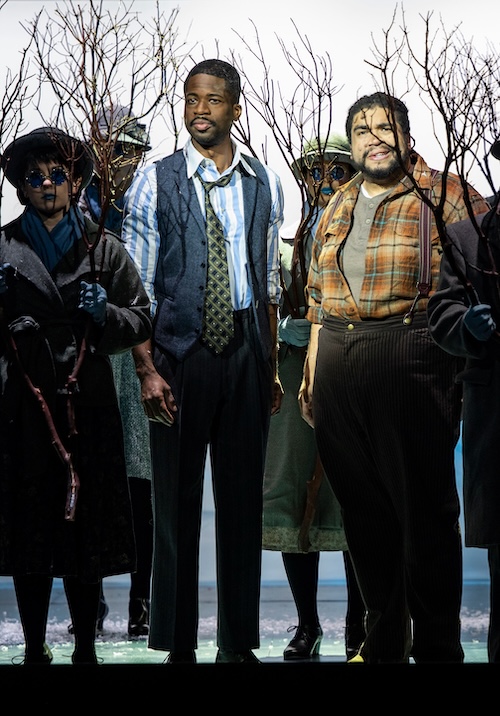
Der Silbersee (The Silver Lake) was the last work Kurt Weill composed before he was forced to flee Nazi Germany. The play with music (subtitled “a winter’s fairy tale”) he composed with dramatist Georg Kaiser amounts to a searing critique of a society teetering on the brink of fascist disaster, sounding a timeless warning of the consequences of authoritarian abuse, wealth inequality and police misconduct. Der Silbersee is one of his finest theater scores.
The belated Chicago premiere of this work by Chicago Opera Theater, coming nearly a century after the work’s first performance in Germany in 1933, is nothing if not timely. Indeed, the potent and ambitious new production by general director Lawrence Edelson that opened Wednesday night at the Studebaker Theater struck the audience like a splash of ice-cold water from the titular lake.
COT’s three performances (which continue through Sunday) are a notable milestone for a company whose central mission has long been to search out important if overlooked 20th century stage works
Edelson is to be commended for giving us a version—sung and spoken in the original German, with English subtitles integrated into the set design—that is arguably more faithful to the original than any previous professional staging of Silbersee in the U.S. (A Broadway-glitzy Silver Lake that I attended at the New York City Opera in 1980 mangled the piece almost beyond recognition.) All of Weill’s music is retained, with judicious cuts to the dialogue bringing the show in at roughly 2¾ hours, including one intermission. The German diction of the ensemble members is good, for the most part.
If the text for Silbersee is less mordantly ironic, and the ending far more hopeful, than that of the Weill-Bertolt Brecht Threepenny Opera and Rise and Fall of the City of Mahagonny, the tuneful score, with its typically Weillian blend of jaunty jazz rhythms and captivating ballads, breathes dramatic conviction into the existential journeys of the central characters, the policeman Olim and his victim Severin. Their struggle—between despair and optimism, injustice and justice—must have struck close to home with Weimar Republic audiences at the time. (The performance that followed the premiere was disrupted by Nazi sympathizers.) Performances of Weill’s works were subsequently banned, and the “degenerate” Jewish composer was forced into an exile that eventually brought him to Broadway.
The plot of Silver Lake is uncomplicated only on the surface.
Severin, a stand-in for society’s hungry downtrodden, is shot and wounded by Olim when the former pathetically steals a pineapple from a grocery store. Sensing the desperation behind this senseless crime, Olim resolves to help Severin after the policeman, comes into an unexpected fortune that enables him to buy and take up residence in an ancient castle.
There Olim attends his victim’s recovery with the help of his housekeeper Frau von Luber and her niece Fennimore. Unaware Olim was his assailant, the embittered Severin seeks revenge. Having ordered Fennimore to spy upon the master and his guest, the scheming Von Luber exploits Olim’s fear of Severin and manages to steal both his castle and fortune. After Fennimore foils the villain’s plan to have Severin murder Olim, the two banished men reconcile and set out, spiritually redeemed, towards a more hopeful future across the fantastical frozen waters of the Silver Lake.
Edelson’s staging, with costumes by Erik Teague and lighting by Marcella Barbeau that support its theatrical purposes most effectively, strikes a happy balance between the farcical elements (represented by the rather two-dimensional villains Von Luber and Baron Laur) and the moral dilemma that links Olim and Severin in unholy alliance. Designer Jeffrey D. Kmiec’s ingenious two-tiered set frames the episodic structure entirely within a child’s bedroom, filtering the moral conflicts through the innocent perceptions of a young girl who later becomes the work’s central female figure, Fennimore, before returning to “reality.” English surtitles are projected onto the central design element as well as on side screens.
But it is the guilt-ridden Olim who is the central protagonist, and bass-baritone Justin Hopkins, a fine singing actor who has taken on a variety of Weill roles, inhabits his (mainly) spoken part with sympathy and conviction. He makes us privy to the workings of the policeman’s conscience while managing the long stretches of spoken text with good German enunciation.
Chaz’men Williams-Ali is nearly his equal in the singing role of Severin. His powerful singing wells up from the depths of the wounded thief’s insatiable thirst for vengeance.
The sweet-voiced soprano Ariana Strahl brings ingenuous charm to Fennimore’s song on Caesar’s death—the demise of a tyrant—that scuttles Olim’s hopes of forgiveness and adds to Severin’s vengeful fury. Her wide-eyed manner feels right for a dea ex machina role far less dipped in wry than most of Weill’s stage heroines.
COT mainstay Leah Dexter sinks her comedic teeth into the villainous Frau von Luber with cackling relish, an extravagant delight in her “fat cat” duet with Dylan Morrongiello’s wonderfully antic Baron Laur. The accomplished Chicago local musters the same razor-sharp comic timing in the character part of the Lottery Agent.
Kudos, too, to COT’s excellent 18-member vocal ensemble that serves a crucial function as Olim’s conscience and Greek chorus-like commentator on the drama.
After Olim and Severin, Weill’s orchestra is really the third protagonist of Silver Lake. Conductor James Lowe gets irresistible crackle and vitality from his players, making his thoroughly engaged instrumentalists an integral part of a most compelling show.
Chicago Opera Theater’s Der Silbersee will be performed 3 p.m. Saturday and Sunday at the Studebaker Theater, 410 S. Michigan Ave. cot.org
Posted in Uncategorized
2 Responses to “COT does justice to a neglected Weill masterpiece in Chicago premiere”
Leave a Comment







 Subscribe via RSS.
Posted Mar 05, 2026 at 2:25 pm by John Abbott
Agreed on all points. This was a superlative, utterly committed performance of an important (and up until now unknown to me) work. My appreciation for COT for making this happen, all the more in these perilous times.
Posted Mar 06, 2026 at 5:48 pm by Davd Lawsky
I was lucky enough to be at the premiere and I think the review does it justice. This was a unique opportunity to see this work. I have been to several productions of Weill’s Threepenny Opera, and one each of his Seven Deadly Sins and Mahagonny.
But this is the first time I’ve seen this opera produced — and beautifully, with imaginative sets, wonderful singing and staging and an excellent ensemble.
I talked to several other members of the audience and people liked it uniformly.