Death becomes the CSO in Hrůša’s compelling program of last things
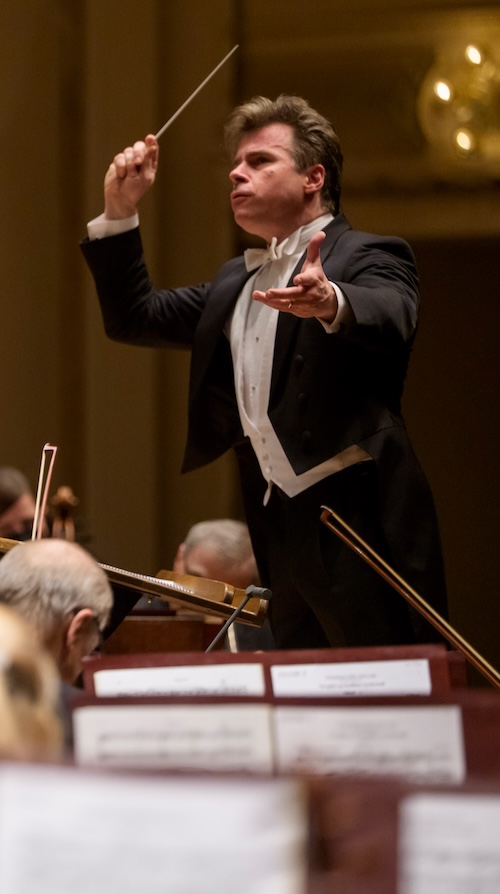
Jakub Hrůša has become one of the Chicago Symphony Orchestra’s most popular guest conductors over the past decade, largely through powerful performances of epic, evening-long works—Smetana’s Má vlast (his 2017 CSO debut), Mahler’s Symphony No. 9 and, especially, Shostakovich’s Symphony No. 11, CCR’s Top Performance of 2025.
Yet the Czech conductor has also shown a creative hand in assembling unique programs of shorter works. Such was the case Thursday night with Hrůša returning for his second and final appearance of the season to direct a thoughtfully varied program focused on last things.
The evening of musical death led off with the Overture to Leoš Janáček’s opera, From the House of the Dead. The Czech composer’s final opera, adapted from Dostoyevsky’s semi-autobiographical novel of inmates in a Siberian prison camp, is characteristic in its edgy and individual style, delivering roiling drama in a taut six minutes.
Two violins announce the emphatic opening theme and the jumpy curtain-raiser veers from agitated solo violin bursts to a fanfare-like trumpet theme. Fitful moments of nobility in the brass seem to hint at something durable in the human spirit even amid the opera’s milieu of almost ceaseless human suffering.
Hrůša led a direct and forceful performance with concertmaster Robert Chen deftly dispatching the frenzied violin solos. Like most intriguing excerpts of Janáček’s stage works, this fine performance makes one want to experience the complete opera.
Sergei Rachmaninoff made his Chicago Symphony Orchestra debut in 1909 when the Russian composer conducted the American premiere of The Isle of the Dead, just one month after the world premiere in Moscow. (Rachmaninoff moved to the piano bench after intermission as soloist in his Second Piano Concerto with Frederick Stock conducting.)
Isle of the Dead is one of Rachmaninoff’s finest works, yet less often heard than his concertos or symphonies due to the tricky programming of this dark 18-minute tone poem. The composer was famously inspired by Arnold Böcklin’s haunting paintings depicting a shrouded figure ferrying a coffin across the River Styx.
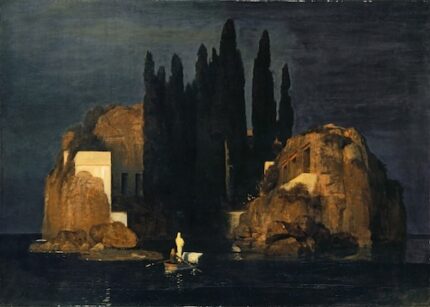
Hrůša took a walking pace for the main theme, first announced by the basses, that reflects the metaphorical journey across the river. The conductor directed the music with a steady hand, drawing dark resplendence from the CSO and imbuing the narrative with firm, inexorable momentum. The violins’ reminiscences of bygone times provided lyrical contrast and Hrusa built the arch-like structure to a thunderous climax. The music descends and the watery music returns for the return journey in this skillfully paced and dexterously balanced performance.
If the first half of the program ruminated on matters of well, death-death, the second part moved more to love-death.
Did any composer take their leave of life with a more relaxed and beneficent farewell as Richard Strauss in his final work, the Four Last Songs? Each setting presents a different angle on the contented end of a long and fruitful life suffused with a golden glow.
The career of Corinne Winters, the evening’s soloist, is on an upward trajectory. She has sung Mimi at the Met and last fall the soprano achieved an impressive Puccini hat trick by tackling all three heroines in Houston Grand Opera’s production of Il Trittico.
Winters possesses an ideal Strauss lieder voice, flexible, bright and shimmery. Unfortunately, like all singers at Orchestra Hall, she had to contend with an unhelpful acoustic for high solo voices, one of the ill results of the 1997 renovation.
The soprano seemed simpatico with the intimate, conversational quality of these settings, neither making them into operatic scenas nor overplaying the emotions.
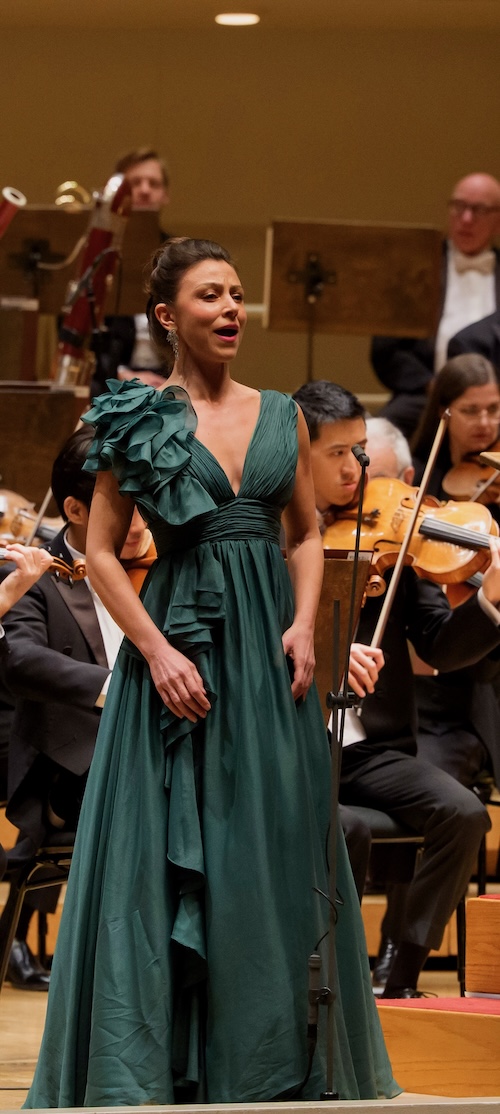
Still Winters seemed to take a while to warm into this music. In the opening song, “Frühling” (Spring), the singer was a little too laid back, her voice fading into inaudibility at lower dynamics. With “September” Winters seemed to find her footing, floating the final stanza on a note of quiet resignation, accented by the ensuing valedictory horn solo by principal Mark Almond.
Winters was at her finest in “Beim Schlafengehen” (Going to Sleep)—projecting more fully into the hall and soaring at the song’s climax (“And my soul, unguarded, would soar free in flight”). Robert Chen’s lovely understated violin solos enhanced the setting’s nostalgic expression. “Im Abendrot” (At Sunset) provided just the right golden coda.
The accompaniment of Hrůša and the orchestra was first class in every respect—providing a rich Straussian tapestry yet well balanced against the soloist with fine transparency, every subtlety of scoring coming across. The conductor ensured that the quotation from Strauss’s Death and Transfiguration—a work written at age 25, nearly six decades earlier by Strauss—made its effect in the final setting, bringing the composer’s life and art full circle.
Music of Wagner closed the evening. For longtime Orchestra Hall habitués, it can seem like few opera excerpts have received more stodgy, by-the-numbers local outings than the Prelude and Liebestod from Wagner‘s Tristan und Isolde— especially in the post-Solti 1990s.
As led by Hrůša, Thursday night’s performance provided an uncommonly fresh, at times riveting restoration. The conductor took extra time before giving the downbeat, and from the hushed concentration of the pianissimo opening to the first appearance of the chromatic “Tristan chord,” conductor and musicians brought a nearly theatrical drama to this often-played music. (Hrůša just assumed the post of music director of the Royal Opera House, Covent Garden last fall.)
Nothing was casual or offhand and the wide dynamic range and flowing, acutely focused performance always had a destination in mind. The “Liebestod” (Love-Death) had an almost spring-like quality and proceeded to its apotheosis dramatically yet logically with a complete lack of rhetorical flourishes or overheated accretions. This superb Wagner performance provided a perfect ending to this compelling Memento mori program.
It was a bit depressing to see so many empty seats for such an intelligent and well-played program led by one of the CSO’s finest podium guests. Hopefully, more aficionados will turn out for the remaining three performances.
_________
The CSO announced the hiring of two new string players this week. Jikun Qin, a native of Shanxi, China, joins the viola section on April 13. And Canadian Jasmine Lin will join the second violin section on July 6.
They are the fifth and sixth CSO musicians appointed by music director designate Klaus Mäkelä. Read more about both players here.
The program will be repeated 7:30 p.m. Friday and Saturday and 3 p.m. Sunday. cso.org
Posted in Performances
6 Responses to “Death becomes the CSO in Hrůša’s compelling program of last things ”
Leave a Comment
 Subscribe via RSS.
Posted Apr 10, 2026 at 12:17 pm by Dave
A magnificent concert indeed. It’s interesting you mentioned the hall acoustics because that was on my mind as well, especially in the Strauss and also in the Wagner to an extent. A shame Chicago doesn’t have a hall with acoustics to match the exceptional quality of the orchestra.
Posted Apr 10, 2026 at 12:27 pm by tws
A spot-on review of one of the most exciting programs of the season. I’m going again Saturday and hope Hrusa and Winters will make some adjustments for the acoustics. It was also a very short program and I wish they’d included another piece or longer Tristan excerpt.
Last night’s audience included a very large high school band group and, while I’m thrilled they got to experience it, they were understandably not the most sympathetic crowd. Some of the least enthusiastic ovations all season for a real gem of a concert.
Posted Apr 10, 2026 at 1:34 pm by Aileen
A very well-said review. Yesterday’s programming was interesting and thought provoking and the empty seats in the hall did not match the quality of the performance. One of our favorites of the season.
Posted Apr 10, 2026 at 5:27 pm by Marie deTrujillo
Every time Hrusa appears with the CSO, the orchestra is at its best. His programming is varied and interesting. Thursday was no exception – it was a wonderful concert and I’ll be back tomorrow.
A hint to Jeff Alexander: make Hrusa principal guest conductor. Four weeks a year of Hrusa once Klaus is on board as MD would be the best possible thing for the orchestra and music lovers in Chicago.
Posted Apr 11, 2026 at 1:26 am by Randy Wilson
I went two nights in a row. I do feel the soprano may have adjusted some of her volume because the Friday night show was more satisfying in that regard. It’s true the audience on Friday was fuller (that’s good) with youthful attendees (also good!) but the applause was less reverent, from clapping between numbers which is understandable, to clapping before the numbers began, seemingly as a joke.
Overall a beautiful second night of a wonderful program by our superlative performers.
Posted Apr 11, 2026 at 10:48 pm by RJB
Stupendous concert. The Janacek was an interesting new experience. The Rach was compelling—a piece that was easier to wrap my arms around in live concert than in the recordings I sampled beforehand. The Strauss was exquisite and will long stay in my memory.
And OMG, the Wagner—just as the reviewer wrote, nothing was ordinary, all just riveting, knife-edge details throughout: the daring extended pauses, the flexible tempi, the highlighted wind solos (Mr. Welter’s fantastic oboe playing…and that exposed pianissimo bass clarinet transition).
Mr. Hrusa’s musicianship yields rich rewards, and we are lucky to have him, for as many weeks as he possibly can come. From the warm greetings he extended in a walk-around through sections, it seems that he is happy to be here too.