Hahn makes a gentle return to stage with French program
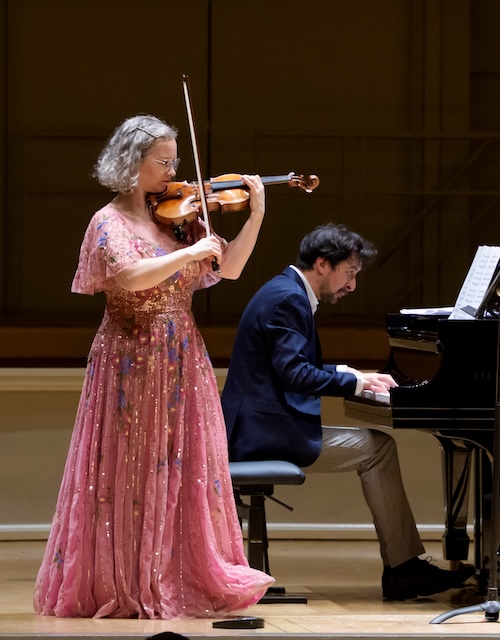
For the first time since December 2023, Hilary Hahn graced the stage at Symphony Center on Sunday afternoon. After a double pinched nerve led her to undergo cervical spinal disc surgery, the celebrated violinist had to pull out of most of the 2024 and 2025 concert seasons. She only just returned to concertizing in February.
A CSO artist-in-residence from 2021 to 2023, Hahn was greeted warmly by the Chicago audience before she even played a note of her French-themed recital, which closed her five-city world tour of this program.
Hahn and pianist Tom Poster set out to demonstrate the variety within French and French-inspired chamber music, with elements of Impressionism, Romanticism, jazz, and minimalism all making appearances. That said, the program was largely gentle in affect, perhaps as a precaution given Hahn’s recent injury. Nonetheless, there was plenty of virtuosity and deep musical sensitivity on display.
Three violin sonatas by Ravel, Debussy, and Fauré anchored the program, interspersed with four shorter pieces, including the Chicago premiere of Scott Tixier’s Ressemblance, written for Hahn for this tour.
Tixier is a French jazz violinist and composer known for his improvisational skills. He mixes elements of improvisation and jazz into Ressemblance, reflecting his musical world growing up in Paris. Balancing classical study at the conservatoire and playing at jazz clubs at night occasionally resulted in “foggy mornings,” Tixier said in his program note.
This foggy atmosphere was well captured in Ressemblance, which begins and ends with a soft, meandering pizzicato melody over suspended piano sonorities. Blues and jazz influences eventually emerge from this haze, as well as a rhapsodic middle section complete with virtuosic passagework, double stops, and harmonics for the violin, and an equally virtuosic and largely independent piano part. Although the two instruments were often in their own worlds, Hahn and Poster made them cohere with perfect ensemble and balance.
Ressemblance flowed logically from the preceding Sonata for Violin and Piano by Ravel. Completed in 1927, the sonata is rife with jazz influences. A nod to Gershwin’s Rhapsody in Blue could even be heard in the finale, while the central movement showcased the Frenchman’s interpretation of the blues, with sensual slides, blue notes, and staccato piano chords. Hahn impressed with her stamina in the bee-like moto perpetuo finale, while Poster brought a delicate touch to the impressionistic flights of the opening Allegretto.
The only non-French composer on the program was Chinese-born composer Bun-Ching Lam. Although executed perfectly, Lam’s Solitude d’automne proved slightly too austere—and a bit too similar to the Tixier that preceded it—for the restless audience on a sunny Sunday afternoon.
The more traditional melodicism of Debussy’s Sonata for Violin and Piano in G minor that followed came as a balm after the two modern pieces. Poster demonstrated great control in the first movement’s muted arpeggios, over which Hahn intoned a rich melody in the violin’s lower register. Composed during World War I, the sonata carries a tinge of sadness, even in its playful commedia dell’arte-inspired “Intermède.” Hahn and Poster brought out the finale’s many colors and shades, building crescendos and tempos thoughtfully throughout the movement.
The second half began with Debussy’s piano prelude La fille aux cheveux de lin, arranged by Hahn and Poster. Hahn made Debussy’s melody soar in a way the piano alone cannot do, yet it was never overwrought. The audience respected the magical silence at the end of the piece, allowing the performers to launch seamlessly into Lili Boulanger’s “Nocturne” from Deux morceaux. Hahn and Poster brought out the charming lyricism and luscious French harmonies of Boulanger’s gem of a piece, with Hahn’s tasteful phrasing preventing it from becoming saccharine.
Fauré’s Sonata No. 1 for Violin and Piano in A Major provided a meaty, Romantic conclusion to the otherwise soft-centered program. Poster brought technical prowess to the demanding piano part, his dramatic solo introduction setting the tone for the dense sonata. The melody was passed deftly between the violin and piano in a call-and-response section in the first movement, each instrument cresting in and out of the texture in perfect balance.
Poster brought a pillowy touch to the rocking siciliano of the Andante, and the rhythmically quirky scherzo was played with pinpoint precision. Hahn’s relative restraint in dynamics and phrasing in the previous movements paid dividends in the brilliant finale.
The violinist loves a good encore—so much so that she recorded a whole album of encores in 2013. True to form, Hahn ended her recital with three brief encores, all by female French composers: Cortège by Lili Boulanger, Tarentelle by Pauline Viardot, and Sérénade espagnole by Cécile Chaminade. Each piece was a glittering jewel, but the crystalline harmonics at the end of the Chaminade were especially stunning, providing the audience with a precious moment of peace before exiting into the cacophony of Michigan Avenue.
Posted in Uncategorized
Leave a Comment

 Subscribe via RSS.