A Copland classic shines amid CSO’s America 250 mishmash
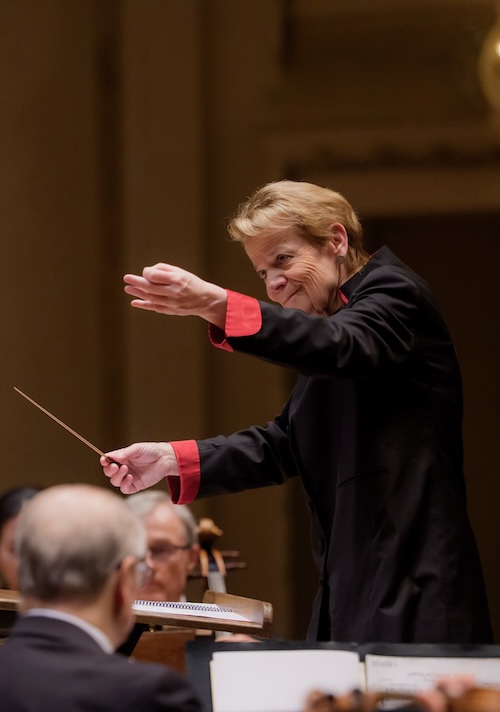
Across the fruited plain, American orchestras are embarked on musically celebrating the 250th anniversary of our nation for the next month leading up to July 4th.
In the case of the Chicago Symphony Orchestra, the U.S. semiquincentennial is being marked with “America 250: A Musical Journey.” The three-week series led off with the first program conducted by Marin Alsop Thursday night.
While the aim and intentions are admirable, one can’t help feeling that these concerts amount to a missed opportunity. One was hoping the CSO would mark the occasion of the 250th anniversary by exploring neglected symphonic works by American composers that richly deserve wider advocacy.
Instead, it looks like CSO programmers spent about five minutes thinking seriously about classical repertory before turning it over to the marketing department for most of the decision-making. This is the kind of thing that happens when you’re between music directors for years on end with an inevitable void in artistic leadership.
The resulting programs for this season-closing series are a stylistic mishmash, heavy on “crossover” that seems more interested in selling tickets to non-classical audiences and Symphony Center events than doing a deep dive into serious American music.
While the first half of Thursday’s concert balanced an Aaron Copland classic with a new John Adams piece, the second half was given over to a performance of a large-scale jazz work. Next week’s program bizarrely couples Leonard Bernstein’s Symphony No. 2 (“The Age of Anxiety”) with spirituals sung by a gospel choir. Nothing wrong with jazz or spirituals but that’s not what most Chicago Symphony subscribers come to Orchestra Hall to hear.
By comparison, take a look at the Grant Park Music Festival’s bracing America 250 programming this summer to see what a smarter, more thoughtful lineup of populist American favorites and contemporary works can be for those willing to put some serious effort into their planning.
Thursday night’s program led off with The Rock You Stand On, the most recent effort by John Adams. Despite the patriotic-sounding title and the occasion of its local debut, this CSO co-commission has zero to do with the country’s 250th anniversary. Rather, it was written for and dedicated to Alsop, an Adams friend and frequent collaborator.
The ten-minute work begins with short, angular string fragments that seem to ironically echo Adams’ early Minimalist handprints. The jumpy music grows more syncopated and bounces around to different sections of the large orchestra. Scored for vast forces and ample percussion, one waits for the tempo to accelerate and the music to break out of its chugga-chugga vamping for a colorful, brilliant and exciting effect.
That never happened. Despite Adams’ encomium to Alsop’s conducting skills, one felt keener balancing and more intense rhythmic drive might have allowed the piece to make a stronger impact. As it was, the music felt grey and heavy-footed, straight-jacketed in an unchanging tempo and never taking off. Add The Rock You Stand On to the growing list of Adams misfires over the past decade.
Copland’s Appalachian Spring may have been an easy choice for inclusion in this year’s celebrations, a work as acclaimed as it is beloved. Yet this is one iconic score that deserves all of its fame and renown. With each passing year, Appalachian Spring seems to embody something nostalgic, naive, yet strong and humane in the American spirit, qualities that can often seem far away amid the roiling maelstrom of political and social divisions.
At the CSO’s last performance 16 years ago, the late Michael Tilson Thomas presented the complete Appalachian Spring score, which contains a lengthy, dark and shadowy section in the final half of the work that Copland excised from the familiar suite. That music can be jarring on first hearing—I wasn’t quite convinced in 2010 but have since come to believe that it adds a dramatic weight and even greater expressive depth to the score as a whole. (One can hear the complete version in Tilson Thomas’s recording with the San Francisco Symphony here.)
Alsop elected to perform Appalachian Spring in the traditional ballet suite sans that section. The conductor is often at her most consistent in American music and Alsop led an idiomatic and sensitive performance that gave this beautiful score its due, drawing responsive and polished playing (a couple horn bloopers apart). The lonely, sweet-sad clarinet solos of Stephen Williamson—and later, oboe solos by William Welter— seemed to convey the very essence and heart of this music.
The major work Thursday night was supposed to be the local premiere of Wynton Marsalis’s Symphony No. 5 (“Liberty”), also a CSO co-commission (along with four other orchestras), but it has been postponed. Despite repeated queries as to the reason why, the CSO press office gave no explanation, referring press to the similarly unhelpful release that merely announced the program change.
“Liberty” was slated to be premiered by the Philadelphia Orchestra last month and that ensemble was somewhat more forthcoming in its joint statement with the composer: “Large-scale new commissions evolve throughout the creative process, and all parties agreed that additional time would best support the long-term life of the new symphony.” In other words, Marsalis likely didn’t make his deadline for the piece.
Instead, the CSO played selections from Marsalis’ Symphony No. 4 “The Jungle.” Or, more accurately, the CSO participated in “The Jungle,” which was mostly played by Marsalis’s Jazz at Lincoln Center Orchestra.
The “jungle” that Marsalis’s title references is the city of New York (not the meatpacking plants of Chicago as in Upton Sinclair’s novel of the same name). The sprawling work spans over an hour and is cast in six sections, of which four were performed Thursday night. The musicians of the JLCO sat at the front of the stage in three rows, with Marsalis in the center of the back row with fellow trumpet players.
The first section “The Big Scream (Black Elk Speaks)” set the musical stage for the entire piece. The title says the composer, “reflects our Native-American roots” and there are cries and yelps from the jazz instrumentalists presumably echoing the title personage as well as the primal milieu. In “La Esquina,” West Side Story seems to peek around the corner, with a Latin flavor to the music.
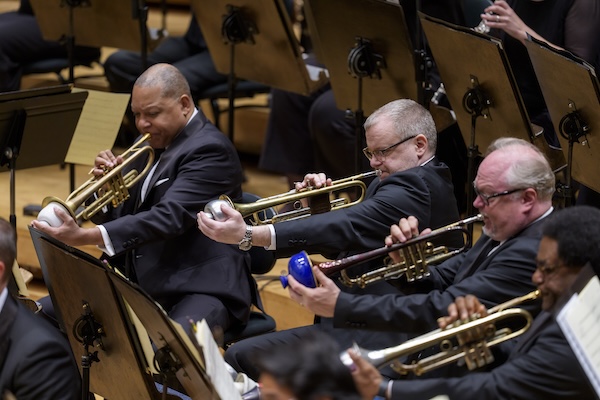
As in most of these jazz-meets-classical confections, the jazz ensemble basically enters and sits on top of the classical orchestra for the duration. Most of the music from “The Jungle ” is cast in an uptempo big-band jazz idiom and the Jazz at Lincoln Center Orchestra drives the music throughout. While there are a few opportunities for wind and brass players in the latter sections, the CSO is largely reduced to an onstage banda—playing a supporting role to the JLCO, with some intermittent window-dressing riffs for the scattered strings.
“The Jungle” is not a traditional symphony by any stretch of the imagination but merely a structural framework for Marsalis’ brand of striding big-band jazz. It sounded like fine, spirited jazz to me but I’ll leave it to the experts to judge.
Marsalis at 64 still has major chops as he showed in his soaring breakout trumpet solos, along with those of the other terrific JLCO musicians. The music built to a raucous and cacophonous final crescendo before a surprisingly subdued coda. Alsop is an adept conductor of second-rate music and she kept the boisterous beast on track and the disparate forces moving and as well balanced as possible.
But, to paraphrase the great cultural observer Bugs Bunny, “It ain’t classical, Doc.”
The program will be repeated 1:30 p.m. Friday and 7:30 p.m. Saturday. cso.org
Posted in Uncategorized
3 Responses to “A Copland classic shines amid CSO’s America 250 mishmash”
Leave a Comment
 Subscribe via RSS.
Posted Jun 06, 2026 at 6:38 am by Chris Sheahen
I enjoyed the Marsalis piece, although I would have liked hearing neglected American orchestral works. I was disappointed with the Adams. He can do much better. The Copland was excellent.
The audience seemed to love the whole program, so maybe the planners succeeded.
Posted Jun 06, 2026 at 4:50 pm by Randy W
Gosh, this was not my perception of the night at all. I attended on Thursday like the reviewer. We both agree the Copland is an exceptional composition that was performed beautifully. Americana at its least flag waving and most accomplished.I enjoyed the Adams very much and didn’t find it tedious like others seem to have done. The pulse was unwavering which led to what I heard as some exciting results in dynamics and harmonic intensity. To each their own.
And I frankly adored the Marsalis composition, precisely because the voices and rhythms and personalities flitted between the “solo” jazz band and our own hometown players. It was exciting and well conceived (and yes, episodic and a bit praise-seeking).
Posted Jun 09, 2026 at 7:08 am by Chuck
I was at Friday’s matinee performance. I could not agree more with the above review. Jazz at a classical music concert is intrusive and off-putting. In the future, as a subscriber, I will likely transfer out of such concerts should this occur again.
Jay Nordlinger, a music critic who writes about music in New York for The New Criterion, shares Mr. Johnson’s view of jazz at classical concerts. In the June, 2026 issue, Mr. Nordlinger writes, “…orchestra executives try to be cool. They want to make classical music popular, even hip. It will never be so. There’s a reason they call pop music “pop music” — it’s popular. Classical music will always be loved and nourished by a minority. And that’s okay.”
Bravo to Mr. Johnson and Mr. Nordlinger.