A modern requiem, Brahms symphony highlight weekend Grant Park program
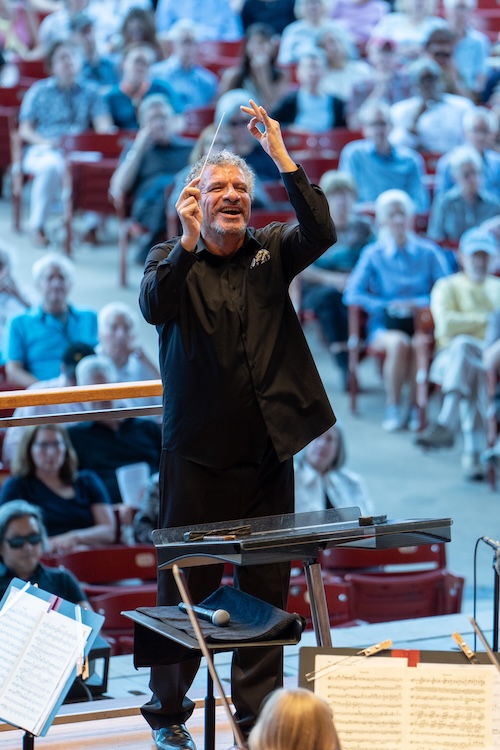
The Grant Park Music Festival settled into high summer gear Friday night with Giancarlo Guerrero leading a diversified program that included the first season appearance of the Grant Park Chorus.
The weekend program opened with Charles Ives’ Variations on America. As in Joan Tower’s Made in America on opening night, a patriotic ode is deconstructed, in this case “America” (“My country ’tis of thee”). Originally written for organ, the teenage Ives’ anarchic mashup is aimed not at the song (or the country) but at the academic New England composers he loathed for their conservative musical styles (which frequently incorporated adaptations of national songs).
William Schuman’s arrangement for orchestra brilliantly transcribes Ives’ original into a vivid showpiece and Guerrero led the Grant Park Orchestra in a spirited, personality-plus rendition that put across Ives’ wryly satirical variations with subversive humor and great panache.
The major work of the evening was Gabriela Lena Frank’s Conquest Requiem. In his brief introduction, Guerrero extolled the work’s anti-colonial message, stating that Christopher Columbus, Hernán Cortés, and Francisco Pizarro “were directly responsible for the destruction of entire societies.”
Frank’s piece is less overtly polemical. The inspiration is the true story of Malinche, an indigenous Nahua woman who became a mistress and political liaison to Cortés, the Spanish conqueror of the Aztecs. Their son Martín is still considered one of the first mestizo, or mixed-race, people in North America.
Premiered in 2017 by the Houston Symphony, the Conquest Requiem alternates the Latin text of the Catholic liturgy for the dead (in the music for chorus) with solo sections for two soloists, representing Malinche and Martin. Those words come from a mix of ancient poetry (in the uneuphonious Nahuatl language of the Aztecs) and new Spanish texts by playwright and librettist Nilo Cruz.
The scoring by Frank—who won the Pulitzer Prize in music earlier this year for her symphonic work, Picaflor: A future myth—is typically colorful, inventive (including thunder sheet at one point) and kaleidoscopic. In the “Judex ergo” section the percussion and primitive cross-rhythms seem to recall Orff’s Carmina Burana.
Amid the darkly somber, rather sermonic style of much of the music there is a brief but welcome moment of peace in the “Recordare, Jesu pie” for chorus, and the work ends on a hopeful and forgiving note in the concluding “In Paradisum.”
And yet, despite those moments and the colorful orchestral writing, ultimately Conquest Requiem seems like less than the sum of its parts. The work feels weighed down by the ballast of its variegated sources and prevailing solemnity. And, despite the surface curb appeal, the music lacks a strong expressive profile and indelible moments. I’ve had a similar reaction to other Frank works, including her opera El Último Sueño de Frida y Diego, seen at Lyric Opera and the Met this past spring.
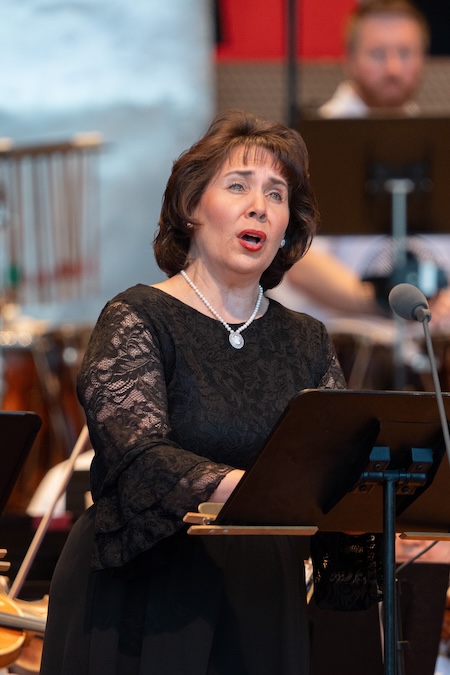
Soprano Jessica Rivera and baritone Andrew Garland were the two soloists, reprising their role premieres from Houston nearly a decade ago. Rivera has a rich soprano and brought apt angst to the conflicted Malinche. Unfortunately, much of her vocalism Friday night was alarmingly wobbly. Rivera seemed to get her vibrato under control in the latter sections where she sang more convincingly and effectively.
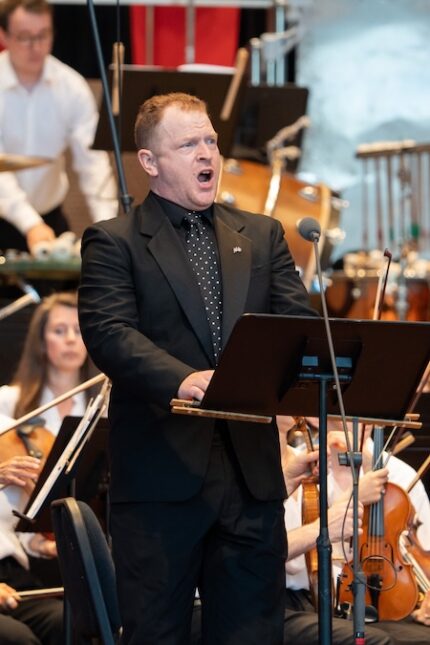
The character of Martin is a cipher with his brief moments giving no chance to etch a character. Even so, Andrew Garland sang impressively, showing a refined yet imposing baritone. One would like to hear this singer in a more grateful opportunity.
The Conquest Requiem is clearly a work that Guerrero believes in, having recorded it last year (with the same soloists), and he elicited playing of great vitality and dedication from the Grant Park Orchestra. Well prepared by Christopher Bell, the Grant Park Chorus distinguished itself with polished and well-blended singing of the Latin liturgy.
Frank’s Conquest Requiem may have been the marquee piece on this program, but it was Brahms’ Symphony No. 4 on the first half that provided the highlight of the evening.
Guerrero led an individual yet idiomatic account of this familiar work. Taking the “non troppo” seriously, the conductor directed a spacious and searching account of the first movement—finding a rare fantasy element, while allowing the musical drama to unfold naturally yet with sure momentum.
In a flowing account of the Andante, Guerrero showed himself a subtle and sensitive Brahmsian, drawing burnished string tone and inward expressive depth from the orchestra. The third movement was aptly bracing and the variations of the concluding Passacaglia rounded Brahms’ last symphony off with apt strength and defiance.
The program will be repeated 7:30 p.m. Saturday. gpmf.org
Posted in Uncategorized
Leave a Comment


 Subscribe via RSS.