Escher Quartet makes welcome return to North Shore Chamber Festival
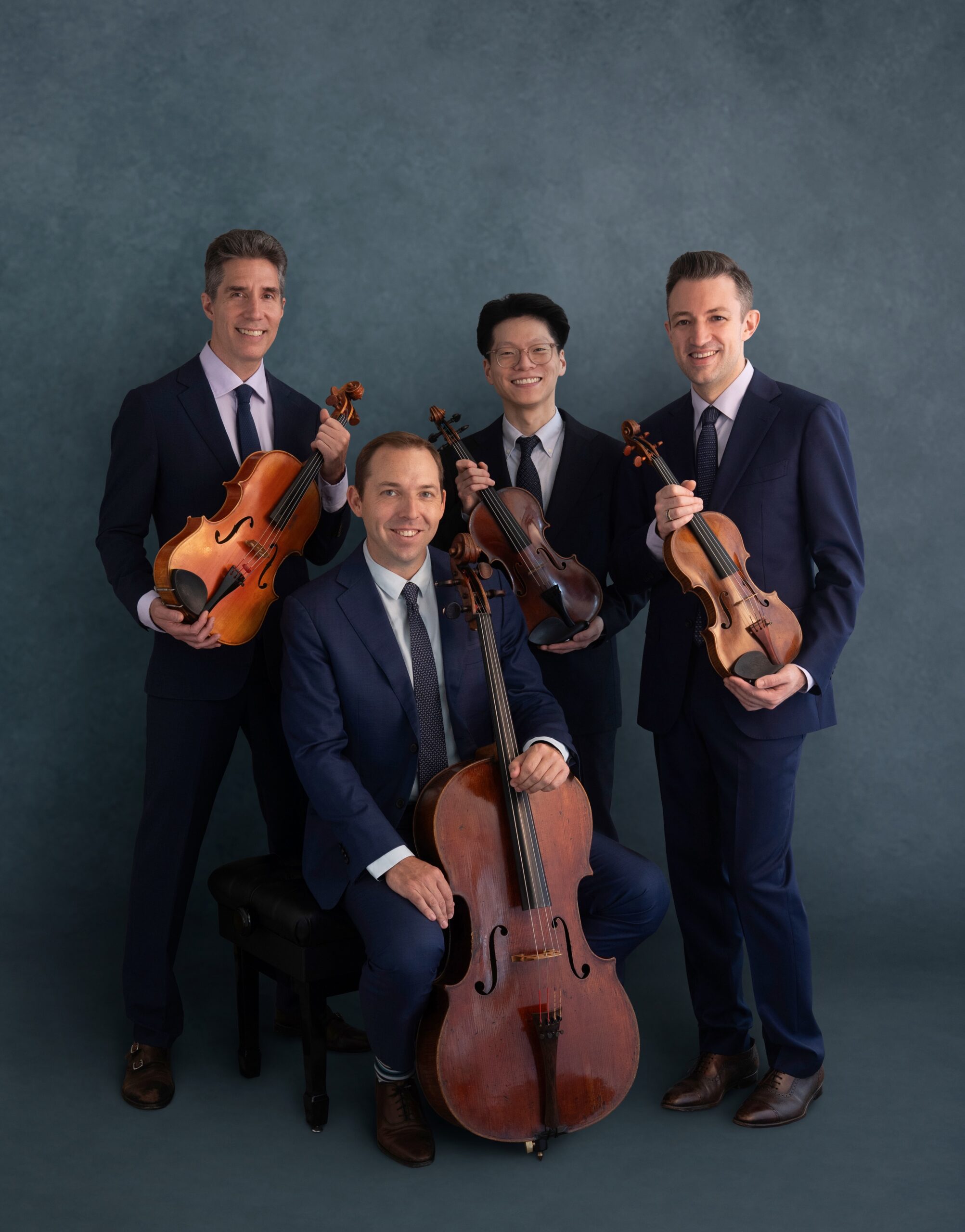
The North Shore Chamber Music Festival (NSCMF) marks an inflection in Chicago’s classical calendar. The three-concert series offered the first week of June at Northbrook’s Village Presbyterian Church for 16 seasons has come to feel like the unofficial start of summer programming, even while some downtown ensembles wrap up their seasons.
Under the leadership of artistic director and violinist Vadim Gluzman and executive director and pianist Angela Yoffe, the NSCMF has consistently offered inspired chamber music and garnered a loyal audience in the northwest suburbs and far beyond.
Friday’s program was a meat-and-potatoes affair: Mozart and Dvořák, with sides of Barber and Suk.
Samuel Barber’s Adagio from his String Quartet, Op. 11, is the original version of the inescapable Adagio for Strings, which Barber orchestrated at the request of Arturo Toscanini. The Escher String Quartet, frequent NSCMF guests returning after a few years’ absence opened the performance with a haunting account of the most widely performed nine minutes of American music. Beginning with the single voice of the first violin, the Escher collectively sustained the movement’s striving, ascending lines, deftly pacing its interruptions and restarts to convey a palpable sense of grief.
Mozart’s Clarinet Quintet in A Major, K. 581, showcased NSCMF stalwart Ilya Shterenberg, with genial support from violinists Gluzman and Joshua Brown, violist Masumi Rostad, and cellist Mark Kosower. Along with the great Clarinet Concerto, Mozart wrote the Quintet for his friend and fellow Mason Anton Stadler, a bond that shone through in the smiling collegiality of Friday’s performance.
The musicians captured the limpid graciousness of the Allegro, and Shterenberg and Gluzman eloquently traded strains in the rapt Larghetto. The Menuetto went with open-air jollity, adorned by a pair of winking trios. The concluding Allegro con variazioni is a wonder, and Shterenberg and colleagues charted Mozart’s transformations of his unassuming material into episodes of bounding virtuosity and almost spiritual consolation.
Josef Suk was a student of Dvořák, an influence that was clear in the 1902 Elegie for Piano Trio, offered by Yoffe, Gluzman, and Kosower. A gentle pulsating in the piano gives way to a rhapsodic melody traded between violin and cello, which sets off a tense, roiling central episode. Yoffe’s evocative support throughout this impassioned stanza was particularly striking.
The Escher returned to conclude the evening with Dvořák’s String Quartet No. 12 in F Major, “American,” Op. 96. The Barber and Dvořák works were the festival’s ostensible nod to the 250th anniversary of America’s founding next month, which felt rather perfunctory.
The Allegro non troppo crackled with the Escher’s effortless ensemble, and they movingly plumbed the spiritual lamentation of the Lento. The dynamic musicians cantered through the Molto vivace and ended with a kinetic account of the Finale. This was quartet playing of the highest order.
As noted at Wednesday’s concert some members of the Northbrook audience again proved vexing. There was a steady stream of punctuation by jangling cell phones, and many were taking videos during the performance.
Applause between movements is usually unwelcome—between variations, as in the Mozart quintet, it’s incomprehensible. In a moment only David Lynch could imagine, a pushy, self-identified “loyal patron” loudly exhorted between movements, “There should be no clapping now!”
A standard announcement about putting away phones and holding applause would go a long way.
The North Shore Chamber Music Festival concludes 7:30 p.m. Saturday at the Village Presbyterian Church with music of Tchaikovsky, Gershwin, and Mozart. nscmf.org
Posted in Performances
2 Responses to “Escher Quartet makes welcome return to North Shore Chamber Festival”
Leave a Comment
 Subscribe via RSS.
Posted Jun 06, 2026 at 12:56 pm by Jacob Hildner
Yes, the audience behavior — clapping (often loud and instant) between movements and filming (two people were filming on their phones directly in front of me) — has been the only sour note in the festival so far, but a surprisingly big one that distracts and irritates throughout the evening.
I don’t recall ever encountering anything this bad before, at this festival or anywhere. I’m sure they don’t want to alienate any audience member, but I second the idea of a friendly announcement at the beginning of the concert to silence phones, not film, and hold applause until the end of the piece, for everyone’s enjoyment.
Posted Jun 14, 2026 at 1:18 pm by M Weston
You’re right about the clapping, it was pretty bad and I attended Friday and Saturday.
But it was evident that classical music is cherished in this community. And, in this day and age of coarseness, that’s a blessing !