Weilerstein wraps CSO season with absorbing survey of American music
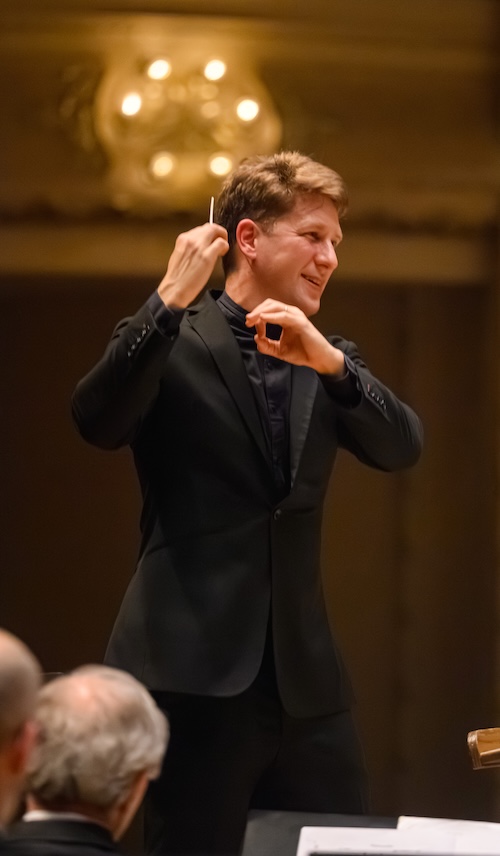
As crazy quilts of musical Americana go, the program presented by the Chicago Symphony Orchestra Thursday night at Symphony Center was a humdinger.
Its eclectic components spanned several centuries and multiple generations of American composers—as well as a transplanted Central European composer who paid musical homage to the nation that offered him haven and new opportunity.
Presented as part of the orchestra’s monthlong celebration of American music, on the occasion of the nation’s 250th birthday, this wide-ranging sonic tapestry benefited from the firm, vigorous direction of conductor Joshua Weilerstein. Making his debut on the subscription series after a 2023 CSO appearance at Ravinia, he drew committed playing from the various iterations of the CSO.
Thursday’s survey of 20th and 21st century American orchestral works began with a recent piece by former CSO composer-in-residence Jessie Montgomery, working its way back in time through the iconic figures Aaron Copland and Duke Ellington to the crusty Yankee visionary who really founded American music, Charles Ives.
Evocations of turbulent battles for social equality lie just below the teeming surface of Montgomery’s Banner, heard in its 2017 version for string quartet and chamber orchestra. Full of rhythmically driven energy, her eight-minute piece suggests the sometimes violent contradictions between American ideals and American reality. The music pivots from snippets of “The Star-Spangled Banner” to a kind of uneasy hymn punctuated by a relentless drum beat. Montgomery’s work made a potent curtain raiser.
Then it was on to a genuine rarity, Bohuslav Martinů’s The Rock, new to the CSO’s repertory.
After emigrating to America in 1941, the Czech composer, by then blacklisted by the Nazis, took up U.S. citizenship and entered a late flowering of creativity. This 1957 symphonic prelude was one such result. The cellos sing nostalgic evocations of Czech folk music that are soon swept away by punchy intimations of American urban landscapes. It ends with a full-orchestra chorale ablaze with optimistic affirmation. Even if it isn’t a masterpiece, almost anything Martinů wrote for orchestra is worth hearing. Weilerstein and the CSO delivered a cogent reading that made one eager to hear more Martinů at Orchestra Hall—the Sixth Symphony, anyone?
The inclusion of Copland’s Lincoln Portrait, a key work of 1940s wartime patriotic populism, as part of the anniversary celebration was practically de rigueur. It was a fitting coincidence that the piece should be presented on the day of the dedication of the Obama Presidential Center on the city’s South Side.
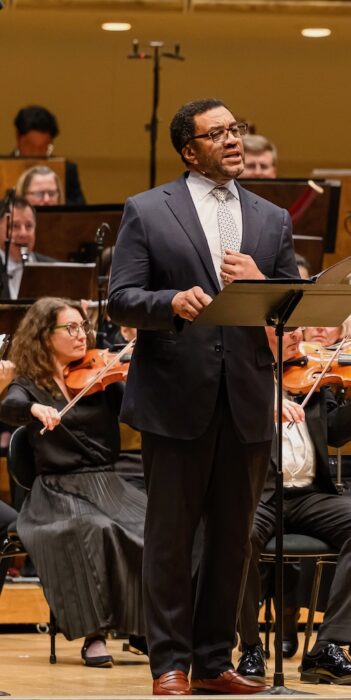
Weilerstein knows the Copland style and he whipped up plenty of high-decibel fervor for the big moments, unfortunately confusing intensity with loudness. The narrator was Chicago native Harry Lennix, a distinguished stage, film and TV actor and director whose work is familiar to Steppenwolf and Goodman Theatre audiences. He declaimed the quotations from President Lincoln’s speeches in a thoroughly professional manner, falling just short of the eloquence that would have made a respectable account truly memorable.
Like Martinů, Charles Ives has fallen into neglect at the CSO in recent years, so it was good to have one of his most important pieces, the orchestral set Three Places in New England, back in the repertory. With this sonic phantasmagoria we get sights and sounds of early 20th century American life, including hymns and marching tunes, filtered through the composer’s maverick imagination.
More than a century after it was finally assembled, the music’s sheer audacity remains hardly diminished. Weilerstein really came into his own with this one, and so did the orchestra. He managed to clarify the knotty polyrhythms and raucous dissonances, sorting out the dense harmonic layers with a precision that did not skimp on tenderness or atmosphere.
With the addition of five saxophones and drum kit to the ensemble, the concert ended with Ellington’s 1950 tone poem Harlem, heard in the orchestration by Luther Henderson. This jazzy musical thrill-ride, colorfully textured and filtered through a sensibility that fused vernacular and classical traditions as perhaps no other in midcentury American composition, is always great fun to hear.
The Chicago players and unnamed guest musicians really sizzled, nudging the down-and-dirty syncopations with all the joyous spontaneity of a great night at New York’s Cotton Club in the late 1920s when Ellington was coming of age as a musician. It ended the evening on a whooping high.
The program will be repeated 7:30 p.m. Saturday and 3 p.m. Sunday at Symphony Center. cso.org
Posted in Uncategorized
Leave a Comment

 Subscribe via RSS.