Conductor debuts in mixed program with Grant Park Orchestra
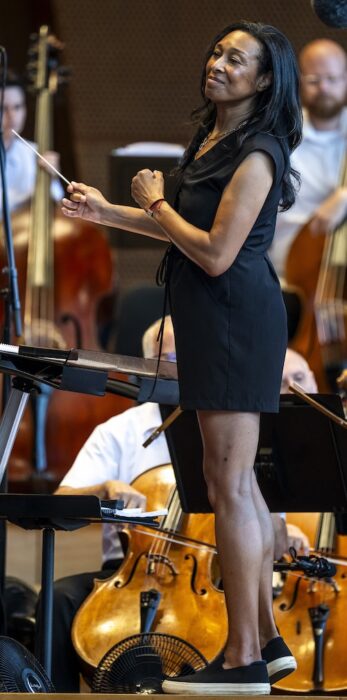
In 2008, conductor Jeri Lynne Johnson founded Philadelphia’s Black Pearl Chamber Orchestra, seeking to embody desired social changes through orchestral programming and performance. Johnson made her debut with the Grant Park Orchestra on Wednesday’s sweltering evening in a program framed by works of William Grant Still and Florence Price.
Still’s Festive Overture from 1944 was written and premiered at the height of American involvement in WWII, and was first played by the GPO in the immediate aftermath of the war’s conclusion. Still’s work conveys an unsettled confidence, with a strutting main theme that never quite finds its stride, seeming to anticipate Shostakovich’s work of the same name a decade later.
An optimistic brass fanfare gave way to a more ruminative central section with questioning statements from guest concertmaster Ilana Setapen (from the Milwaukee Symphony) before the return of the ambiguous opening material. Johnson’s attentive direction sustained this tension without trying to force Still’s writing into a facile triumphant box.
Michelle Cann was the soloist for Ravel’s Piano Concerto in G, returning to Grant Park after opening their 2022 season with Florence Price’s Piano Concerto in One Movement. Cann, a Grammy winner who joined the Curtis faculty in 2020, captured the Allegramente’s bustling urban energy, alternating with the Basque composer’s more sultry jazz-infused episodes.
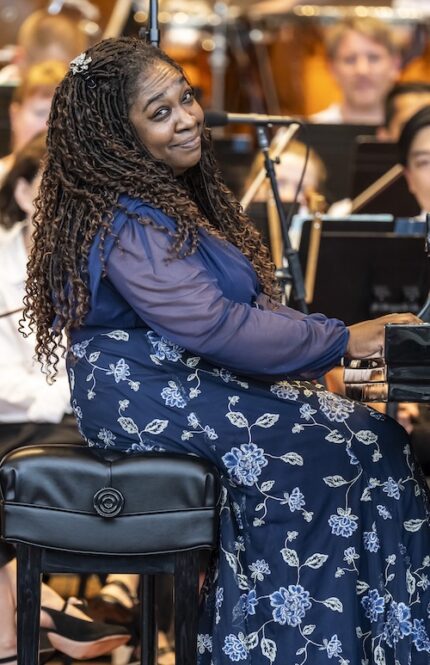
Cann admirably sustained the Adagio assai’s endlessly spinning melody at the outset, though Johnson struggled to make the movement cohere as it progressed. Cann was not aligned with the English horn at the theme’s return, where her glittering accompaniment overpowered Anne Bach’s solo, which was scarcely audible. Cann bounded assertively through the Presto’s infectious pyrotechnics, supported by nimble acrobatics across the orchestra’s wind sections.
A standing ovation brought Cann back for an immediate encore, 20th-century jazz virtuoso Hazel Scott’s transcription of Liszt’s Hungarian Rhapsody No. 2, which enhances Liszt’s original with jaunty antics that Cann whipped through with flair.
The evening closed with the first Grant Park Orchestra performance of Florence Price’s Symphony No. 3 in C Minor from 1940. Riccardo Muti led the work’s belated local premiere with the Chicago Symphony Orchestra in 2022, and Wednesday’s Grant Park performance, though committed, made a similarly jejune impression.
The brass chorale of the opening Andante seems to channel Tristan und Isolde before giving way to an Allegro that ultimately feels tentative, never pushing any idea too far. One can hear Price’s struggle for recognition and concern for staying in her era’s stylistic confines, but this does not necessarily make for engaging material. The lyrical second theme is affecting, but feels obviously derivative of the famous Largo from Dvořák’s “New World” Symphony.
A sense of wistful stasis pervades the Andante ma non troppo, though it is at times hard to follow the music’s narrative thread. The third movement, Juba, is an admirable attempt to inject African dance into the American symphony, but the treatment is so simplistic it ultimately feels out of scope with the genre, sounding like a capable orchestration of Joplin.
The closing Scherzo has whiffs of the fulminating energy of a Dvořák finale, but ultimately feels like a series of musical cliches that amount to a pale shadow of its Romantic models. Johnson and the Grant Park players gave Price’s work all the help they could, but ultimately their case for this uneven work was no more convincing than Muti’s with the CSO.
Christopher Bell conducts the Grant Park Orchestra in James MacMillan’s Cantos Sagrados, Vaughan Williams’ Toward the Unknown Region, and the Fauré Requiem 6:30 p.m. Friday and 7:30 p.m. Saturday. Michelle Cann will perform “Beyond the Years: Unpublished Songs of Florence Price” with soprano Karen Slack 2 p.m. Sunday. grantparkmusicfestival.com
Posted in Uncategorized
Leave a Comment

 Subscribe via RSS.