Kern delivers a summer highlight as Kalmar returns to Grant Park Festival
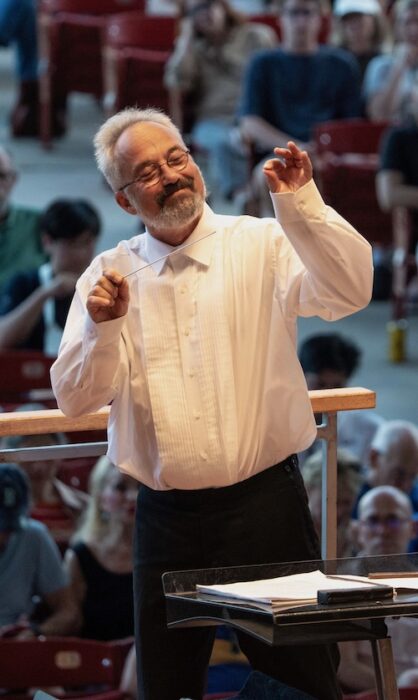
The headline from Wednesday night’s Grant Park Orchestra concert wasn’t the intense heat—even with the mercury hovering around 90 degrees at curtain time—but the return of Carlos Kalmar after a season’s absence.
Artistic director and principal conductor of Chicago’s summer lakefront series for a near-quarter-century (2000-2024), Kalmar helped to build the Grant Park Music Festival to, arguably, the highest artistic quality in its history. The conductor directed consistently excellent performances across a dizzyingly wide variety of repertoire with a dedicated commitment to American music and lesser-heard works.
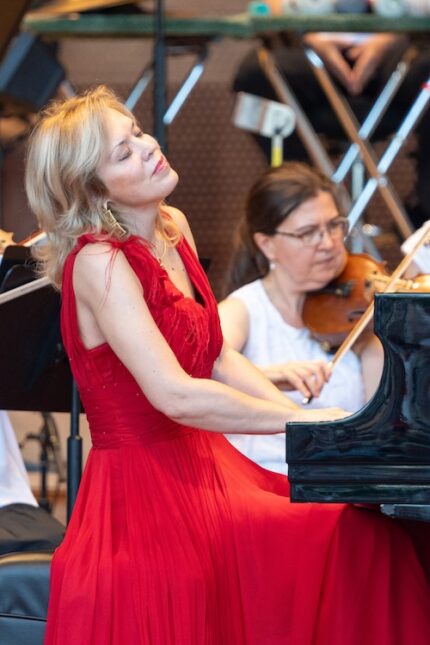
Yet even as big an artistic personality as Kalmar wound up yielding the spotlight on the first half of Wednesday’s program to the evening’s soloist, Olga Kern, in her belated Grant Park debut.
The Russian-American pianist is an artist we don’t hear often enough in Chicago. In fact, her most recent CSO appearance was at Ravinia 17 years ago, and one felt regret at that extended absence even more hearing Kern’s extraordinary performance of Rachmaninoff’s Piano Concerto No. 3 Wednesday night.
A gold medal winner at the Eleventh Van Cliburn Competition in 2001, Kern has the power and unassailable, Russian-trained technique to sail through the most demanding complexities of this famously challenging warhorse. Yet the pianist also floated the lyrical themes with a limpid touch and individual rubato. She brought massive strength to Rachmaninoff’s longer cadenza (with what sounded like some extra embellishments), and rarely has that solo passage sounded so convincingly like the climactic peak of the first movement.
In the Intermezzo the pianist was clearly in synch with the brooding, inward expression of the slow movement, well contrasted with the light, balletic quality she brought to the ensuing waltz-like section. Kern’s faultless prestidigitation built accelerating momentum and mounting excitement to the coda, providing the most exhilarating display of old-fashioned bravura the summer concert season has brought us to date.
Kern, who appeared to be dealing with a summer cold or allergies, still graciously responded to the clamorous ovation with a bonus—a witty, frolicsome encore of Moritz Moszkowski’s Étincelles (Sparks), in the Vladimir Horowitz arrangement.
The only serious debit on the concerto performance was technical, not musical. To quote Mark Twain, Kalmar’s orchestral accompaniment was clearly better than it sounded Wednesday night.
While the amplified piano was robust and well projected, the sound of the Grant Park Orchestra emerged as jarringly anemic and colorless. Crucial passages and wind solos were inaudible or barely registered, as if the onstage mics failed or weren’t even turned on. Kern’s artistry and virtuosity powered through the unequal sonics, but this was a classic case of a tech fail undermining a performance.
Whatever the problem was with the orchestra’s miking or amplification in the Rachmaninoff concerto, the issue was resolved at intermission, for the Grant Park musicians were restored to their customary sonic presence and tonal brilliance in the second half.
It was heartening to see most attendees in the pavilion stick around after the populist Russian warhorse—even in the continuing heat—for lesser known works by Stravinsky and Elgar.
Jeu de cartes (Game of Cards) is one of Stravinsky’s most engaging short ballets. The dancers represent player cards, who are bedeviled by the Joker in the deck. Each of the three short sections or “deals,” is announced by a fanfare-like motif.
Kalmar led a delightful performance that could not have been bettered in its rhythmic acuity, precision balancing, and deft handling of Stravinsky’s intricate counterpoint. The Grant Park woodwinds shone in this music, serving up wonderfully witty and nimble playing, and Kalmar ensured that all of Stravinsky’s harmonic curveballs and rhythmic backflips registered.
Like many composers before him, Edward Elgar was inspired by a visit to Italy, which resulted in his musical memento, In the South (Alassio). Some of the material may have been drawn from music that predates the English composer’s Mediterranean sojourn but this large-scale concert overture is still crafted with customary skill and lyrical warmth.
Over his long Grant Park tenure, Kalmar has shown himself a masterful Elgarian in memorable performances of the composer’s epic Symphony No. 1, concertos and other works. Such was the case again, with Kalmar leading a bracing, rich-textured performance that brought out all of Elgar’s kinetic energy and scoring brilliance.
The dashing opening theme went with heroic vitality, the Roman legions tramped imposingly, and Kalmar kept surging momentum to the fore, expertly handling Elgar’s tricky narrative through the contrasting episodes. Terri Van Valkinburgh brought a lovely, wistful expression to her viola solos in the inward “canto populare” section.
The program will be repeated 6:30 p.m. Friday.
__________
Christopher Bell, who provided a typically ebullient introduction to Wednesday night’s concert, will be a presence at the Grant Park Music Festival through 2029. Bell, who is currently marking his 25th anniversary as chorus director, has just had his contract renewed for three more seasons.
Christopher Bell leads the Grant Park Chorus in an American program, 6:30 p.m. Thursday at South Shore Cultural Center as well as the Independence Day salute 7:30 p.m. Saturday, July 4. gpmf.org
Posted in Performances
Leave a Comment
 Subscribe via RSS.