Grant Park musicians salve the fury and grief of Corigliano with the spiritual balm of Mozart
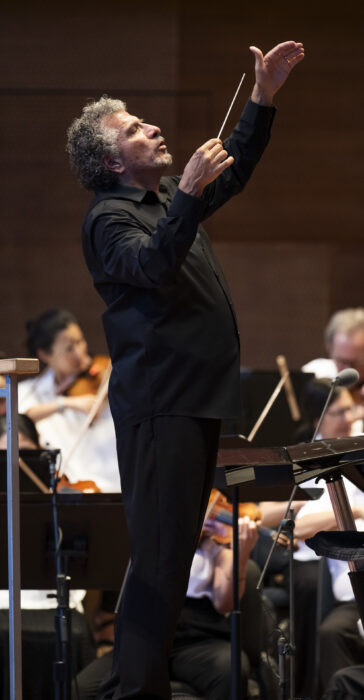
Music of mourning reached across the centuries to gripping effect at the Grant Park Music Festival Friday evening at the Pritzker Pavilion in Millennium Park.
Artistic director and principal conductor Giancarlo Guerrero led the season’s penultimate weekend of concerts by the Grant Park Orchestra with an uncommon if inspired pairing of requiems.
Separated by almost 200 years, Mozart’s unfinished setting of the Requiem (presented here in its 1991 completion by Robert D. Levin) and John Corigliano’s Symphony No. 1 complemented each other even better than one expected—the Mozart mass providing welcome heart-ease after the devastating Corigliano symphony.
Corigliano wrote his First Symphony on commission from the Chicago Symphony Orchestra in 1988-89 near the end of his tenure as the orchestra’s first composer-in-residence. The CSO gave the world premiere in 1990 under then music director-designate Daniel Barenboim following his predecessor Georg Solti’s inexplicable refusal to take up a score expressly written for him and the orchestra.
One of Corigliano’s most widely performed works and certainly his most deeply personal, the symphony commemorates close friends he had lost to the then-emerging AIDS crisis, while reflecting on others he was losing.
The music veers between rage, nostalgia, frustration and numbed grief, weaving a musical AIDS quilt out of disparate materials. It has held up remarkably well over the decades—an important document from one of American music’s elder statesmen, whose raw power, at once unsettling and healing, continues to resonate far beyond the circumstances of its creation.
Guerrero threw himself into his reading like a man possessed, the only way one should approach this take-no-prisoners piece.
The heartbeat of open A’s pounding away relentlessly throughout the opening movement (titled “Apologue: Of Rage and Remembrance”) tore through the muggy evening air like a primal scream. It finally gave way to the distant sounds of an offstage piano playing Leopold Godowsky’s transcription of Isaac Albeniz’s Tango, a favorite piece of Corigliano’s pianist-friend Sheldon Shkolnik.
(A frequent soloist at Grant Park and the work’s dedicatee, Shkolnik died of AIDS, at 52, a week after attending the CSO’s world premiere of the symphony.)
Guerrero deftly shaped the violent extremes of tempo and texture that form the second-movement “Tarantella,” written in memory of a music-industry executive who died of AIDS dementia. The music lurched in and out of lucidity to harrowing effect.
Principal cello Walter Haman sounded the tender solo lines of “Chaconne: Giulio’s Song,” an elegy to a longtime friend of the composer’s, an amateur cellist. The movement ended with a clangorous march of brass and percussion that, along with the rest of the performance, gave the Grant Park stalwarts a stiff workout.
A pity that the offstage piano was so prominently amplified as to prevent the Albeniz-Godowsky fragment from sounding as if were coming from a hazy distance, per the composer’s intentions.
Guerrero’s enterprise also was reflected in his choice of editions for the Grant Park Chorus and Orchestra’s deeply felt account of the Mozart Requiem.
The 1991 completion by pianist and Mozart scholar Levin carefully revises the traditional version by Mozart’s pupil Franz Xaver Süssmayr. Levin thinned out the dense orchestration, corrected grammatical errors and added a newly composed fugue for the “Lacrimosa” section based on a sketch found in Mozart’s papers.
Far from a radical rewrite, the Levin edition is a respectful overhaul, completely Mozartean in style, that has taken its rightful place in the modern choral repertory.
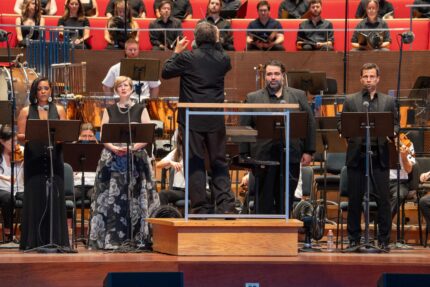
Director Christopher Bell’s contingent of choral voices has gone from strength to strength all season, and Friday’s performance found them rising to the challenges of the unfamiliar Levin realization, under Guerrero’s steady guidance, like the fine-tuned, tightly disciplined chorus they are.
If their sound as heard through the sound system lacked the ultimate transparency of an indoor performance, it had plenty of full-throated strength and solidity in sections like the “Dies irae,” along with immaculate enunciation of text in the fugal pages.
Together, Guerrero, the chorus and orchestra brought out a caring sense of the spiritual mystery behind the final notes Mozart ever wrote.
A sturdy quartet of vocal soloists shared in the applause. Kelly Markgraf brought a rock-solid bass to his entry in the “Tuba mirum” section, followed by the elegant Mozart tenor of Andrew Haji and the angelic soprano of Janai Brugger. All three singers were very good. Mezzo-soprano Susan Platts sounded rather hooty at her entrance, the voice gaining focus later in the performance.
The program will be repeated 7:30 p.m. Saturday at the Pritzker Pavilion, Millennium Park; gpmf.org
Posted in Performances
2 Responses to “Grant Park musicians salve the fury and grief of Corigliano with the spiritual balm of Mozart”
Leave a Comment
 Subscribe via RSS.
Posted Aug 08, 2026 at 9:35 pm by david m novak
The Corigliano overwhelmed me to such an extent that I left before the Mozart. What a piece of music and what a performance!
I attended the world premiere decades ago. The music has gotten even better with age. Double WOW.
Posted Aug 13, 2026 at 12:20 pm by Jepaco
Wonderful review. Like David M Novak, I was absolutely overwhelmed by the Corigliano, and agree with Mr von Rhein that the Mozart seemed a balm afterward.
I have had the recording of the Corigliano since it first came out and no doubt listened to it several times, but it’s a piece that needs to be heard live.