Mäkelä’s revisited “Firebird” takes memorable flight at Ravinia
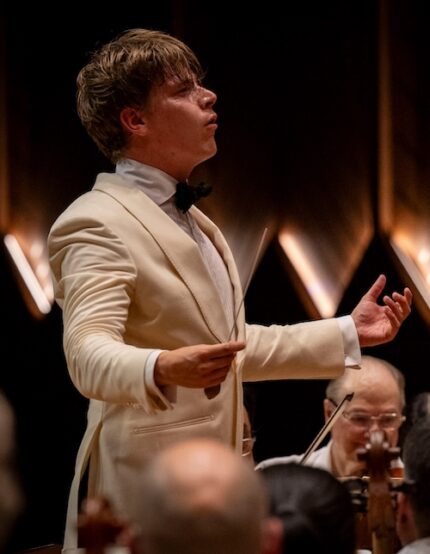
The second and final program of Klaus Mäkelä’s brief Ravinia residency with the Chicago Symphony Orchestra drew a much larger turnout on Friday than the previous evening. Who knew Igor Stravinsky and Claude Debussy were more likely to pack the pavilion and fill the vast lawn than Strauss and Sibelius?
The first half was devoted to Debussy in the Finnish conductor’s first CSO performance of any of the French composer’s music.
Prelude to the Afternoon of a Faun led off. Mäkelä led a spacious yet focused reading that, characteristically, gave ample space for phrasing by the woodwinds. Presenting this work while still lacking a first-chair flute can be a perilous venture yet guest principal flute Kayla Burggraf—who just joined the Houston Symphony last month—brought the requisite languor and arboreal atmosphere. There was equally sensitive oboe and clarinet playing, respectively, by the CSO’s Two W’s—William Welter and Stephen Williamson.
Iberia, the central triptych of Debussy’s “Images” for orchestra, closed the first half in a reading that seemed like more of a work in progress. Mäkelä and the CSO put across the bright Spanish colors of the outer sections with fine rhythmic snap and vivacity, and Williamson’s antic clarinet work was especially delightful. The central movement, “Les parfums de la nuit,” while well played and balanced, felt too firmly outlined and “present,” missing the requisite nocturnal mystery and a sense of time standing still.
The evening concluded with Stravinsky’s The Firebird. As popular and often played as is the 1919 Suite from the composer’s ballet, one can only truly appreciate Stravinsky’s achievement when Firebird is heard complete and in the original scoring. The richness of Stravinsky’s 1910 version is as remarkable for its subtle hues as its kaleidoscopic audacity (triple winds, three harps, piano, celesta, xylophone, four Wagner tubas and bass drum). The fantastical tale is also less inscrutable when heard in narrative order.
It was Stravinsky’s Firebird that won over the musicians at Mäkelä’s 2022 CSO debut. As fine as that performance was, Friday night’s revisitation was on another level altogether.
As before, the performance was remarkably organic. From the rumbling tread of the lower strings in the Introduction, the dark fairy tale proceeded naturally and inevitably through its various episodes under Mäkelä’s direction, as fluid and graceful as the dancers likely performed at the Ballets Russes premiere 116 years ago.
Despite the score’s familiarity, Friday’s performance still emerged astoundingly fresh. Time and again one marveled at the iridescent richness and ingenuity of Stravinsky’s music and his orchestration—not just in the un-excerpted passages but in the different scoring of the well-known sections as well.
Kastchei’s Dance was infernal indeed with a vehement violence that felt almost assaultive. Yet most striking was how human and emotionally involving of an experience this performance turned out to be. The plight of the Firebird, her pursuit and capture by the Tsarevich, proved unusually compelling, with her desperate entreaties heart-breaking.
The ballet felt as much of a journey as the Straussian mountain climb the previous evening. The glowing coda and gradual rising of the Berceuse theme felt not noisily triumphant but heart-easing and transcendent.
It almost seems invidious to single out individual players when the musicianship was so stellar across every section. Concertmaster Robert Chen’s sensitive violin playing proved even more silken and tender than four years ago, and Mark Almond’s horn solos in the Berceuse and elsewhere were as polished and eloquent as in the Alpine Symphony the previous evening.
__________
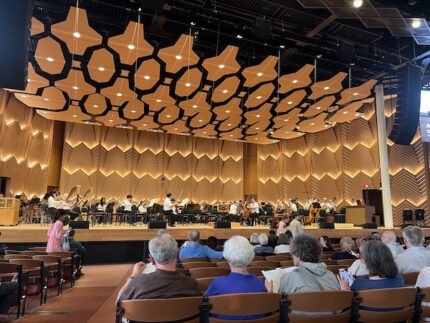
At the risk of declaring victory too soon, Ravinia’s $70 million renovation of what is now called the Hunter Pavilion appears to be an unqualified success. The quasi-Moorish visual design is a bit busy but striking and pleasing to the eye. The new seats are wider, plushly paddled and comfortable. The larger seats and significantly expanded stage reduces the pavilion seating (the new capacity is 2,840) but that’s 500 fewer seats that the festival often had trouble filling anyway.
Any fears that such a multipurpose space—one that must also accommodate the pop and retro-rock concerts that dominate much of Ravinia’s schedule—might prove less hospitable for classical events appears to be unfounded. In fact, the opposite appears to be true.
Heard from two vantage points on successive nights near the front left-center (Row L) and towards the back (DD), the sound emerged rich, clearly detailed and powerful at both locations, without any “canned” or clinical quality to the necessary amplification. Some Ravinia regulars complain of a persistent low rumbling sound but I didn’t notice anything like that at either concert. In fact, the sound of the orchestra seemed so natural, warm and well balanced that I forgot it was amplified and simply became caught up in the performances.
Congratulations to Ravinia CEO Jeffrey P. Haydon, the Ravinia board, Lohan Architecture and all involved who planned and executed this impressive physical and acoustical refurbishment.
Now can the CSO hire the same acoustical team to fix Orchestra Hall?
Pianist Mischa Dichter performs music of Beethoven, Brahms, Chopin and Prokofiev 1:30 p.m. Sunday at Ravinia’s Bennett-Gordon Hall. ravinia.org
Posted in Performances
One Response to “Mäkelä’s revisited “Firebird” takes memorable flight at Ravinia”
Leave a Comment
 Subscribe via RSS.
Posted Aug 09, 2026 at 4:28 pm by PRyan
A divine night of music. The greatest orchestra in the world never fails to delight the senses.
So much to look forward to with Klaus. Great choice to lead the CSO!!