“Liliom” is a dazzling showcase for the elegant virtuosity of Joffrey Ballet
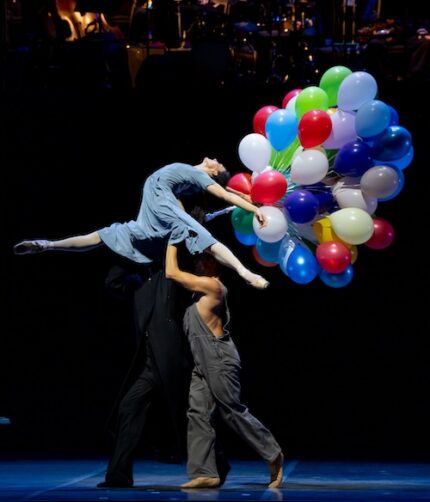
John Neumeier is among the most innovative architects of dramatic dance in the theater, and his distinctive brilliance as a choreographer and stage director has built a loyal and receptive following in Chicago in recent years.
Think of his Gluck Orphée et Eurydice for Lyric Opera of Chicago in 2017, with members of Joffrey Ballet Chicago fluidly executing the prominent dance element. Or consider his imaginative adaptation of Tennessee Williams’ The Glass Menagerie, which his Hamburg Ballet brought to the Harris Theater in 2023.
The best of the Milwaukee-born, Hamburg-based Neumeier’s ballets pack a vibrant if quirky theatricality that can hit you in the gut, put a smile on your face and touch your heart in rapid succession. They refute the widespread notion that dance cannot process emotional complexity with much success.
So it is with Neumeier’s dazzling Liliom, which opened Joffrey Ballet’s 71st season Thursday at the Lyric Opera House.
Superbly executed down to the last flourish, the narrative ballet is a tour de force for all concerned.
Created for the Hamburg Ballet—which Neumeier has helmed as artistic director and chief choreographer for more than 50 years—this bittersweet Depression-era romance is based on the 1909 drama of the same name by Hungarian playwright Ferenc Molnár.
If the central plotline rings a vague bell, that’s because the Molnár original inspired the enduringly popular musical Carousel.
Liliom is the ill-fated love story of a street-tough carnival barker Liliom (Billy Bigelow in the musical and film versions), who abandons his shady lifestyle to romance the virtuous young Julie. Liliom commits a crime to secure money for their expected child. Having died before he can be apprehended, Liliom languishes in purgatory before he is miraculously granted a final act of grace that would grant him the redemption that eluded him in life.
Rodgers and Hammerstein gave their adaptation a feel-good ending awash in sentimental gush. Neumeier goes in for a kind of fantastical surrealism mixed with intense, even messy, emotion. Don’t expect to leave the Opera House dabbing away tears to “You’ll Never Walk Alone.” Liliom dances a rueful farewell to the son he never knew, before being called back to the star-strewn beyond.
Neumeier’s engrossing dance-theater piece populates the stage with all manner of richly observed humanity, circa 1932 America. We see carnival entertainers, crooks, clowns, funny red devils, the corrupt rich, flirty couples, a heavenly gatekeeper. The stage teems with activity practically nonstop–subsiding every so often to propel the main plot and various subplots forward.
All this would appear made to order for the vibrant energy and sleek virtuosity of the amazing Joffrey dancers. Liliom puts virtually the entire company roster, plus a horde of extras, on full display, with revolving casts assuming the principal and supporting roles in the remaining nine performances.
The narrative is undergirded by a Michel Legrand score that pours out lush cinematic lyricism for full orchestra, periodically giving way to the sax-saturated hot licks of an onstage instrumental combo. The Lyric Opera Orchestra under Nicholas Koo and the Rob Parton Big Band prove to be a wonderful aural complement to the emotional topography of the narrative.
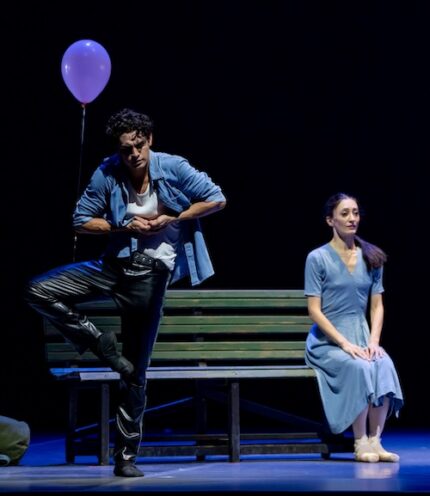
On opening night, José Pablo Castro Cuevas, as the eponymous antihero Liliom, and Victoria Jaiani, as Julie, revealed a potent dramatic chemistry that blazed a taut through-line in a 2½-hour performance comprising seven scenes and prologue, with intermission.
Cuevas’ Liliom exuded bare-chested bravura in the big moments and hesitant tenderness in the intimate moments with the woman who would make a better person of him. Watch Cuevas melt into angular frustration whenever his best efforts to prove himself worthy of Julie’s love came to naught. One casting oddity: Reed Henry, who danced the role of Liliom’s son Louis—and very well, at that—appeared to be approximately the same age as his father.
Jaiani’s protective Julie was a wonderfully poised presence in the drama—a young woman selfless enough to stick with Liliom despite their vastly different natures. Her delicate spins and aching back-bends of mourning as she cradled the lifeless body of her lover was the climactic highlight of a performance alive with superb dancing from top to bottom.
In supporting roles, Amanda Assucena oozed sensuous, sinuous allure as the carnival owner (and Liliom’s sometime squeeze) Mrs. Muscat. Xavier Núñez brought athletic swagger to the lowlife Ficsur. Natali Taht, as Julie’s friend Marie, and Jonathan Dole, as Marie’s husband-to-be, Wolf Beifeld, made the very most of the secondary sweethearts.
The colorful carnival lights and charming miniature carousel of Ferdinand Woegerbauer’s striking stage designs stood in sharp contrast with the gritty images of shabby, desperate men gathered in protest outside a jobs office.
A final bit of advice as you take in this moving (in all senses) feast of a ballet. Don’t try to figure our each and every detail of the busy—sometimes overly busy—scenario. It’s the danced emotion at the heart of Liliom and Julie’s story that matters the most. And these dancers make it soar.
Joffrey Ballet Chicago’s Liliom continues through September 27. joffrey.org
Posted in Performances
One Response to ““Liliom” is a dazzling showcase for the elegant virtuosity of Joffrey Ballet”
Leave a Comment






 Subscribe via RSS.
Posted Sep 26, 2026 at 8:29 am by John Ross, Jr.
Joyful and visually magnificent; “Liliom” is a brilliant ballet not to be missed. A feast for the eyes and ears and yet not a single word is ever spoken for well over two hours: The dancers and musicians say it all.