Compelling story, music are undone by stiff panegyrics in Lyric Opera’s “Omar”
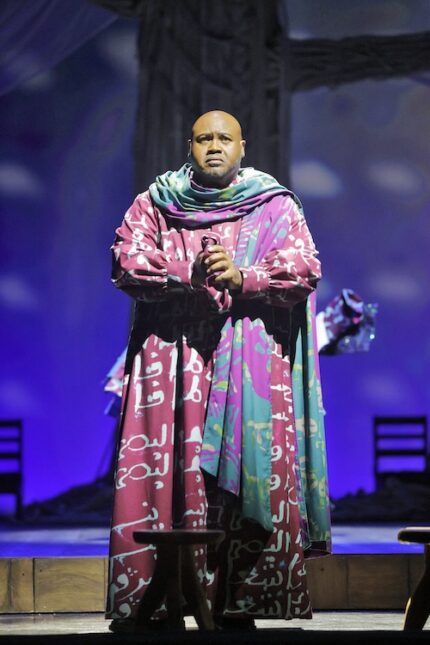
After its world premiere at Spoleto Festival USA in 2022, the opera Omar made several stops around the country and garnered a Pulitzer Prize. Omar came to Chicago Friday night for a brief three-performance run at Lyric Opera.
Omar was a pet project of Anthony Freud, the company’s unlamented former CEO and general director who seemed to have an uncanny reverse Midas touch for presenting works and stagings that few opera-goers in Chicago wanted to see. (This production’s underwriting comes from two different Pritzker foundations.)
Jointly composed by Rhiannon Giddens and Michael Abels, Omar tells the true story of the Koran scholar Omar ibn Said, a West African who was captured in Senegal and brought to America by slave raiders in the early 1800s. Omar escapes from Johnson, a cruel and sadistic plantation owner, and is captured and jailed.
Eventually Omar is sold to the comparatively more enlightened Owen, who is intrigued by Omar’s Aramaic religious writing on the walls of his cell. Encouraged by his daughter Eliza, Owen purchases Omar, hoping to convert him to Christianity and even gifting him a Bible in Arabic. Omar becomes lost and confused in his spiritual quest. Eventually encouraged by his friend Julie and the spirit of his deceased mother Fatima, Omar dedicates himself to writing about Islam and becoming a Koran scholar. The opera ends with a dramatic chorus—singers standing in the aisles of the theater—as Omar calls on the people of the United States to atone.
The good news is that the music by Giddens & Abels (sounds like a law firm) is tonal, attractive and varied, moving the action quickly along the 2-1/2 hour span (including intermission). Also the story of a dignified man’s search for spiritual enlightenment and his true self is universal and compelling.
Yet despite the encomia larded on Omar by legacy media—and the inevitable Pulitzer Prize—there are two major problems with Omar, both of which stem from the libretto, written by co-composer Giddens.
The first is that for too much of the opera Omar—as well as some supporting characters— are stiff cardboard archetypes that rarely seem like genuine, three-dimensional—or even two-dimensional—human beings. From the curtain Omar is valorized as a flawless noble figure, so much so that the performance often seems like an extended panegyric, a worshipful pageant to Omar and Islam in which the audience is being allowed to participate. Act II improves somewhat as a sort-of romance blooms between Omar and Julie. An energetic dance scene for the slaves seems intended to liven up the rather dour proceedings.
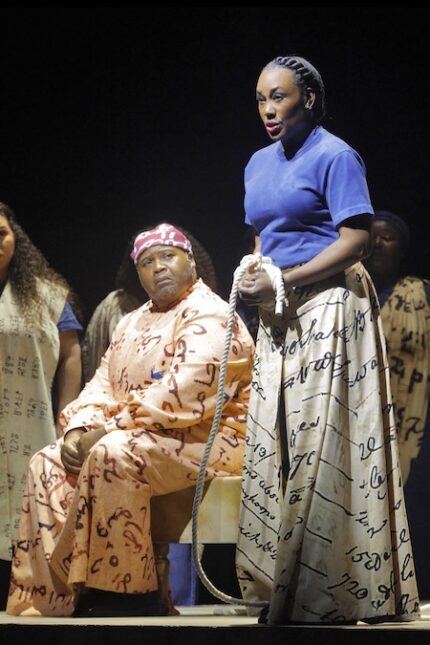
The other major problem is that the libretto too often seems to morph into a religious ceremony. The opening scene, set in Africa, consists almost entirely of Islamic prayers to Allah, first by Omar, then the chorus and his mother Fatima, which would be fine but it goes on for nearly 15 minutes. Is this an opera or a mosque service?
When the action returns to Omar and the other characters, dramatic momentum returns. Yet the opera—which seems to end two or three times—closes not on a note of religious freedom or ecumenicism, which everyone could applaud, but on a somewhat ominous note with Omar stating that America should atone and convert to Islam, implying that there could well be dire consequences otherwise.
Suddenly, one wants to hear an operetta by Franz Lehár.
Lyric’s cast for Omar is solid and often excellent, making up to some degree for the proselytizing PSA’s and libretto issues.
Issachah Savage did all one could ask for in the challenging title role. Long a fixture in local choruses, Savage’s clear, powerful and penetrating tenor made sure impact at Omar’s key moments as with his long solos in Act II. His lower range was huskier but Savage brought a dignified bearing to a role with limited dramatic opportunities.
Kearstin Piper Brown brought an engaging stage presence and rather light soprano to Omar’s friend Julie. Zoie Reams delivered dramatic moments as Fatima, Omar’s mother with her ample mezzo tones.
Other standouts among the large supporting cast were Matthew Dexter as Abdul, Omar’s brother, and Daniel Luis Espinal as the slave Auctioneer and Taylor, Owen’s friend. Camille Robles showed a pleasant voice as Owen’s compassionate daughter Eliza, but her semaphore Magic Hands gestures were distracting.
Kyle Ketelsen is cornering the local market in portraying some of the most loathsome characters seen on the stage at Lyric— Howard, the manipulative cult leader in The Listeners last year and now the racist, repellent plantation owner Johnson. Oddly, he also portrays the more compassionate and kinder—if still condescending—plantation owner Owen. All these white slaveowners look alike.
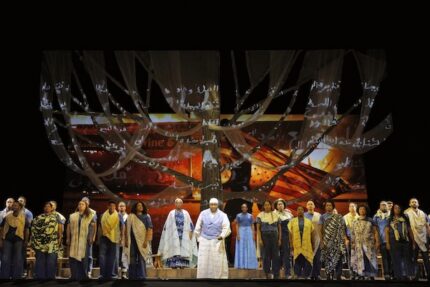
Amy Rubin’s scenic design provided some colorful visuals, not least Omar’s Aramaic writing magically appearing on the set walls. Such moments alternated with drab earth-colors, which were mitigated somewhat by Pablo Santiago’s artful lighting.
A striking visual projection of an African mosque in the opening minutes made one anticipate more effective projected images to come. Unfortunately, subsequent projections were either lackluster or blocked by central set elements. Those mishaps apart, director Kaneza Schaal moved the action solidly in workmanlike fashion.
The program lists three different costume designers, which indicates a problem. Apart from some colorful African garb in the early going, most of the slaves and chorus seemed to be wearing contemporary jeans and their own rehearsal clothes, with little sense of historic period or character.
Conductor Kazem Abdullah did a laudable job keeping this episodic piece flowing and on track. Chorus director Michael Black elicited strong and mostly cohesive singing from the large, mostly black chorus.
Omar will be repeated 2 p.m. Sunday and 7 p.m. Wednesday. lyricopera.org
Posted in Performances
Leave a Comment


 Subscribe via RSS.