Under Szeps-Znaider, CSO’s Mozart-Brahms program fails to achieve liftoff
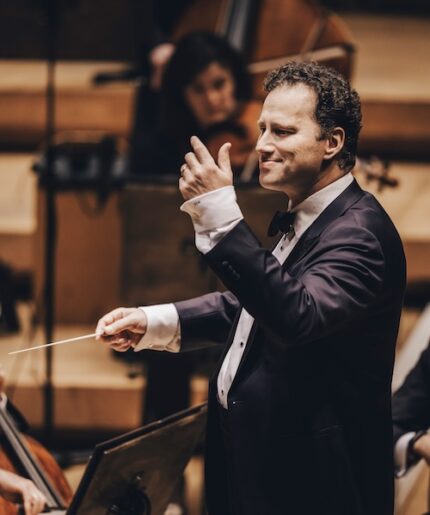
Someone at the Chicago Symphony Orchestra must really like Nikolaj Szeps-Znaider.
Thursday night provided one of those CSO evenings where while listening to the music one found oneself also pondering the vagaries of which conductors get tapped to fill the CSO’s guest conductor slots and why.
Szeps-Znaider is wrapping his two-week CSO residency for the current season with a program of Mozart and Brahms. And while Thursday night’s performances were done in amiable, workmanlike fashion, neither was distinctive, much less inspirational—which has largely been the story of the Danish-born violinist-conductor’s performances over the recent years.
The CSO can attract, and often books, the finest available guest conductors from around the world. Yet it is hard to understand how someone like Szeps-Znaider gets multiple weeks every season when other conductors who have drawn consistently outstanding results with the CSO are not seen at Orchestra Hall.
To take two obvious examples: at the end of this season it will have been three years since the excellent Susanna Mälkki last led a CSO concert. And after Christian Thielemann’s deep and memorable Bruckner Eighth Symphony in 2022, local audiences are still awaiting the German conductor’s return to Chicago.
Nothing against Znaider, who is an engaging presence and one of the finest violinists of his generation. But after several years of conducting, the depth and artistry of his violin playing still have yet to be manifested in his podium work. And, frankly, CSO musicians and audiences deserve a higher standard.
The evening began with music of Mozart. The composer famously dished off his Symphony No. 36 in four days while on tour. Yet even by Mozart’s elevated standard there is not the slightest evidence of K.425 being penned in a rush. The elegant, perfectly proportioned “Linz” symphony eventually garnered its sobriquet from the city in which Mozart led the premiere.
Szeps-Znaider led a trim reading with well-judged tempos, making a case for scale by taking all repeats in the framing movements. Yet while the main section of the opening movement was spirited enough, balances were fitfully off with the over-prominent timpani repeatedly drawing attention to itself. Strings were ill-blended, with violins lacking presence at times.
The ensuing Andante proved poised yet superficial, failing to plumb any of the melancholy lurking beneath the surface. And while the finale was vigorous, it was hardly the exhilarating Presto conclusion it should be. In the trio of the Menuetto William Welter and Keith Buncke provided a welcome spark of personality with their oboe and bassoon playing, respectively, that was lacking elsewhere.
And so it went with Johannes Brahms’ German Requiem after intermission.
Ein deutsches Requiem is about as failsafe a choral concert work as exists, the young Brahms’ blend of the sacred and secular providing music that is somber and dark-textured yet also glowing and consolatory as well as uplifting in its joyous moments.
Thursday night’s capable CSO performance led by Szeps-Znaider was not a bad Brahms Requiem. It just wasn’t a very good or consistent one.
The dark-hued opening bars with chorus stealing in quietly over organ and low strings set the atmospheric stage nicely. Yet the music-making that ensued never seemed to unfold in a natural, organic manner. Szeps-Znaider’s direction was fussy in some places and too casual in others, producing an unsettled, herky-jerky effect. An all-purpose garrulity tended to prevail.
The main issue was that Brahms’ isolated moments of breakout spiritual exaltation (in the third and sixth sections) when the performance should soar stayed decidedly earthbound. Both the choral singing and orchestra playing in those sections felt tamped down and grievously underplayed, unbalancing the entire dramatic scheme. The final movement, which brings the work full circle, has rarely sounded more anticlimactic than on this occasion.
While the 110-strong members of the Chicago Symphony Chorus, prepared by Donald Palumbo, sang with notable power and flexibility, ensemble diction was persistently cloudy and often indecipherable. One would like to hear more consonants than was the case Thursday night, not least with a German text.
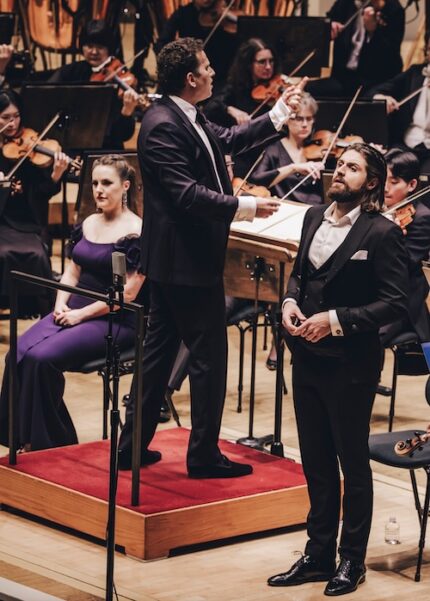
The saving grace of the performance was the evening’s two soloists, almost making one wish that Brahms had given them more to do.
Konstantin Krimmel, in particular, was sensational. His saturnine, black-toned baritone proved ideal for this assignment. The German-Romanian singer brought just the right dark tone and acutely focused dramatic point, whether singing of the brevity and futility of earthly existence or the promise of post-mortal life to come.
Louise Alder sang with poise and expressive vulnerability in her lone solo, providing an apt blend of consolation and heartache in the section Brahms belatedly added to the Requiem as a lament for his deceased mother.
Like much else of the performance, the orchestral playing sounded unsettled Thursday night with an early entrance by the flutes and errant intonation from players you don’t usually expect it from.
The program will be repeated 1:30 p.m. Friday and 7:30 p.m. Saturday. chicagosymphony.org
Posted in Performances
Leave a Comment

 Subscribe via RSS.