Bella Voce continues its holiday tradition with a joyous and complete “Messiah”
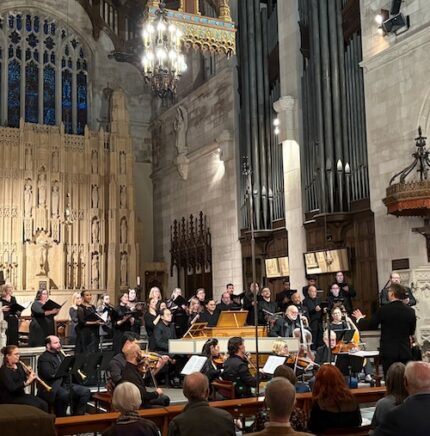
Almost every one of the numerous performances of Handel’s Messiah that crowd Chicago’s concert calendar around Christmas time comes with cuts and various other musical modifications. Some are discreet, others disfiguring.
Insofar as Bella Voce is concerned, a bowdlerized Messiah is no Messiah at all.
In fact, artistic director Andrew Lewis has espoused full-text renditions of this imperishably popular oratorio since 2012, when he and his admirable choral ensemble ventured the first of numerous complete Messiahs. These have since become an indispensable part of the local musical celebration of Yuletide.
So it was Sunday afternoon at Evanston’s St. Luke’s Episcopal Church, where a sold-out audience heard a stirring, uncut performance by Lewis, his chamber chorus and orchestra, with vocal soloists drawn from the choral ranks.
Handel’s setting of librettist Charles Jennens’ extended reflection on Jesus as the Messiah called Christ yielded what was to become the most popular oratorio ever written. Because he composed alternative performing editions of Messiah for different soloists and occasions, there is no such thing as a definitive final version.
The composer himself supervised three complete versions of his great oratorio in Britain during the final years of his life. Perhaps only when listeners hear the full text can they get a true picture of Handel’s grand design, in all its musical glory, emotional power and spiritual uplift.
Having sorted through the welter of available options, Lewis put together a version that honored Handel’s intentions while displaying the collective strengths of his vocal and instrumental forces in a stylish and convincing manner.
On Sunday, his chorus of 25 voices, orchestra of 20 period players and no fewer than 15 vocal soloists sounded crisply engaged in the words and music, their skills equal to the added musical and technical demands: Bella Voce’s scholarly regard for high Baroque manners was infused with modern vitality.
Lewis succeeded in making the rough places wondrously plain through his flowing tempos and crisply articulated rhythms. His shaping of the long Handelian lines allowed phrases to breathe in an intimately expressive manner, all the while showing a firm command of the overarching narrative.
The church’s warm acoustic enriched the choral and instrumental textures without getting in the way of textual clarity (especially welcome in fugal passages).
His choral contingent sang with precise ensemble, blend and intonation. Several of the section-ending choruses crackled with bouncy energy. The singers were matched by instrumental playing of comparable distinction; likewise the obbligato contributions of concertmaster Martin Davids and trumpeter Josh Cohen.
A couple of scheduled soloists were replaced at the eleventh hour by chorus colleagues. All 15 singers proved worthy of their assignments but a handful stood out.
All had been encouraged to embellish the repeats of their airs, a task they executed with assurance—none more so than tenor Oliver Camacho, whose plangent, liberally ornamented “Comfort ye my people” and “Every valley shall be exalted” set the high-water mark for the other soloists.
One would be remiss in not praising the deeply felt “But who may abide” of alto Gabrielle Timofeeva; the confident sincerity of alto Anna Rasmussen’s “O thou that tellest good tidings to Zion”; the refulgent fervor of soprano Kirsten Hedegaard’s “I know that my Redeemer liveth,” or the vocal beauty and expressive authenticity soprano Kimberly Jones brought to her three airs.
This listener was particularly taken with the tonal purity and radiance of soprano Nini Marchese in her “Rejoice greatly, O daughter of Zion’; her flashing coloratura marked her as first among equals. But bravi to all the soloists.
To judge from their warm response at the end of the three-hour performance, the audience savored this rare opportunity to experience a fair amount of relatively unfamiliar Handel in context. All told, Sunday’s Messiah must be reckoned among the high-water marks of Andrew Lewis’ 20 distinguished seasons as director of Bella Voce.
Bella Voce continues its 2026-27 season with “Baltic Solstice,” December 19 and 20. bellavoce.org
Posted in Performances
Leave a Comment
 Subscribe via RSS.