Janowski, CSO present a rewarding program with a pianist’s notable debut
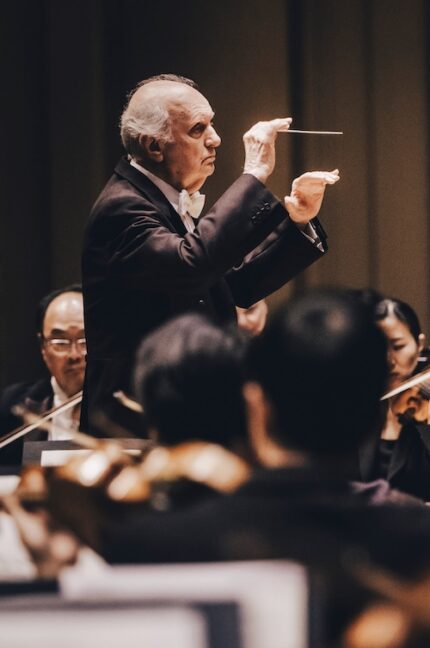
Marek Janowski returned to the local podium Thursday night and, after a couple of uneven weeks at Orchestra Hall, the Chicago Symphony Orchestra sounded largely like its old self.
The composer names may have been familiar in Janowski’s German program—Wagner, Strauss and Beethoven—but two of the three works are relative CSO rarities, including the Prelude to Parsifal, which opened the evening.
Wagner’s final opera is a slow-unwinding allegory of Christian mysticism based very loosely on the Knights of the Round Table, and set in three massive acts. The Prelude sets the scene with the main motives laid out in majestic blocks, the luminous themes containing some of the most beautiful music ever penned by Wagner (or anyone else).
Janowski is a longtime Wagner veteran having led performances of his operas and recorded the first digital Ring cycle back in the 1980s (which still holds up quite well today).
From the first notes, the conductor’s authority was manifest, with Janowski leading a taut, concentrated yet spacious performance. If his straightforward style didn’t always lean into the music’s spirituality, Janowski’s keen clarity and balancing allowed all of Wagner’s subtle colors and inexorable climaxes to register with profound impact. A tentative entrance by the flutes apart, the playing was polished and committed across all sections with gleaming trumpet work by John Hagstrom.
Richard Strauss never composed a piano concerto but he did write a goof on piano concertos with his early Burlesque (or Burleske). Written at age 21, when his successful tone poems were still on the horizon, Burlesque is a large-scale scherzo for piano and orchestra that often morphs into a double concerto for piano and timpani (which begins the piece and has the last word).
Give pianist Mao Fujita credit for originality in electing to make his CSO debut not with a sure-fire Romantic barnburner, but with this quirky Strauss rarity, last assayed by the CSO with Daniel Barenboim as soloist 24 years ago.
The Burlesque may not be top-drawer Strauss but on Thursday night, Fujita nearly made it sound like an overlooked masterpiece.
A Silver Medal winner at the 2019 Tchaikovsky Competition, Fujita made his U.S debut at Carnegie Hall in 2023, where the 27-year-old pianist has returned for regular recital appearances.
Fujita’s airtight technique and quicksilver virtuosity proved eminently well-suited to this youthful Strauss caprice. The engaging pianist threw off the fitful bursts of brilliance with easy bravura and brought a Chopin-like elegance—and surprising expressive depth–to the lyrical passages. Perhaps most importantly, Fujita was fully in synch with the piece’s essential humor, from his playful, light-fingered exchanges with the timpani and other instruments to the climactic cadenza, which he played with impressively dexterity while also managing to convey its essential parodistic quality.
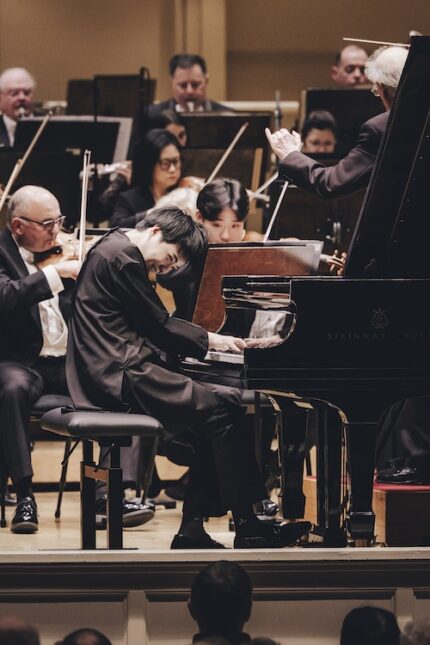
Janowski and the orchestra delivered close and witty support with principal timpanist David Herbert providing equal agility and a light touch to his prominent role.
The restive, errhine audience quieted down enough enough for Fujita’s encore of Tchaikovsky’s Nocturne, Op. 10, no. 1, rendered with acute tonal refinement and delicacy.
Strauss’s Burlesque may not have been played by the CSO in a quarter of a century, but one can hardly say that about the evening’s closing work, Beethoven’s Symphony No. 5.
Familiar as the Fifth may be to concert-hall regulars, as they say, there is always someone in the hall experiencing this music for the first time.
Any newcomers to Beethoven’s Op. 67 likely came away with a strongly favorable impression. Janowski’s no-nonsense performance was outwardly traditional in terms of tempos—perhaps a little more on the stately side than is common these days—with a couple idiosyncratic twists added to the mix.
Balances were, well, unique. The 87-year-old conductor must have requested boldly projected horn playing from the jump, which made for bracing, occasionally harsh tuttis in the opening movement.
He also deemphasized the timpani part. In contrast to his prominent role in the preceding Strauss work, David Herbert’s playing—on the lower “Classical” timps– was often inaudible and submerged into the orchestral fabric.
Even with those oddities, Janowski led a strong and well-paced reading, bracingly dramatic in the opening movement, warmly expressive in the Andante and vigorous in the scherzo.
Janowski’s preference for punchy horn playing came to grief at times in the otherwise exhilarating finale with the two horns’ tone turning raspy and jarringly raw. Even so, this was an individual and effective Fifth to cap the CSO’s thoughtful German program.
_______
Herbert Blomstedt 1927-2026
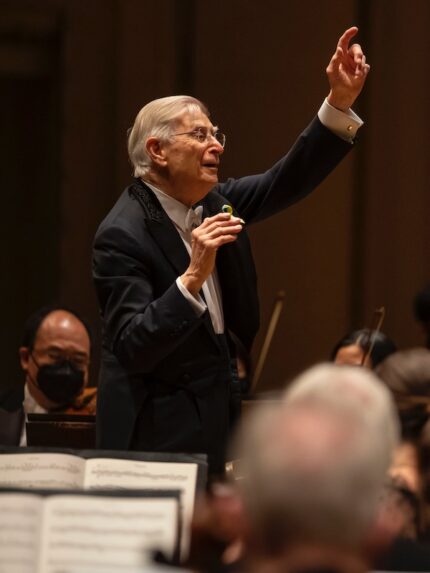
Herbert Blomstedt died at the age of 99 on Wednesday. The Swedish conductor (born in Springfield, Mass) first led the CSO in 1988 and would return to conduct eight more times. After a decade-long hiatus, Blomstedt returned in his 90s for regular CSO appearances. His last CSO stand was an all-Dvořák program in 2023.
Blomstedt was music director of the San Francisco Symphony from 1985 to 1995 where he raised the regional ensemble’s quality to that of a major orchestra (paving the way for his successor, Michael Tilson Thomas). Blomstedt’s decade in San Francisco resulted in several fine recordings, including a trio of superb Hindemith discs and an outstanding cycle of Carl Nielsen symphonies that remains a cornerstone.
Read remembrances of Herbert Blomstedt by CSO archivist Frank Villella and at the San Francisco Symphony website.
The program will be repeated 1:30 p.m. Friday and 7:30 p.m. Saturday. chicagosymphony.org
Posted in Performances
Leave a Comment

 Subscribe via RSS.