Lyric Opera gets the comedy and vocalism right in a delightful “Don Pasquale”
“Dying is easy. Comedy is hard.”
That oft-quoted line—attributed to various expiring actors on their deathbeds—also reflects the fact that tragic dramas invariably come off with more consistent success than comedies on the opera stage. Certainly that has been the case locally more often than not in recent years
Happily, Lyric Opera gets most of the important things right—vocally and comedically—in Donizetti’s Don Pasquale, which opened Thursday night for a two-week run.
The souffle-light scenario tells of Don Pasquale, a wealthy old man who has disinherited his nephew Ernesto for refusing to marry the woman he selected for him. To get even, Pasquale’s physician and “friend,” Dr. Malatesta, enlists Norina, Ernesto’s beloved, to masquerade as “Sofronia,” a young and beautiful woman for Pasquale to marry, much to the old bachelor’s delight.
Pasquale becomes instantly besotted with the meek Sofronia; unfortunately for him once the marriage takes place, Sofronia/Norina changes instantaneously from a quiet and submissive girl to a haughty, domineering and materialistic harridan who makes his life miserable. Ultimately, the ruse is revealed and Pasquale is so relieved to be out of his domestic nightmare that he gives his blessing for Ernesto and Norina to marry.
Don Pasquale was Donizetti’s last great success. The 1843 opera retools stock commedia’ dell arte characters into a concise and intimate chamber opera with soaring bel canto arias and virtuosic sections. Don Pasquale proved to be the apotheosis of the opera buffa genre as well as marking the beginning of its decline.
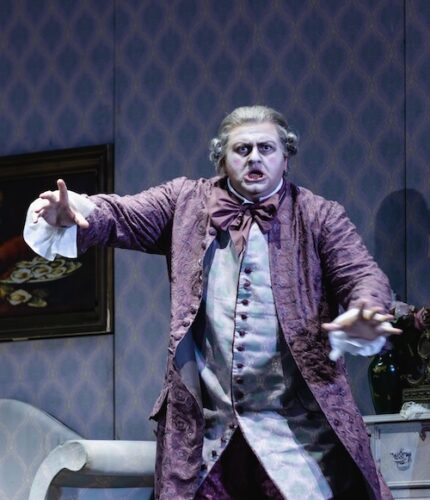
In the title role, Misha Kiria, making his Lyric debut, was about as complete a Pasquale as one will find on any opera stage. With his towering stature, the Falstaffian Kiria looked like he stepped out of a lithograph of Luigi Lablache, who created the role at the Paris premiere.
Kiria embodied all the bluster, arrogance and faux bravado of the foolish Pasquale in genuinely amusing fashion. Vocally the Georgian baritone was faultless, singing in an ample yet impressively agile voice and throwing off the tongue-twisting patter sections at lightning speed with astounding clarity and accuracy.
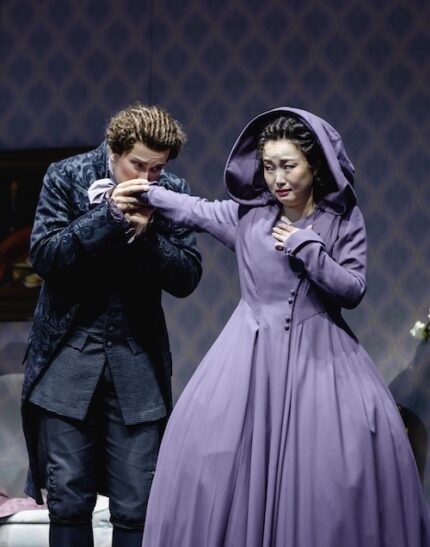
As Dr. Malatesta, Ian Rucker was on the same level. Like Kiria, the former Ryan Center member possesses a big voice, warm and rounded but with similar flexibility. Rucker proved an amiable conspirator and was also able to wrap his voice easily around the score’s challenges.
The celebrated Act III duet for Pasquale and Malatesta as they hatch a plan to catch Sofronia with her lover (“Aspetta, aspetta, cara sposina ”) was both hilarious and exhilarating in its rapid-fire bravura. Considering the vocal fireworks on display, one can’t begrudge the pair their instant encore.
Lyric has been publicizing this show as a kind of star vehicle for Ying Fang—which is strange because: 1. This was her role debut as Norina, and 2. Don Pasquale is a true ensemble piece with the title role as the fulcrum of the action.
All three of the Chinese soprano’s previous Lyric appearances have been in Mozart vehicles—Zerlina (in the 2019 revival of the popular Don Giovanni staging), followed by Pamina in The Magic Flute and Susanna in Le nozze di Figaro. (Unfortunately, the latter two were among the worst Mozart productions in Lyric history.)
Fang seems less naturally suited to the tough and wily Norina then the more innocent heroines of her Mozart outings. Still, she capably acted the role as well as gamely delivering Norina’s comic transformation (as Sofronia) from convent inhabitant to marital disaster.
Vocally, Fang provided more mixed rewards. She sang with refined tone in lyrical passages—as in her Act I Cavatina and blended gratefully with Alberto Robert’s Ernesto in a lovely rendering of their climactic duet (“Tornami a dir che m’ami”).
Yet her light soprano too often turned wan under pressure and tended to fade in ensembles. Ultimately Fang appears to lack the agility and brilliance on top that the role really requires. The showy second section of Norina’s Act I duet with Malatesta never took flight the way it should due to Fang’s cautious coloratura and less-than-clarion top notes. Enrique Mazzola’s herky-jerky tempos didn’t help.
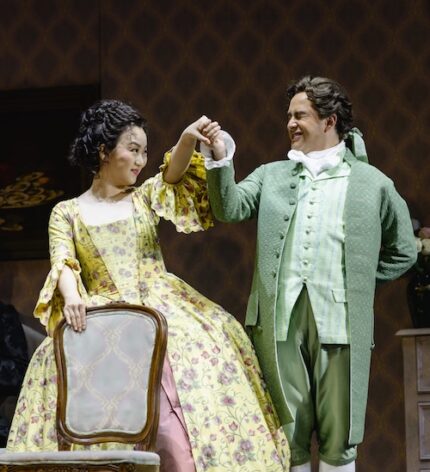
Oddly, Alberto Robert in his U.S. debut, also seemed ill at ease in the more high-flying sections of Ernesto’s arias. Still, the Spanish singer possesses the right light tenor for the role and he floated elegant vocalism in his arias with an especially gleaming “Com’è gentil.”
This Glyndebourne Opera production seems a bit lost on the vast Lyric stage and is starting to look its age, unaided by the drab light pastels that dominate the rather shabby costumes.
Still, the revolving sets worked well enough and director Mariame Clement at least avoided the inane silliness that most American opera directors think automatically equals funny.
Some of her quirky touches proved a mixed bag—from moving the action back in time to the 18th century to playing up a seemingly flirtatious relationship between Malatesta and Norina (though that at least helps to explain in part the doctor’s mystifying motivation in concocting this scheme).
Clement’s worst conceit was creating a needless housekeeper character, ”Berta,” (played by Sarah Sapperstein) who proved an intrusive and charmless presence. Her reacting to the comedic action with silent disapproval added an annoying and unfunny layer to the complicated goings-on. The best thing about this addition was Malatesta continually chucking her out of the room.
Mazzola often seems most in his element in early 19th century Italian repertoire. Lyric’s music director favored extreme tempos Thursday night, bringing welcome energy to the fast music yet too often dragging slow tempos. Ensembles tended to be cloudy with voices unevenly balanced. The chorus sang well even if their belated showy appearances in elegant court finery detracted from the main action of the opera.
Never mind. Despite reservations, the performance is enjoyable, and there are enough laughs and fine singing—by Misha Kiria and Ian Rucker particularly—to make buying a ticket to this Don Pasquale worthwhile.
Don Pasquale runs through November 27. Sydney Mancasola sings the role of Norina in the final performance. lyricopera.org
Posted in Performances
Leave a Comment



 Subscribe via RSS.