Grant Park Orchestra goes deep with a rich, rewarding program on last things
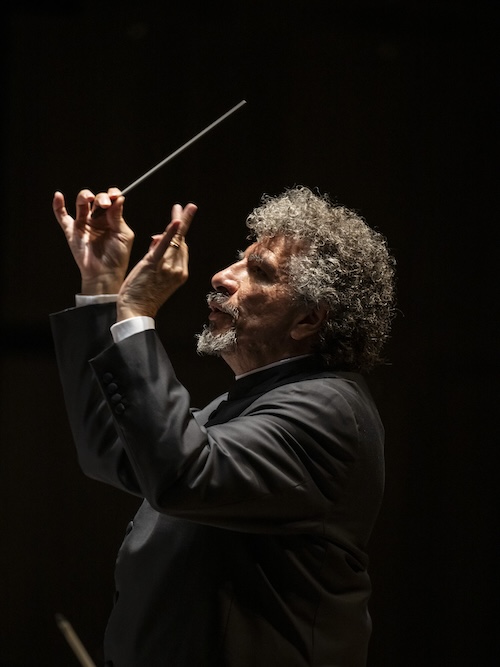
Give credit to Giancarlo Guerrero for seizing the opportunity that Lollapalooza inadvertently bestows on the Grant Park Music Festival every first weekend in August.
With Lolla taking over downtown outdoor venues, the summer classical series went underground to the Harris Theater on Friday night. And Guerrero, in his first season as the festival’s new artistic director and principal conductor, devised a smart and rewarding program that took advantage of the welcoming indoor acoustic.
A concert centered on death may not seem like the most frolicsome of summer music events. But Guerrero’s thoughtful program offered four contrasted, ultimately life-affirming works that leavened any potential gloom or redundancy. The fact that three were contemporary pieces added to the concert’s attractions.
The song cycle seems to be one of those classical genres that is going the way of the Dodo bird—at least in Chicago. All credit then to Guerrero and colleagues for bringing us Peter Lieberson’s Neruda Songs Friday night.
The cycle was written by the composer for his wife, the celebrated mezzo-soprano Lorraine Hunt Lieberson. Drawing on five love poems by Pablo Neruda, the settings tell of a couple’s deep bond while also marking an inevitable sense of time passing and the innate impermanence of all things. Adding to the poignance of the work, Lorraine Lieberson was diagnosed with breast cancer while her husband was completing the cycle. She was able to premiere Neruda Songs in 2005, performing it three times before passing away the following year. (Her performance with the Boston Symphony Orchestra has been released on CD.) Peter Lieberson himself would die, also from cancer, just five years later.
The tragic circumstances surrounding the work’s origins should not overshadow its supreme artistic quality, and Neruda Songs is the great song cycle of the modern era. Lieberson is sensitively attuned to the Chilean poet’s allusive style, and the songs are skillfully written for low female voice and scored with consummate mastery and subtlety. The cycle culminates in the achingly beautiful final setting, “Amor mio, si muero y tu no mueres” (“My love, if I die and you don’t”).
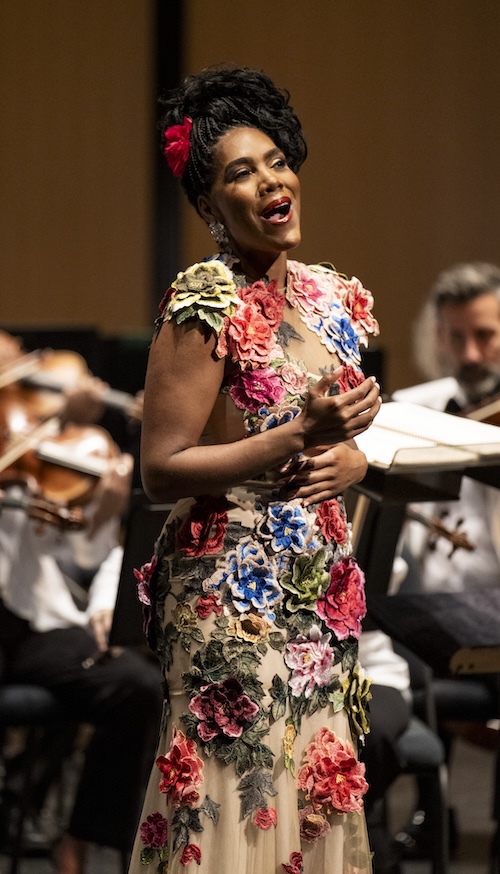
J’Nai Bridges was the evening’s soloist and her deep, dusky mezzo proved well-suited to Lieberson’s cycle. Bridges was consistently attentive to the texts, singing expressively and communicating the predominate moods of longing and regret. Her Spanish diction wasn’t always clear and the soloist seemed more attuned to the extroverted moments of the cycle than its meditative intimacy. If her performance didn’t quite reach the cumulative heartbreak potential of these deeply felt settings, Bridges’ glowing vocalism largely provided its own rewards.
No complaints about the stellar orchestral support from Guerrero and the Grant Park Orchestra. Guerrero scrupulously balanced the large forces and the musicians’ finely polished playing allowed the iridescent beauty of Lieberson’s scoring to soar. Mercifully, an English translation of the texts was projected on a screen, making up for the festival’s usual incomprehensible lack of notes, texts and translations.
Brian Raphael Nabors’ Pulse opened the evening. Initially Pulse seemed like the odd man out in this program, yet Nabors’ piece merited inclusion due to its representing the “natural, unified rhythm” of the universe. Guerrero led a vital and colorful reading of Nabors’ kaleidoscopic music, nicely putting across its offbeat instrumental effects. Ultimately, however, at 12 minutes, Pulse seems a bit overextended for its material.
Coming after the numbing awfulness of Missy Mazzoli’s The Listeners at Lyric Opera last spring, it was good to be reminded of what an inspired composer she can be in such works as These Worlds In Us. Mazzoli’s first piece for orchestra has a duo aeronautical inspiration, taking its title from James Tate’s poem The Lost Pilot (based upon his father, a pilot who was killed in WWII) as well as Mazzoli’s own father, who served as a pilot in Vietnam.
Mazzoli packs a lot into this eight-minute work and These Worlds In Us is scored with characteristic invention, including watery string glissandos and percussionists dubbing on melodicas, a kind of mouth organ. (“Percussionists have all the fun,” said Guerrero, who was one himself before taking up the baton.)
The conductor led a clear and firmly outlined performance though a wider dynamic range overall would have made for more effective results. (Riccardo Muti found greater atmosphere and depth in Mazzoli’s piece with the Chicago Symphony Orchestra in 2021.) Something was bound to suffer with such a complex program as this on a summer schedule, and more rehearsal time for fine tuning would likely have helped.
The concert closed with the one cornerstone work on the program, Richard Strauss’s Tod und Verklärung.
Strauss’s tone poem depicts the final moments of an artist on his deathbed—his memories, life-struggles, eventual death and passing into a transcendent state. Death and Transfiguration was one of Strauss’s first great successes, and it is remarkable to think that the composer created a work of such depth, maturity and existential insight while still in his 20’s.
Guerrero showed himself a most sympathetic Straussian in Friday night’s compelling and galvanic performance. The conductor charted every element of the narrative with almost clinical precision, from the hushed fluttering heartbeat of the opening, to the heroic swagger of the protagonist’s romantic youth and the roiling intensity of his death struggles. The moment of passing was striking with ex-percussionist Guerrero ensuring the tolling gongs sounded with effective mystery and resonance. The conductor took a daringly spacious pace in the transfiguration section yet sustained it effectively, leading inexorably to the rising transcendent glow of the final pages.
It is always an edifying treat to hear the Grant Park Orchestra indoors and unplugged, and one could truly appreciate the whipcrack virtuosity of these superb musicians in Strauss’s brilliant showpiece. All sections shined brightly across the board, with especially fine contributions from the brass, oboist Mitchell Kuhn and concertmaster Jeremy Black.
The program will be repeated 7:30 p.m Saturday at the Harris Theater. gpmf.org
Posted in Performances
Leave a Comment

 Subscribe via RSS.