Ariel Quartet makes a magnificent return to Winter Chamber Festival
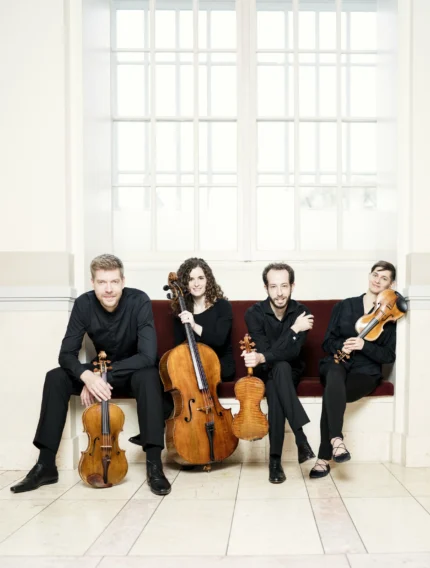
There was a fateful near-synchronicity to the appearance by the Ariel Quartet at the 29th Winter Chamber Music Festival on Friday evening at Northwestern University, quite apart from the finely meshed poise of its performances. Once again Pick-Staiger Concert Hall was packed, despite the arctic blasts sweeping off the lake.
Only one year separates the founding of the annual Evanston series, in 1997, from the inception of the Ariel foursome at the University of Cincinnati’s College-Conservatory of Music, where it currently serves as faculty quartet-in-residence.
When visa problems prevented the Vertavo String Quartet from fulfilling its scheduled appearance, festival director Blair Milton called on the Ariel as their replacement. A now-internationally seasoned ensemble of musicians who had come together as teenagers at the Jerusalem Academy Middle School for Music and Dance, the Ariel most recently graced the festival in 2024.
One of the most arresting things about this splendid group is how closely each musician—Alexandra Kazovsky and Gershon Gerchikov, violins; Jan Gruning, viola; Amit Even-Tov, cello—dialogued, physically as well as aurally, with the others, and, through them, to the audience.
Their firm yet wonderfully spontaneous tightness of ensemble carried across a rewarding program that spanned key works from the first to the second Vienna School.
The second quartet of Haydn’s Opus 33, in E-flat, is nicknamed “The Joke” because of the several fake endings the composer slyly provides near the end of the rondo finale, marked Presto. Several times he stops the blithe main theme in its tracks, leaving us uncertain as to whether we have reached the end. The last pause grows hesitantly, finishing with a soft whisper that concludes, as it were, in mid-thought. Audiences almost invariably fall for the joke and start applauding before the last notes are sounded, believing the piece is over. Friday’s listeners did so as well, helped along by the Ariel’s body language.
Indeed, the sheer physical involvement of first violinist Kazovsky was as animated as her sound, as she swayed, leaned back and crouched forward in response to Haydn’s musical urgings—sparking comparably deft responses from her well-balanced colleagues. Geniality, refinement, precision and closely observed dynamics and phrasing ruled the day; charm was not sacrificed to speed.
This lively musical conversation propelled the listener some 129 years forward to a very different Vienna, a place that would soon be part of a catastrophic world conflict and where music’s tonal moorings were also on the cusp of being shattered.
Second violinist Gerchikov, in his articulate spoken introduction to Alban Berg’s Opus 3 String Quartet, made an apt comparison between the “new musical language” of the Haydn, Mozart and Beethoven string quartets and the revolutionary works of Arnold Schoenberg and his pupils Berg and Webern, in their pieces derived from 12-tone technique more than a century later.
Berg’s 1910 quartet predates his plunge into serialism—couched in a chromatic late-Romantic expressionism that at times looks backward to Wagnerian harmonic practice while prefiguring Berg’s mature leap into full-blown atonality. The two movements are extremely concentrated, the emotional gestures fully charged from start to finish; there is barely enough room for the music to relax, and then only for an instant.
The Ariel caught the score’s febrile intensity with tremendous feeling and bite. Shaping Berg’s rising and falling harmonic tensions with proper force is no mean feat for any quartet. But this foursome was at the top of its game, pouncing on the aching lyricism and expressive through-line that point the disparate gestures towards their destination. I don’t expect to hear this elusive piece more luminously performed.
Kazovsky and colleagues devoted the second half to the first of Beethoven’s late quartets, No. 12 in E-flat, Op. 127. Here we found ourselves in yet another unique (if far more expansive than the Berg) world of feeling, one in which deeply personal emotions are made universal, even transcendental.
Beethoven’s refusal to bow to convention is evident at every turn, beginning with the first-movement Allegro that begins with bold declamatory chords before settling into the serene lyricism of the main theme. The second-movement variations form an extended rhapsody spanning great arcs of knotty contrapuntal activity. A bouncy Scherzo, bristling with energy, gives way to a shortish finale that caps things off to pointed, exhilarating effect.
The Ariel has performed the complete Beethoven quartet cycle many times in many places over the years, and the mastery of these players was never in doubt throughout Friday’s performance. So complete is their technical command as to allow them to move well beyond the many problems posed by late Beethoven into the total expressive immersion this music demands from interpreters.
The opening Allegro, alive with sonorous weight and clear polyphonic definition, found the players completing each other’s musical sentences with an almost uncanny acuity that was pure pleasure to witness.
With the Adagio they reached deep into the introspective serenity and spirituality of late Beethoven, remarkably sensitive to weight as well as quality of string sound and how that relates to the expressive congruity of one variation to the next.
Negotiating the starts and stops of the Scherzo with the quick reflexes of a champ behind the wheel of a Ferrari, the Ariel brought things to a magnificent finish with a finale that near the end dissolved into a long trill on the chord of C Major; the effect was that of the utmost rhythmic and harmonic delicacy. If a few scattered pitches went slightly awry in the heat of the moment, who could complain?
Let’s have the Ariel back at the Winter Chamber Fest very soon. Fully scheduled next time, please.
The Winter Chamber Music Festival continues with Trio Seoul performing works by Haydn, Liszt, Ravel and Juri Seo, 3 p.m. Sunday at Pick-Staiger Concert Hall, Northwestern University, Evanston. The festival runs through February 14. music.northwestern.edu
Posted in Uncategorized
Leave a Comment
 Subscribe via RSS.