Järvi returns to CSO with a mixed Northern program
One hears a concerto for piano or violin nearly every week at Orchestra Hall. Occasionally a cello concerto or one for a wind soloist when a principal player is given a spotlight opportunity.
But an accordion concerto?
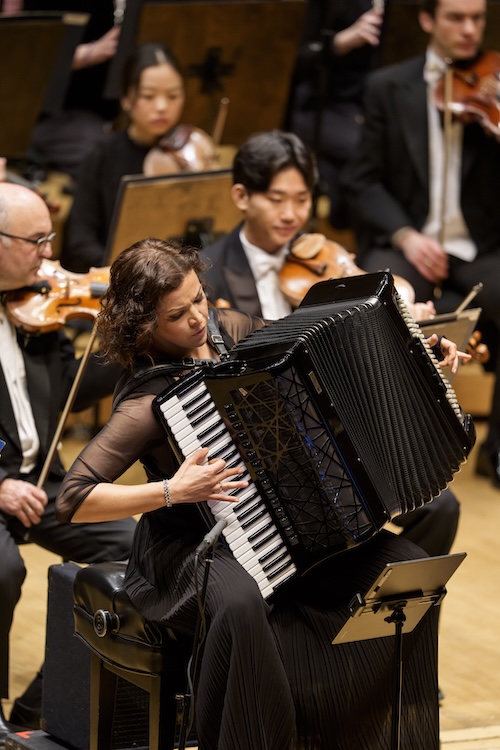
Such was the case Thursday night with Paavo Järvi returning to town to lead the Chicago Symphony Orchestra in Erkki-Sven Tüür’s Prophecy, the offbeat centerpiece of a Northern-centered program, with accordionist Ksenija Sidorova as soloist.
A former rock musician turned classical composer, the Estonian Tüür has been notably prolific, writing ten symphonies to date, an opera (Wallenberg) and a slew of concertos including Prophecy, which premiered in 2007.
Tüür is one of the most consistently intriguing of today’s Baltic composers. His music is bracing and well-crafted, often cast in a when-worlds-collide style that mixes a shimmering Northern impressionism—at times suggestive of his compatriot Arvo Pärt—with an edgy tension and driving, explosive quality that seem to reflect his rock origins.
The title Prophecy, says Tüür, refers to “the extremely long and rich practice of ‘seeing things’ through the history of different cultures and traditions.” He adds, rather cryptically, “these people were met with mixed feelings by the majority of the society. They were respected, disdained, hazardous and kind of mad. However, they had access to the beyond.”
Cast in four connected movements running 20 minutes, Prophecy, opens with a loud percussion note as the accordion enters immediately. A surging tremolo riff in high strings leads to an extended solo passage that conveys something of the instrument’s evocative qualities. The accordion plays brief solos in between the orchestra’s held string notes and iridescent percussion, alternating with swelling chords with a hard, Sibelian cut-off. The second movement accelerates the tempo, with the quick back and forth between soloist and orchestra more suggestive of the traditional dueling concerto style.
A brief solo cadenza leads into an introspective third movement. Here the accordion has more opportunity to shine, and Sidorova’s graceful, seamless playing conveyed an inward expression as well as the instrument’s songful essence, which (inevitably) seems to conjure up nostalgic Paris street-cafe associations.
Increasingly prominent whirling passages in winds and brass lead to a fast and syncopated theme that ushers in the final movement. In the most virtuosic writing of the concerto Sidorova’s bravura playing was extraordinary, her fingers flying across the keys in alternation with the roiling orchestra.
Järvi has been a consistent Tüür advocate both in concert and on recordings, and the Estonian-American conductor brought out the shimmering qualities of the score as well as the rock-edged drive.
Unfortunately, while his balancing was skillful for most of the concerto, Järvi allowed the orchestra to completely obliterate his soloist in the final section. One had to rely on the visual to appreciate Sidorova’s virtuosity since the light sonority of her accordion was rendered wholly inaudible.
Even with that, Sidorova is clearly a poetic and bravura musician on her chosen instrument. Some judicious amplification would likely have given the Latvian musician a fighting chance to be heard against the hard-charging orchestra.
Balancing issues apart, I’m not convinced Prophecy is among Tüür’s finest efforts. Still, the soloist, conductor, composer, and CSO were rewarded with a warm and enthusiastic ovation by the audience.
Sidorova’s musicianship was heard to better advantage in Sergey Voitenko’s Revelation, a solo encore that conveyed all the plaintive emotion and aching nostalgia the instrument is capable of.
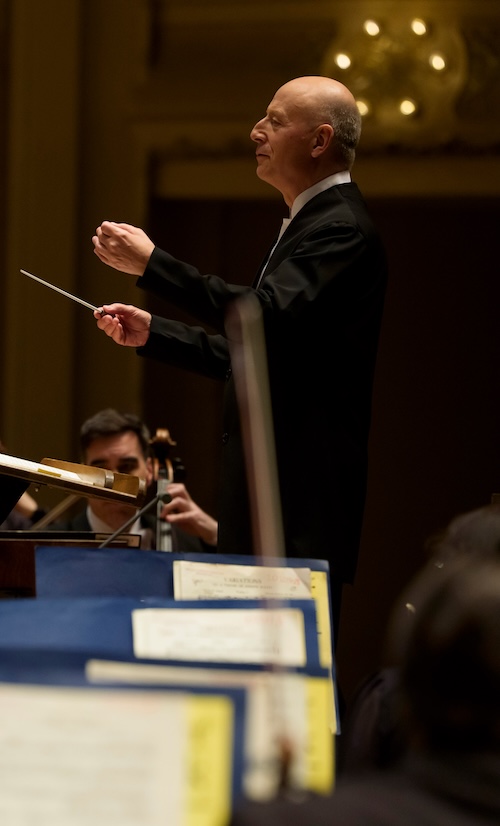
Sibelius’s Symphony No. 2 was the main work of the evening. The CSO gave the first U.S. performance of the Second Symphony—still Sibelius’ most popular work—in 1904, less than two years after the Finnish composer conducted the premiere in Helsinki.
Järvi has been leading performances of Sibelius’s music throughout his career, and has recorded the complete symphonies with the Orchestre de Paris.
The conductor clearly has a handle on how this music should go. Järvi drew rich and weighty playing that put across the elemental strength of the canvas, allowing the lonely wind solos to register, and the craggy brass outbursts to make eruptive impact.
Yet an essential mystery and the more elusive, atmospheric qualities of the score were largely missing in action under Järvi’s emphatic, full-bore approach. More crucially, the conductor too often seemed to be overselling the drama—imbuing the music with a souped-up volatility (in volume and tempos) that seemed at odds with the score. Sibelius’s music needs breadth and space to build to the climaxes with cumulative impact.
There was much fine playing by the orchestra, as a unit and from the front desks—William Welter, particularly, in the natural eloquence of his oboe solos. While the soaring main string theme of the finale came across majestically, Järvi peaked way early—the brassy climaxes were too loud too soon, and only became more assaultive and wearying by the time the double bar was reached.
The Variations on a Theme by Haydn opened the program. Brahms’ symphonic retooling from his original for two pianos was a crucial milestone in his career, giving the composer greater confidence in writing for full orchestra.
Järvi led a direct and clarifying account of this familiar work, with Brahms’ inventive treatment of the theme (amiable but not by Haydn) emerging notably fresh. The fast variations were fleet and vital and the lyrical ones engaging, the seventh iteration in particular going with a lilting, lullaby-like quality. Järvi’s tempos were well-judged apart from a jarringly fast account of the Andante finale. The orchestral playing was burnished, rounded yet concentrated—a really ideal Brahms sonority—and the playing was superb with Welter’s oboe work again especially notable.
The program will be repeated 1:30 p.m. Friday and 7:30 p.m. Saturday. cso.org
Posted in Performances
5 Responses to “Järvi returns to CSO with a mixed Northern program ”
Leave a Comment



 Subscribe via RSS.
Posted Apr 03, 2026 at 12:13 pm by Dave
I agree with your review. The orchestra (even with many principals absent) played beautifully. The rushed tempi, both in the Brahms and the Sibelius, detracted significantly from the emotional range in these works. A pity although still a worthwhile concert.
Posted Apr 03, 2026 at 2:06 pm by John
Cogent and insightful comments, as always. A small correction: The accordion actually was very subtly and tastefully amplified (a stage monitor was placed directly behind Sidorova’s chair). And although the soloist was indeed enveloped by the orchestral sound in the last section, my thought was that this balance was purposeful, given that the composer was in attendance (a rarity for a non-premiere event), and he surely would have had the opportunity to adjust balances during rehearsals.
Sad that the attendance was so poor for what to me was one of the season’s highlights. Perhaps the idea of an accordion had CSO regulars clutching their pearls? In my own case I found that an exceptionally strong score by Erkki-Sven Tüür, plus the astonishing musicianship of Ksenija Sidorova, offered a new perspective on the instrument’s expressive possibilities. I stand disabused of my anti-accordion prejudice.
Posted Apr 03, 2026 at 2:18 pm by Lawrence A. Johnson
In response to my query, the CSO press office stated Friday morning that there was no amplification of the accordion in the Tüür concerto.
Posted Apr 04, 2026 at 6:31 am by Chris
I agree with most everything in this review. We were there Friday. The Sibelius was vibrant, maybe a little loud, but exciting nonetheless. Quite a performance.
Posted Apr 07, 2026 at 7:09 pm by Charles
I was there Saturday, Terrace stage left. I did find it difficult to hear the accordion over the orchestra. The encore was amazing!
Despite my agreement with the tempos and dynamics, I found the entire concert excellent. The Sibelius was stunning, definitely different than my last live experience with this work with MTT conducting 10 years ago but still great.